

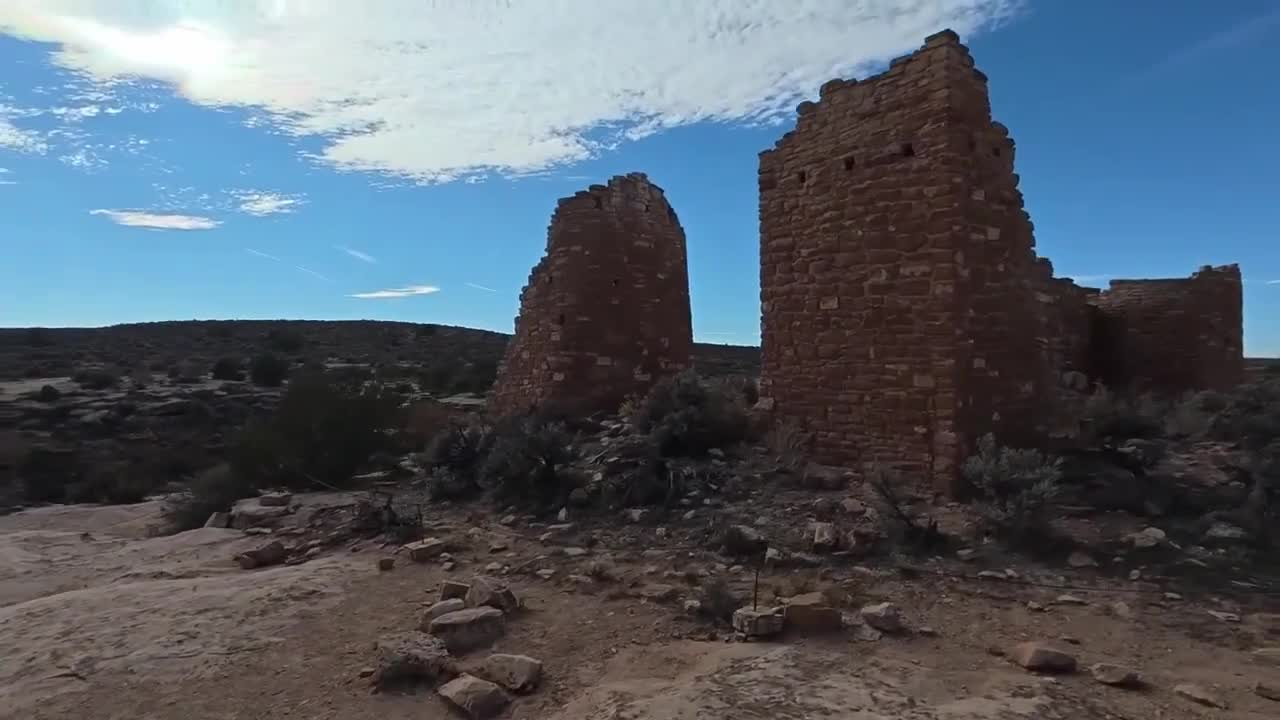


SAN JUAN COUNTY, Utah — Hovenweep is cool.
I'm not playing the non-responsive teenager here.
The word "cool" expresses my regard for this infrequently visited gem of a National Monument.
Super cool medieval towers overlook an otherwise concealed canyon. Under the canyon rim, more Ancestral Puebloan structures stand nearly complete. One is built with a giant boulder for a roof. The same boulder seems to have served as the foundation for a tower above... like a Puebloan "Bat Cave and Wayne Manor" — Southwest style.
Tell me that's not just cool, and I'll tell you to think again!
The Hovenweep region was occupied for thousands of years, with the Puebloans emerging as a cohesive culture over time. Hovenweep was at its peak at the same time as Mesa Verde, from 1000 AD into the 1200s.
I had a great conversation with one of the rangers who specializes in history. She said scholars are reconsidering some of what we assume about this canyon that seems so fortified. The common wisdom... the buildings show a defensive posture... indicating an attitude of fear — fear likely fueled by a scarcity of resources caused by prolonged drought.
Some modern-day members of Pueblo tribes in the Southwest say the buildings are holy, their locations significant for religious reasons, according to the ranger (who couldn't go on camera. My spontaneous Max Tracks modus operandi is a poor match for federal employees getting approval to be on TV).
Ingenious astronomers, the residents of Hovenweep oriented their walls and windows so their homes came with built-in clocks and calendars, according to the National Center for Atmospheric Research. Small portals, too small for windows, allow light to travel across the wall, its horizontal movement indicating the time, while the angle of the sun nudged the light up and down, indicating the date. Other portals are built in a way to indicate seasonal milestones like an equinox.
We've established the coolness — now let's gild that lily with a hike short enough to not be long and long enough to not feel wimpy. It's two miles, mostly around the rim with new ruins around every corner, and you cross the canyon with some of those great mini slots where you walk between boulders.
Did I just coin a perfect term? Mini-slots! Discuss amongst yourselves.
I knew I would love Hovenweep, because I loved it already. This trip added to my appreciation.
This visit was special, though, because it was the crescendo to a road trip I wove with visits to other Ancestral Puebloan sites.
I visited Canyon de Chelly National Monument earlier. The Navajo city of Chinle sits at the mouth of a convergence of canyons that make up the national monument. A visit here is distinctive because the monument is jointly managed by the Park Service and the Navajo Tribe. My interactions for three days here were only with Navajo. It really felt like visiting another country, and I loved it.
Going into this canyon requires the services of a Navajo guide. This can be on foot, on horseback, or in a jeep. In my case, it was in a three-axle troop carrier. Two long benches line either side of the bed behind the cab. Benches suitable for 15, with only me. I wasn't lonely; I just bugged Fernando. Fernando was my very patient and professional guide who never once made me feel silly as I imagined myself a one-man army in my private tank.
In my experience there and with the staff in the park and lodge, the Navajo recognize and even revere the wealth of ancient art, artifacts and architecture left by the previous occupants of the area.
The ruins aren't Navajo, but the Navajo steward them well, and they live amongst the monuments. Several Navajo families have claims to ranch and reside in the canyons. While I was taking pictures along the dry river bed, a beautiful white horse trotted right by. I could hear his pals somewhere up ahead respond to his whinnies with some of their own.
A horse version of Marco-Polo, sans kiddie-pool.
On my way to Hovenweep, I took the advice of a local and stopped at Lowry Pueblo. Lowry is a compact example of a Chacoan era great house, possibly its northernmost outpost.
Chacoan means the era in which Ancestral Puebloan Culture seemed to emanate from what we call Chaco Canyon (and if you're a Max Tracks regular, you are now learning why my dog is named Chaco!).
Chaco Canyon is a world wonder. It's amazing how little traffic it gets. I tried to go on this trip, but I arrived the day before they reopened after the federal government shutdown (of 2025, if you are reading this in the distant future. Hello future you!).
I can't get sidetracked at Chaco here except to say the Ancestral Puebloans of the time built giant, multi-unit structures that could house dozens and even hundreds of people at a time. From Chaco Canyon, roadways spread in perfect compass directions, with large structures along the way. Chaco seemed to have dominated the region from 950 AD to about 1150 AD. Ancestral Puebloan artifacts and excavations show habitation back to at least 100 BC.
Lowry Canyon flourished at what I like to call Chaco Time. Like the tones of a Chaco Bell, the culture reverberated into Southwestern Colorado.
Lowry Pueblo sits at a high point along the fertile plateau lands. To the north, south and west, canyons slide below the horizon, like a three-sided moat also serving as getaway routes, though that is just observation on my part. I don't know if there was any defensive intent in the location.
The Pueblo has two separate impressive structures. The largest and oldest is the multi-story complex of rooms built up over years as the population increased. The Bureau of Land Management stabilized the well-preserved structure in a way that allows visitors to go inside (through a very low door) and see the scale (small) and number (big) of rooms.
Also at the site is a "great kiva." Great kivas were likely ceremonial and community gathering spots, distinguished from not-so-great kivas by their size and the way they are set apart from other structures. This one is about 50 feet across, big enough that there were likely scattered residents in the region who viewed the pueblo as a regional center.
I always have to remind myself when I see a great kiva that it had a roof in its time. The roofs were commonly thatched with timber. Like the children's story, the stones stand a lot longer than the sticks.
The main building contains a kiva as well. Despite what I said in the previous paragraph, it's pretty great. It was a common feature in large Ancestral Puebloan structures. These house kivas seem a little bit more like what we might call a family room or living room. I picture a home with a shrine of some kind... the domestic and spiritual commingling.