

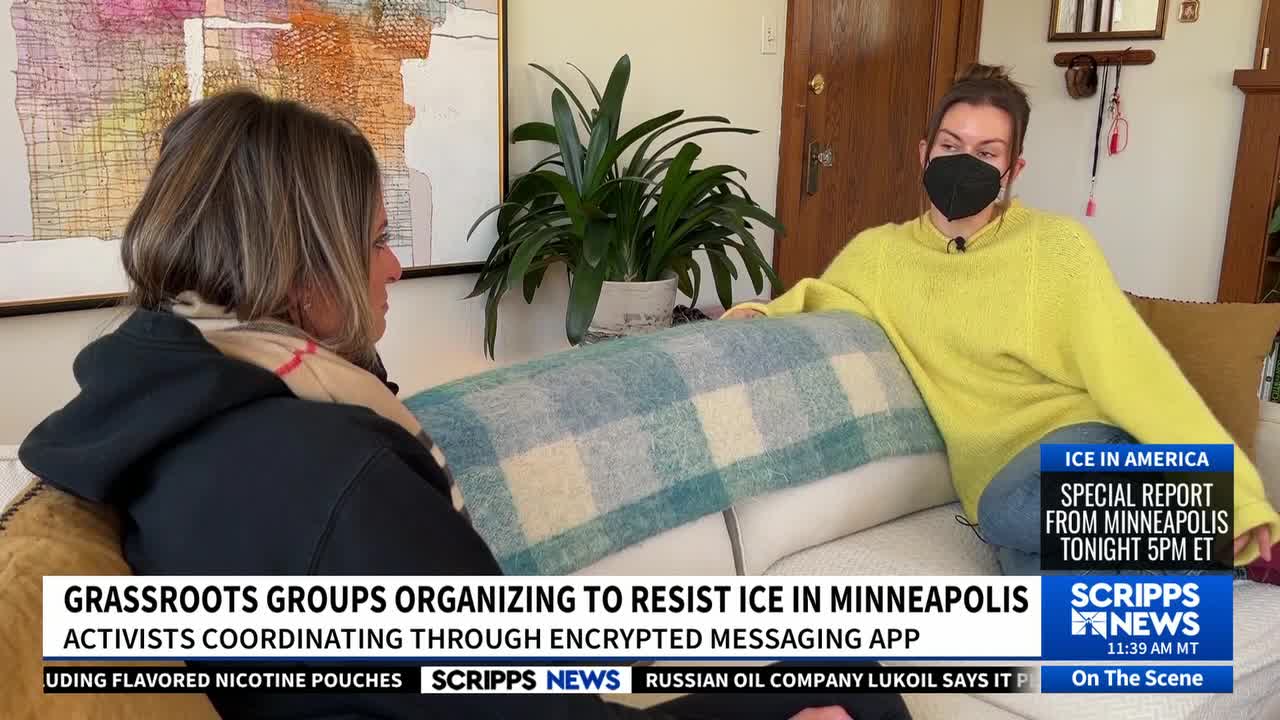


Federal agencies are now focusing on people resisting the immigration enforcement operation in Minneapolis.
Community members play a key role in what’s described as a massive underground network pushing back against what the Trump administration has called Operation Metro Surge. Critics have suggested they are paid agitators, but those involved say they’re relying on grassroots organizational skills common in what they call a state of hockey moms and engaged residents.
RELATED STORY | How a Minnesota federal building has become ground zero for ICE pushback
"Many of us legal observers blowing our whistles and filming and they left," said one activist, who only wanted to be identified as Maxine out of fear she could be targeted. "So, I mean, this works and we're not obstructing justice. We're just literally blowing whistles and filming."
"It's terrifying," she added. "I've seen the videos of Renee [Good] and Alex [Pretti]. And I mean, Alex, he literally could have been me."
Another activist told Scripps News that federal agents are becoming more creative in how they carry out the operation.
"There have been instances of ICE agents putting boxes of food or what look like boxes of foods on porches of homes of immigrants, trying to draw them out that way," said Tim Wegener. "We've had reports of people signing up to be food delivery people. And then as soon as they get an assignment to go deliver food, they're calling ICE and leading them to the house of the people that they're supposed to be delivering food to."
The network of activists — estimated to represent tens of thousands of people — uses the encrypted app Signal to communicate, with each community maintaining its own chat. Wegener said he believes more than 90% of the people in those chats are using codenames to keep their identity hidden.
But the technology is both a tool and a liability. Resistance members say federal agents have infiltrated some Signal channels.
"Now it's just word of mouth," Maxine said. "... I mean, we're at that level of underground railroad because ICE and ICE supporters are finding their way in and trying to impede our work as people who are resisting this occupation in our city."
IN CASE YOU MISSED IT | 'Streets of Minneapolis:' Bruce Springsteen releases new protest song
Wegener said caution is critical.
"At this point, there's nothing," he said. "Minimizing what is written down, making sure that your phone is, you log into your phone with a code rather than biometrics. It's weird to say it. It's basic operational security that's happening right now. And that's just gonna have to continue."
Another concern is that some far-right influencers have posted Signal chat lists online. That prompted FBI Director Kash Patel to announce an investigation into the group chats. Maxine said she now fears federal agents may be tracking her but won't let that impede her mission.
"When we do the bystander training, they give us some suggestions for how to try to protect our identities," she said. "What I feel like is really important is all of us voicing where we stand on this issue and speaking up. I'm not going to dim or quiet my voice based on that fear. I just don't, I couldn't live with myself."
On Thursday, President Donald Trump's Border Czar Tom Homan was asked directly if the leadership of Signal chats would be arrested. He said the organization and funding of attacks on ICE agents will be held accountable, but it wasn't clear how that would be defined in the eyes of the federal government.
