



MOAB, Utah — The Beehive State is widely known as a national leader in cloud seeding, a technique used to help boost snowfall and water supply in the state’s mountains. But a new project in Grand County is testing a very different approach—one that uses electricity instead of chemicals.
The testing site is situated south of Moab, where a private company has installed what it says is Utah’s first ionization site. The system is designed to enhance precipitation from passing storms without releasing any substances into the atmosphere.
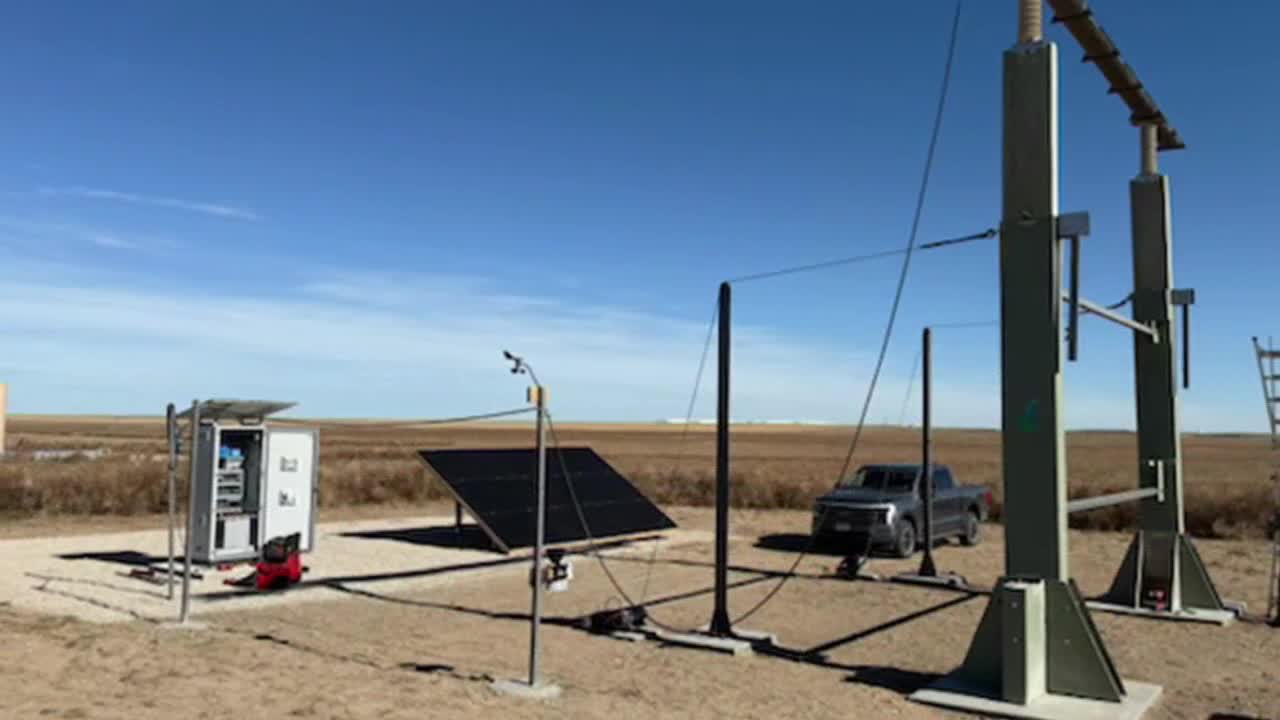
At first glance, the equipment doesn’t appear particularly complex.
“It’s neat, but it doesn’t really look like it does anything,” said Ben Musselman, manager of the Grand Water and Sewer Service Agency. “It’s just there—a solar panel array and kind of a field-goal looking thing that sticks up into the sky. If you didn’t know it was there, you’d never know what it was.”
Despite its simple appearance, the system is built to operate completely off the grid. According to Rain Enhancement Technologies, the company behind the project, the site runs on solar panels connected to a battery bank and inverter system.
“The system in Utah’s got 3.6 kilowatts of solar panels, it’s got a big lithium-ion battery bank, and then it’s got an inverter and charge control system, so it operates completely off the grid,” said Scott Morris, the company’s chief technical officer.
Traditional cloud seeding programs in Utah rely on silver iodide, which is either released from aircraft or dispersed from ground-based generators. Those particles help water droplets freeze and grow into snowflakes.
The ionization system takes a different approach.
Instead of introducing particles into clouds, the device sends a small electric charge into the air during storm events. The charge is designed to interact with tiny dust and aerosol particles already present in the atmosphere.
“Electrons basically escape from it and ionize the air or the dust particles as they go past,” Morris explained. “Those little aerosols get an additional charge, a bit of a spin put on them, and then they keep getting carried up by the wind.”
The idea is that electrically charged particles can attract water molecules more easily, helping raindrops or snowflakes form and grow.
WATCH: New cloud seeding study over northern Wasatch Range likely the largest in state history
Supporters of the technology say one of its biggest differences from traditional cloud seeding is that it doesn’t add chemicals to the atmosphere.
“One of the questions that commonly comes up is about the addition of chemicals to the atmosphere,” Morris said. “That’s the thing that stands apart with our technology—we’re not putting any additives into the environment.”
Utah already invests heavily in conventional cloud seeding programs. The state set aside a record $16 million this year to support operations designed to increase mountain snowfall and improve water supply.
But when it comes to this new electric-based method, state officials are taking a wait-and-see approach.
The Utah Division of Water Resources confirmed the project has been granted a permit to operate, but the agency says it wants to review data from a full season of operation before considering any public funding.
Local water managers say even modest improvements in precipitation could be valuable, especially in a region that often faces drought.
“It could be really big,” Musselman said. “As dry as we are, they’ve made claims of twenty percent. If we get ten percent, we’re ten percent better off than where we’re at. We can sit on our thumbs and do nothing, or we can try another tool.”
Rain Enhancement will complete the study from the first full season of operation by the end of this year. Until then, the small solar-powered array upwind of the La Sal Mountains will continue operating during storms—quietly sending charged particles into the air in hopes of helping produce a little more rain and snow.