

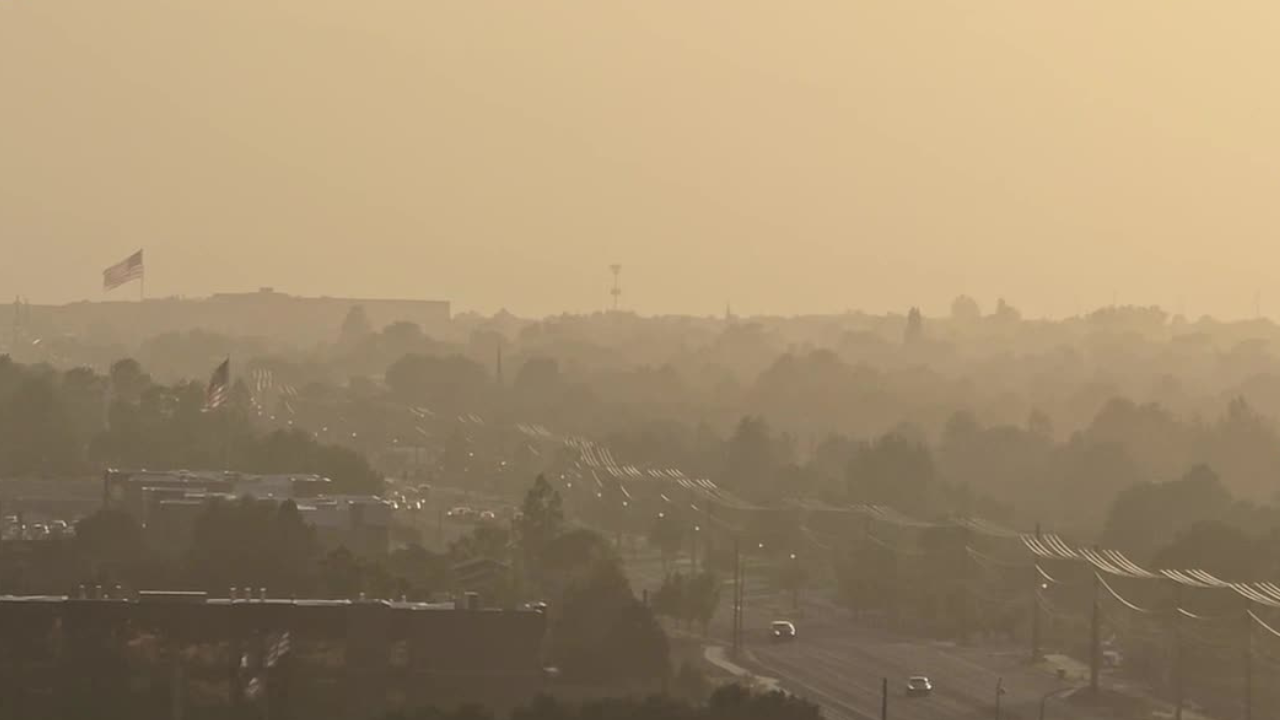


SALT LAKE CITY — A new study finds that dealing with Great Salt Lake dust has trade-offs and ballooning costs.
The study, published Thursday by the University of Utah's Wilkes Center for Climate Science and Policy, lists a number of options from gravel and straw to solar panels to cover the exposed lake bed and how much they could cost.
The Wilkes Center has also unveiled a new map tool to model Great Salt Lake dust exposure found here.
"The dust that you breathe regardless of what it’s made out of, if the concentrations are high enough can trigger immediate response in people. There’s also the potential long-term effects of being exposed to components of the dust such as arsenic and other carcinogens," Dr. Kevin Perry, a professor of atmospheric sciences at the University of Utah and the author of the study, said in an interview Thursday with FOX 13 News.
More and more of the Great Salt Lake bed has been exposed as the lake declines. The study said that more than 800 square miles of lake bed are exposed. The exposed lakebed puts public health at risk in the form of dust storms blowing into communities. FOX 13 News has documented dust storms blowing into Ogden, Farmington and Salt Lake City.
"At present, approximately 70 square miles (about 9% of the exposed lakebed) function as active dust hotspots. If protective crusts continue to degrade or groundwater levels decline further, dust-active areas could expand to as much as 187 square miles (approximately 24% of the lakebed)," the study said.
The study evaluated different methods to cover the exposed lakebed with varying costs and magnitude "ranging from approximately $3 million to $450 million per square mile over a 50-year period, depending on technology, lifespan, maintenance requirements, and water use. When scaled to the ~70 square miles of currently identified dust hotspots, total projected costs range from $3.2 billion to over $31 billion, depending on the mitigation strategy employed."
But even the most simple solution — getting more water into the Great Salt Lake — has costs, the study said.
"If you’re using water for dust mitigation, that water is not going to be doing what we want it to do is restore the lake to ecological health. So there are trade-offs with that," Dr. Perry said.
The report does not make recommendations, but presents the options before Utah political leaders. In response to the dust problems, Utah's Department of Environmental Quality is rolling out dust monitors near communities to better inform residents about what they're facing.
On Thursday, more than a hundred students working with the Youth Coalition for Great Salt Lake and HEAL Utah showed up to the Utah State Legislature, wedging themselves between lobbyists and advocates for other causes to lobby lawmakers to do more to help the lake.
Some children that FOX 13 News observed offered praise to lawmakers for their bills that they believe are helping the lake. Rep. Ray Ward, R-Bountiful, got support from a student who wished him luck as a Great Salt Lake-related bill faced a House floor vote soon.
"I think there has been a lot of progress, there’s been some really good bills that I've seen go through committee really well," Ava Baskin told FOX 13 News.
Others were not shy about pressing their lawmakers to do more, reading from pieces of paper they brought about health effects from dust and a shrinking Great Salt Lake.
"This is our home and we want to protect it," said Keva Lawlor.
The study and the youth lobbying has reached some lawmakers. Rep. Jill Koford, R-Ogden, who runs a lot of lake-related bills for the House Republican supermajority, rushed out of the House chambers to meet with students. She thanked them for their advocacy and urged them to keep it up.
"I'd just like to see us get more water to the lake so that we don’t have a dust problem," Rep. Koford told FOX 13 News as she walked back into the House chamber. "I mean that’s the simple answer, right? It’s not a simple solution."
Read the study here:
This article is published through the Great Salt Lake Collaborative, a solutions journalism initiative that partners news, education and media organizations to help inform people about the plight of the Great Salt Lake—and what can be done to make a difference before it is too late. Read all of our stories at greatsaltlakenews.org.