

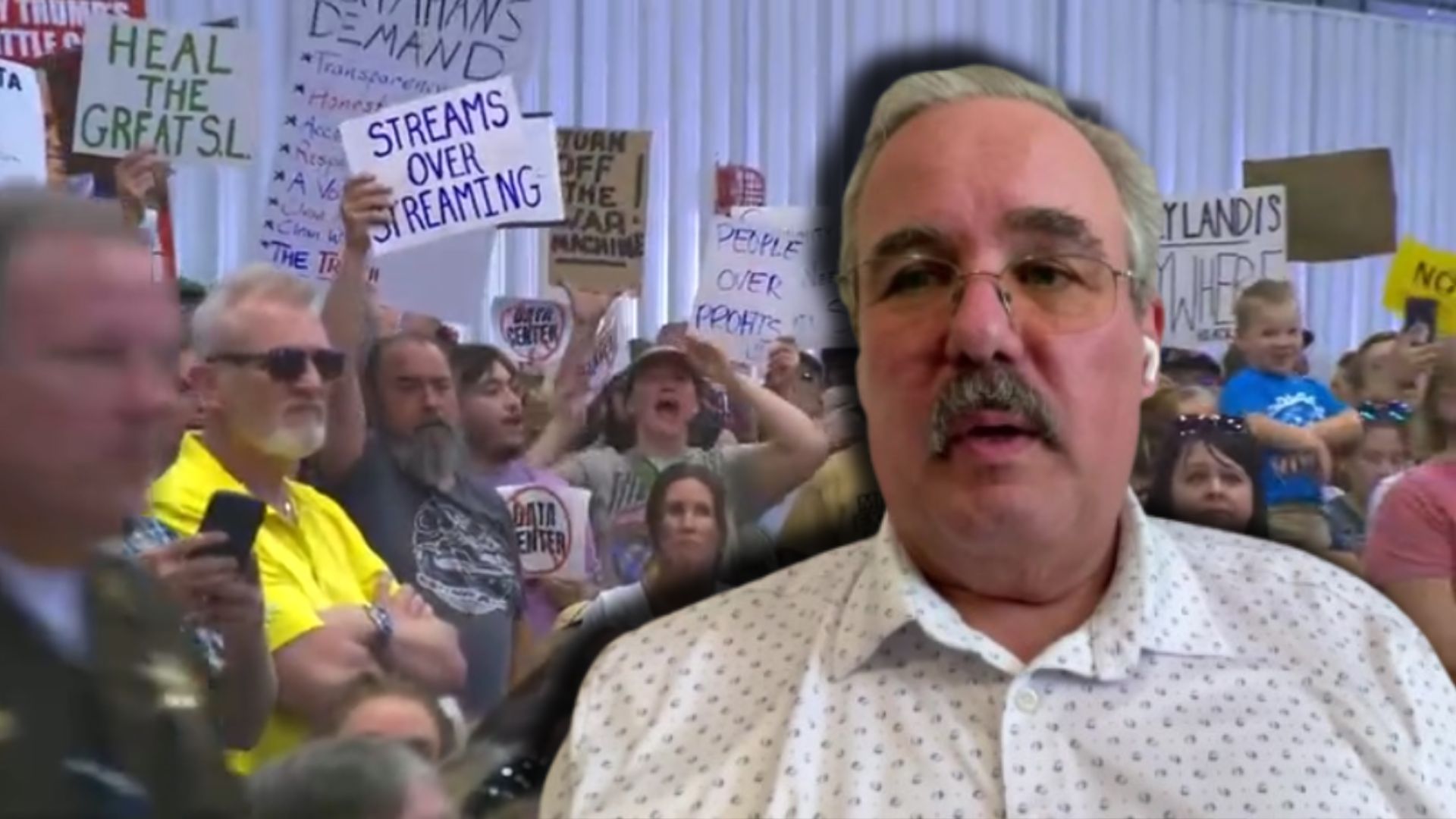


BOX ELDER COUNTY, Utah — Box Elder County Commissioner Lee Perry says he has received death threats since the commission's unanimous vote to approve an agreement for a proposed data center project in Hansel Valley.
Perry says the threats are more alarming to him than anything he faced during his career in policing.
"It's one of those things having spent 32 years in law enforcement, I'm probably more fearful right now that something bad could happen to me than in the 32 years I was out there wearing a gun and a badge and protecting our citizens as a policeman," said Perry. "But I will tell you, I love our law enforcement community because they stepped up in a big way."
Not only has Perry received death threats — all three commissioners had protesters at their homes Tuesday night.
Perry says the pushback on the project has been difficult, but that the commission's hands were tied when it came to what private landowners can do on unzoned property in the county.
When the Military Infrastructure Development Authority (MIDA) first presented the Stratos Project to the commission, Perry claims the board's initial reaction was firm, and that the commission was the last to learn about the project.
"And actually the O'Leary Group didn't present it to us. That's the frustrating part for us as commissioners. We were the last to the table, so to speak," Perry said.
Perry says someone eventually suggested the project's backers consult with county commissioners before moving forward — but that conversation never happened.
"I do know that somebody mentioned, 'Hey, you ought to talk to the county commissioners up there about what you're talking if you're going to put it in their county', which I think is a very wise thing, and I think it would be a great idea, but it didn't happen," the commissioner added.
When MIDA did present the project to the commission, Perry says the board initially said "absolutely not." But MIDA told commissioners the landowners were already on board and under contract to sell their land. Because the property is private and unzoned, the commission's legal options were limited. The best it could do was negotiate stipulations in an agreement with MIDA to protect the county's interests.
"So we felt like this was the best answer - to say, we'll partner with MIDA, that'll protect our taxpayers and put guard rails in place to do some things that we felt like were beneficial to protect our citizens and protect the area of Box Elder County," he explained. "Similar to what happened probably to some level when Morton Thiokol (now Northrup Grumman) came in."
Perry says the commission made sure the agreement required MIDA and investor Kevin O'Leary to be responsible for putting in roads, supplying utilities, and complying with building codes. He adds that the commission also pushed for protections that reflected community values.
"But I can tell you from the beginning, the commissioners, we thought of dark sky lighting, we didn't want to have a big bright glowing thing out in the western desert," said Perry. "We wanted to make sure there were noise limits. We wanted to make sure our fire protection was taken care of. We want to make sure our roads were protected and our farmers and ranchers, who do have cows out there, didn't have to worry about them getting hit.
"Those were all things that we were thinking about right off the bat, and a lot of our citizens felt the same way and expressed those as well."
Perry drew a comparison to then-Morton Thiokol, now Northrop Grumman, which sits on a 20,000-acre site in the area, where rocket motors are built and tested for missions carrying astronauts and other payloads into space. He says Northrop Grumman has been a great corporate neighbor and anticipates the Stratos data center would be as well, if built.
Commissioner Perry trusts the Utah Department of Environmental Quality and the state engineer's office to do their jobs, and that MIDA will make good on its promises, as it has done with projects in Davis, Weber, and Wasatch counties.
A project that would consume more energy than Utah currently produces
Phase 1 of the Stratos Project would have a 3 gigawatt power capacity, with total capacity when built out slated for 7.5 to 9 gigawatts. That is more electricity than all of Utah uses everyday. But MIDA and the investors say the Stratos Data Center would generate its own electricity using natural gas power plants.
Rob Ricci, a research professor at the University of Utah's School of Computing who specializes in data centers, spoke with FOX 13 News on Tuesday about the scale of the project's energy demands.
"As mentioned, it would consume far more energy than the state of Utah currently produces," explained Ricci. "So they essentially, they have to build a bunch of power plants in addition to the buildings that would house the computers and data centers themselves."
Ricci worries the large amount of natural gas the Stratos power plants would draw could affect the natural gas market in Utah, and ultimately lead to higher natural gas prices in the Beehive State.
However, Perry says the natural gas power plants Stratos would build would draw from a pipeline that runs from Wyoming through Utah and Nevada, and ends in Oregon.
Perry added that the pipeline does not supply natural gas to Utah customers, who would not be affected by the natural gas needed to produce power for the data center. He claims once built out, the Stratos project might actually contribute electricity to the grid, thus helping to moderate rates.
There are 27 natural gas power plants already operating in Utah. Most of those plants draw from resources in the Uinta Basin, with other major pipelines crossing Utah from Wyoming and Colorado. Altogether, Utah is a net exporter of natural gas.
This story was reported on-air by a journalist and has been converted to this platform with the assistance of AI. Our editorial team verifies all reporting on all platforms for fairness and accuracy.