

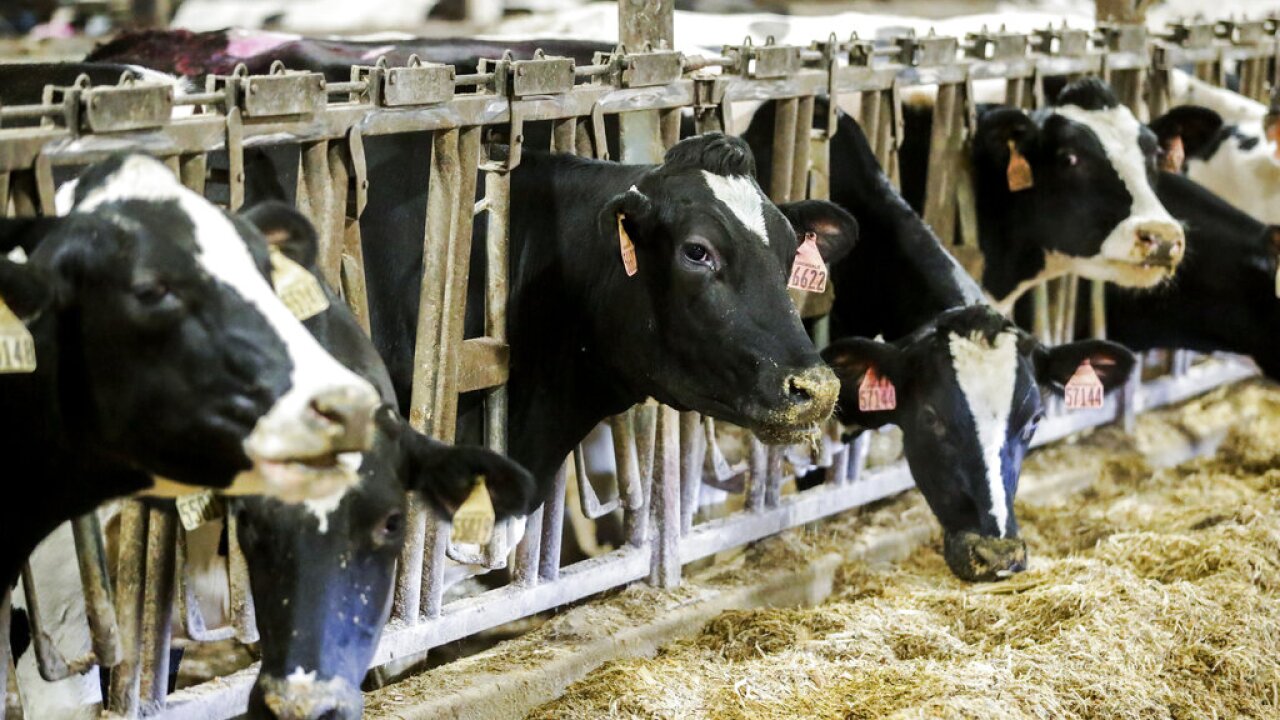


CACHE COUNTY, Utah — A dairy farm in Cache County was placed under quarantine by the state veterinarian after a sample from the farm tested positive for avian influenza.
As a result, all dairy farms in the county will undergo mandatory weekly surveillance and testing, which is funded by the federal government. In the event of a positive test, a dairy is placed under quarantine. During a quarantine, lactating cattle won't be allowed to move on or off dairies unless they are going directly to slaughter.
According to the U.S. Centers for Disease Control and Prevention, the recent detections do not present an immediate public health concern, and no major impacts to the food supply chain are anticipated.
In March 2024, HPAI H5N1 was detected in dairy cattle in Texas and spread to 19 other states, including Utah, Idaho, Wyoming, and Colorado. That year, several northern Utah farms were placed on quarantine.
This recent positive test marks the first detection of the dairy strain of avian flu in Utah since January 2025.
There have been no confirmed cases of HPAI in humans in Utah.
The Utah Department of Agriculture and Food says they are working with dairy producers in the area to devise plans for response, biosecurity, and surveillance. They add that they will be meeting with industry partners and dairy producers over the coming days.
Workers at dairy farms are asked to report any signs of illness in poultry or dairy cattle to the State Veterinarian's Office at statevet@utah.gov. Producers outside of Cache County can also participate in voluntary surveillance by emailing the state veterinarian.
Shayn Bowler is a fifth-generation dairy farmer who owns and operates Utah Natural Meat and Milk. He says he and his wife have been producing meat and raw milk on a plot of land in West Jordan for more than two decades.
He said news of avian flu being detected at the dairy farm near Logan definitely caught his attention.
“We try and take all the precautions that we know how to take: clean food, clean water, healthy cows, watching cattle behavior," Bowler said. "And while we do everything we know how to do to keep them clean, there’s always a concern about something new, being ready for it, knowing what to do.”
That’s where Utah's State Veterinarian Amanda Price said her office comes in.
“My job is to protect the state's animals from diseases," Price said.
So when she received news Monday of a positive test for avian influenza at a Cache County dairy farm, Price put them under quarantine, hoping to keep it contained.
“They will be under quarantine until they have two negative test results," she said. "What the quarantine means for them is that they can’t move lactating cattle to another dairy and we want to be able to track the other animals that are leaving their dairy.”
Officials will also be conducting weekly testing on milk from the nearby dairies in case it does spread. But Price said there is good news.
“There’s no risk to the general public; pasteurization kills the virus," she said.
Price said there’s also minimal impact on the cows that do become infected.
Meanwhile, Bowler said it appears everything that can be done is being done.
“And so, by containing that and correcting it in the best ways we know how ... we can mitigate these kinds of issues and hopefully keep them from spreading, right?” he said.
WATCH: Dr. Andrew Pavia, chief of pediatric infectious diseases at the University of Utah, discusses avian flu
Dr. Andrew Pavia, head of pediatric infectious diseases at the University of Utah and an expert on the H5N1 bird flu virus, said the virus probably spreads through milking equipment and airborne particles, though researchers are not completely certain — and that uncertainty is part of why it is so contagious.
He reiterated Price's expertise that there is minimal risk to the general public.
"It does pose a risk to the farm itself for financial reasons because it will lead to reduced milk production," Pavia said. "It can also infect dairy workers who work in milking barns, and it can spread from farm to farm, so it could have a much broader impact in northern Utah than a single farm, but for the general public, for you and me and people who drink milk that's pasteurized, there's no risk."
Pavia said pasteurization kills the virus completely, and that milk and dairy products from Cache County are safe.
For the most part, cattle recover from the H5N1 bird flu virus, and once they do, their milk is usable again.
However, Pavia cautioned that a single confirmed case may signal a wider problem.
"The one thing that I think is worrisome is that when we detect one case on one farm, often that's the tip of the iceberg, and we're going to find out in the next week or two as the state veterinarian and their team do more testing whether it may have spread to other farms," he said.