



SALT LAKE CITY — Amanda Hunt almost talked herself out of going to the hospital.
In September of 2025, the 38-year-old Utahn, like many of us, felt something was off, but the feeling wasn't certain. Chest pain had her worried, but like many of us, it would have been easy to ignore.
She debated the emergency room with her husband and ultimately decided to go. "I felt funny, and I told my husband, I need to go," Hunt said. But doubt crept in fast. "I questioned even going to the emergency room in the first place.”
Even as they pulled in, the urgency faded as she said the drive over made her feel better. She nearly asked him to turn around and go home.
However, there was a flicker of doubt in the other direction. “I had one of those moments of, what if, by the time I get home, I feel this way again?" Hunt said. "Like in the off chance that something's going on. I'm already here."
That decision would save her life.
At MountainStar’s St. Mark's Hospital, Cardio Rhythm Specialist Dr. Nischaia Nannapaneni took her case. “Amanda initially came in with low phosphorus levels, and she started having some chest pain," Nannapaneni said. "Then she continued to have chest pain, and she was taken to the cath lab, and she underwent a coronary angiogram, which did not show any significant findings.”
With no blockages found, doctors kept Hunt for observation after a few days she was expected to go home. Then, alone in room 5N 25, everything changed.
"While I was just sitting here and relaxing by myself, my vision started going kind of funny and started getting a little lightheaded. Went to go, reach up and call the nurse, and everything just went black," Hunt recalled.
Hunt's heart had stopped.
She had suffered a Spontaneous Coronary Artery Dissection, or SCAD — a rare and largely misunderstood cardiac event that doesn't follow the typical heart attack profile. Unlike the blockages caused by years of cholesterol buildup, SCAD occurs when the inner wall of a coronary artery suddenly tears.
Blood gets trapped inside the tear and presses against the artery wall from within, cutting off blood flow and triggering a heart attack without warning. There are no classic risk factors. No clogged arteries. No prior symptoms.
SCAD disproportionately strikes younger, otherwise healthy women, often with no warning signs whatsoever. According to the American Heart Association, without immediate CPR and defibrillation, survival rates hover around just 10%.
Hunt was 38 years old and had no reason to expect this, but thankfully, she was in the hospital, and she had a nurse like Ellie Roemmich. Roemmich was wrapping up at the nurses' station when the overhead announcement cut through the floor.
Code blue. Room 5 North 25."A code was called, and it was code blue. And so I was walking by the nurse's station, grabbed the crash cart, and then they said five north, 25, and I was like, oh, that's, that's my patient," Roemmich said.
There was no time to wait. Roemmich assessed her patient and began CPR immediately.
Two minutes of chest compressions. Then thankfully, a shockable rhythm emerged. "Code team shows up. We're able to get her back. Thank goodness,” she said.
When Hunt opened her eyes, she was surrounded by a wall of medical staff, all of them calling her name. "I woke up to about five to seven people around me just screaming my name. And eventually I saw Ellie, my nurse. And once I saw her and recognized her, I'm like Ellie, okay, I see you,”
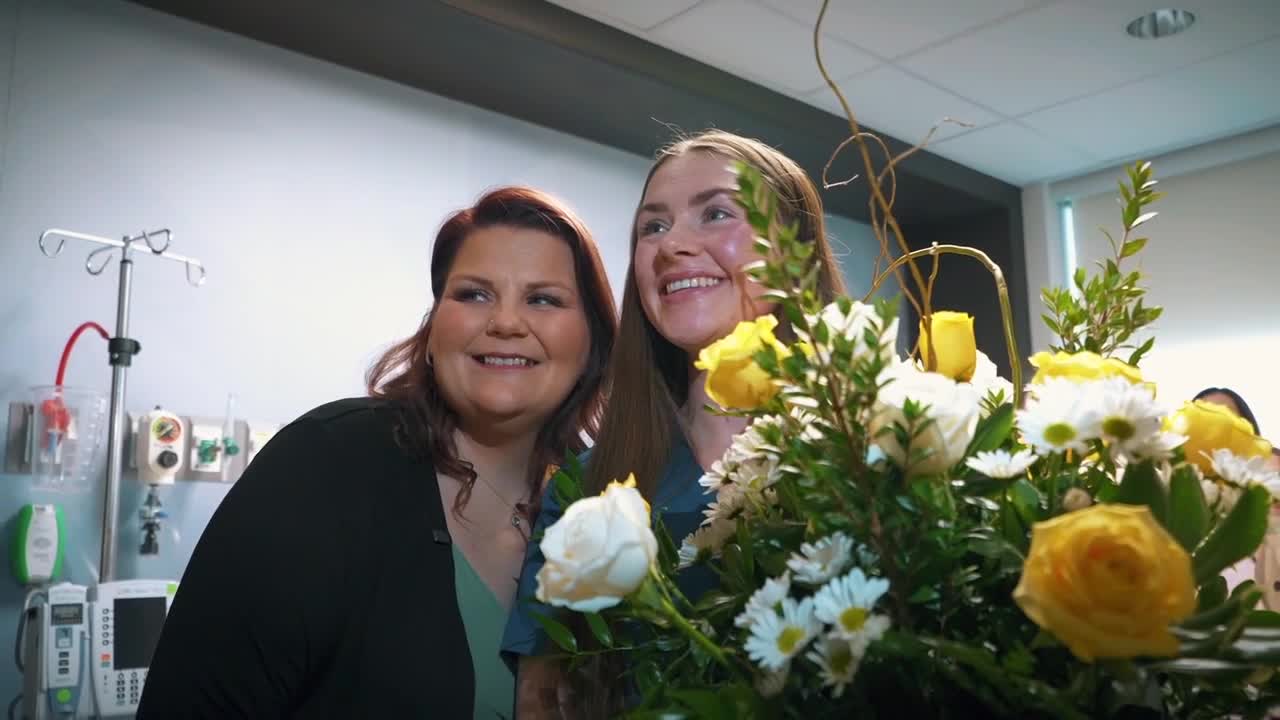
5 months later, after that terrifying ordeal, Roemmich and Hunt would see each other again — the first time since Hunt walked out of St. Mark's alive in a tearful reunion. "It makes me so happy just to see that smile. It's just the same one that I, you know, came back to life with," Hunt said.
For Roemmich, who pours herself into every patient she cares for, the reunion was equally meaningful. "It was really sweet to be able to see her," Roemmich said. "It's definitely something I'll remember for a long time.”
The reason for the reunion is that Hunt nominated Roemmich for a DAISY Award — an internationally recognized honor given to nurses who demonstrate extraordinary, compassionate care. "The moment I realized that she was my guardian angel, I knew that I had to honor her in some way," Hunt said.
"I don't know — you'd never feel like you're deserving of something like that… you just don't expect it," she said.
But Hunt was sure she did, saying, "All of her patients are so lucky to have her."
Now on the road to recovery, Hunt had an internal defibrillator placed and is navigating a new relationship with her own body built on awareness rather than fear. "Just living day to day, trying to be more careful with my heart," she said.
When asked if she ever imagined something like this was possible, her answer was immediate. "Not at all. Never thought that in a million years that I, at 38 years old, would have my heart go out on me," Hunt said.
For her physician, Dr. Nannapaneni, her message to anyone reading this is direct: don't wait. "Do not ignore chest pain. Get to the hospital as fast as you can. Do not ignore the signs of heart attack, because time is muscle," she said.
A message echoed by Hunt, who admits she understands that medical bills are expensive but says, "I’m alive because I took that chance, and I'm sorry, but you need to take that chance, because what if?"
The stakes, for her, couldn't be more personal. “[Ellie] gave my children their mother back. She gave my husband a wife that gets to remain with our family that we've, you know, fought really hard for," Hunt said. "And that's amazing to me.”
This story was reported on-air by a journalist and has been partially converted to this platform with the assistance of AI. This reporter verified all reporting in this story on all platforms for fairness and accuracy.
