

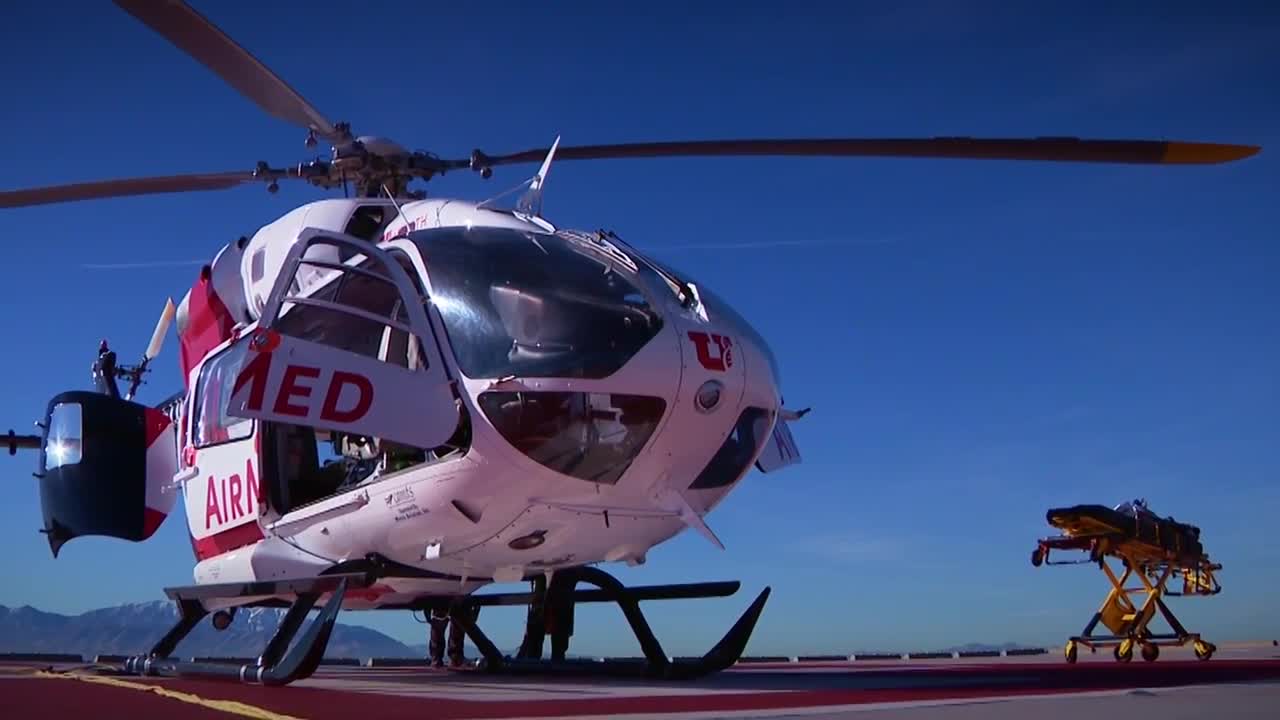


SALT LAKE CITY — When seconds matter, there are few sights more reassuring across the Salt Lake Valley than that AirMed logo lifting off into the sky. But what you might not know is that one of those helicopters — and the team behind it — is unique, with a very specific mission.
"Our mission is really to care for the sickest babies in the Mountain West region," says Dr. Kelli Lund, the medical director of the AirMed Perinatal Team at University of Utah Health.
The mission she leads is one of a kind in the region. While most medical helicopters focus on trauma and emergency transport, this specialized team has carved out a critical niche: ensuring the tiniest, most vulnerable patients get the care they need, no matter how remote their location.
On top of their important work, they are good at it, too. The University of Utah Health's AirMed Perinatal Team recently received national recognition for its work transporting and caring for the sickest babies and mothers in the Mountain West region.
The Association of Air Medical Services awarded the team the Neonatal and Pediatric Transport Award of Excellence in Fort Worth, Texas, this past October.
"This team is very silent about their professionalism, and the fact that they're getting honored, it means a lot, because they didn't ask for this. They're very humbled by this amazing award," AirMed outreach coordinator Cory Cox said.
"There are some really fantastic flight crews across the United States, and to be recognized as one of the best of those is a huge honor," NICU flight nurse Becky Kerry said.
The team operates a dedicated aircraft specifically for mothers and babies, staffed around the clock by a crew that includes a NICU nurse and a respiratory therapist.
"I am actually not aware of another flight team that is composed of both OB and neonatal… We have our own dedicated aircraft just for moms and babies in the Mountain West region, so that really does set us apart," Lund said.
The crew flies in an EC 145 helicopter, which is equipped to switch from caring for a mother in distress to a baby in an isolette.
"This is an EC 145 — a dual-engine, high altitude, high-performance helicopter that works really good for the Wasatch landscape, with mountain terrain that we have to get over, potentially off airport landings in high altitude environments," Cox said. "And then we have to be able to carry three crew members along with it... Not all helicopters can do all of those roles, so this is a very unique helicopter where we can have everything all combined with one aircraft."
Every morning, the crew inspects their equipment to ensure they are ready to bring intensive care capabilities directly to the patient.
"I go through all the baby stuff, all the drugs we need, IV supplies, chest tube materials if we need to put a chest tube in, central line equipment if we need to put in a central line. We just kind of go through and make sure all of that equipment is present and isn't damaged or expired," Kerry said.
"We're basically bringing the ICU to this patient. We have everything on board and all the skill that that patient's going to need at that time… Having an aircraft right here on the helipad really makes a difference, and we're not waiting for transport," flight respiratory therapist Sheila Fullmer said.
The University of Utah AirMed program has a long history, starting nearly 50 years ago as the eighth air medical program in the United States.
"Air medical started out in this country — it actually started out because of the Vietnam War," Cox said. "And then it went to academic medical centers to see if we could do that, and we proved to the world that we could. And so being the eighth air medical program to start up in the United States and really the world, we've proven time and time again that this can be done, and we keep breaking the boundaries of innovation."
Today, that innovation includes a TeleNICU program that allows the flight crew to begin care before they even take off.
"They've really embraced our TeleNICU program," Lund said. "They're able to log in to calls at our TeleNICU sites and actually see their patient before they go get them. They actually are able to give recommendations to rural hospital staff and help them care for the babies. The care can really start before they ever reach the patient, and before they actually take off from the University of Utah."
For Kerry, the mission is deeply personal.
"I had my son born at 26 weeks — 14 weeks early. He spent four and a half months here in the NICU at Primary Children's, and they had all of the flight nurses' pictures on the wall. I decided that's where I wanted to end up, flying the babies," Kerry said.
The team's ultimate goal is to provide the best care possible and offer reassurance to families and rural healthcare providers.
"I always like to tell the families: 'I'm gonna be sitting right there next to them. We are gonna take the best care of them,' and hopefully that helps relieve some stress for their families," Kerry said.
"I can't tell you how many times I've gotten phone calls from rural physicians telling me what professionals our AirMed perinatal team are. They show up. There's a sigh of relief. They know their baby is going to be taken care of really well," Lund said.
"My team makes it very easy. They really are the ones that deserve the recognition here. To see them get recognized for all of the hard work and everything that they do on a day-to-day basis is amazing," Lund said.
