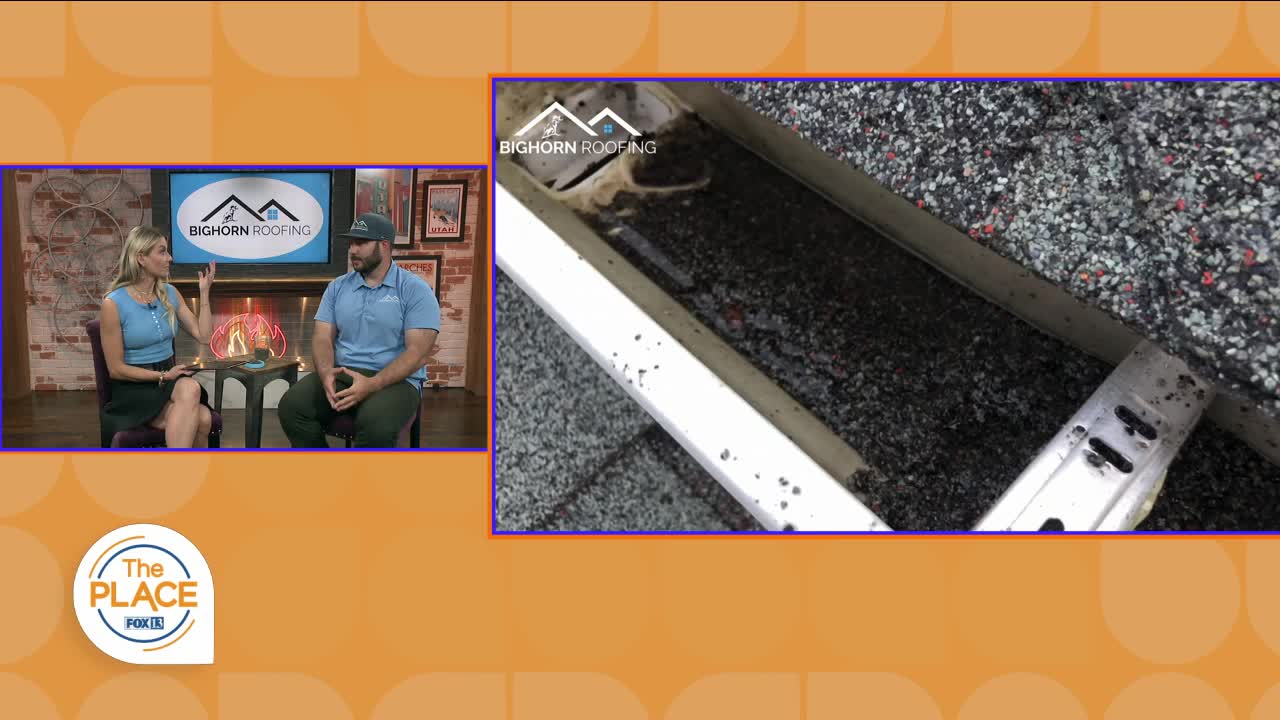

If you watched our August segment with Bighorn Roofing on FOX 13 The PLACE, you heard Bryce Rose walk through the five warning signs every Utah homeowner should check for this fall — most of them visible from the driveway, and all of them worth catching before the first snow.
Here in Utah, roofs age faster than they do almost anywhere else in the country. Our altitude means stronger UV exposure. Our winters bring wind-driven snow, ice dams, and repeated freeze-thaw cycles that work on every seam, fastener, and shingle edge. And our summers finish the job — surface temperatures on a dark roof can hit 160 degrees. A roof that would last 25 years in a milder climate might not make it past 17 or 18 here.
Which is why September and October matter. This is the window when most of the damage is still visible from the ground, when repair costs are still reasonable, and when good crews still have time to get to you. Wait until the first storm and everything changes.
The Five Warning Signs Every Utah Homeowner Should Check This Fall
As Bryce laid out on the segment, most of these signs are things a homeowner can spot themselves. Grab a jacket, walk your property, and look up. Here is what you are looking for.
1. Granules in Your Gutter Downspouts
Asphalt shingles shed protective granules as they age. A little bit is normal after installation. A steady flow into your downspouts means the shingles are wearing out.
"If you look in your downspout and it looks like coarse black sand, that is your roof telling you it has one — maybe two — Utah winters left," Bryce said on the segment. "Once granule loss accelerates, the shingle underneath starts breaking down fast."
2. Curled or Cupped Shingle Edges
Walk your property and look up at the roof. Shingles that curl at the corners or cup upward are no longer sealing to the roof deck below. That gap is where winter damage begins.
"Freeze-thaw is what kills a curled shingle," Bryce explained. "Water gets under the lifted edge, freezes overnight, expands, and pries it further open. One Utah winter can finish off an entire slope."
3. Faint Water Stains on Upstairs Ceilings
Yellow-brown rings on interior ceilings are often assumed to be old damage. According to Bryce, they usually are not.
"A stain that is dry today can be actively leaking every time it rains or snows," he said. "In Utah, a small leak becomes an ice dam problem by February — and ice dam repairs cost several times what the original fix would have."
4. Damaged Flashing Around Chimneys, Vents, and Skylights
Flashing — the thin metal strips that seal the places where things poke through your roof — is where most Utah winter leaks actually begin. Bryce called this out as one of the most overlooked warning signs on the segment.
"Most of the winter leaks we see do not start at the shingles. They start at the flashing," he said. "If yours is rusted, lifted at the edges, or you can see caulk where metal should be, that is a winter problem waiting to happen."
5. Your Roof Is 15 Years or Older and Has Never Been Inspected
Manufacturer warranties assume average conditions. Utah, as Bryce put it, is anything but average.
"We are at high elevation. UV exposure is stronger, freeze-thaw is punishing," he said. "A roof that would last 25 years in Ohio might last 17 or 18 here. If yours is 15 or older and no one has ever been up there, this fall is the year to check."
Why September Is the Smartest Month to Look
Search data backs this up. Nationally, September is the year's peak month for homeowners Googling "roof repair near me" — up roughly 24% from the annual low. October peaks for "roof inspection" searches, up 28%. Utah homeowners are not researching brands in September. They are researching whether they have a problem — and hoping to catch it before winter.
Bryce recommends scheduling any needed inspection or repair by mid-October, before Utah's first snowfall makes rooftop work difficult and drives up emergency-repair pricing. He also had a warning about who to hire.
"If a Utah roofer can start tomorrow in September, that is a red flag — not a green light," Bryce said. "Good crews here are booked through fall. That is just how the industry works. If someone is available immediately during peak season, ask why."
The Bighorn Price Lock
Material costs move. Supply chains shift. Insurance rates change. Bighorn does one thing no other Utah roofing or siding contractor does — if they quote your project today, they will hold that price for a full year.
That means Utah homeowners can plan ahead. Get the inspection this month, get the quote, and schedule the actual work for the season that fits your life. No pressure to sign today to "save" something that might not be there tomorrow.
What to Do If You Spot One
An inspection is free and doesn't obligate you to anything. About half the time, Bighorn's crews are telling homeowners they have another 3 to 5 years of life left in their roof — and that is a good phone call to make in September.
The alternative is finding out in a February snowstorm. That is when repairs get expensive, options get thin, and you are picking from whichever crews are still available.
About Bighorn Roofing
Bighorn Roofing is a family-owned, Utah-based exterior contractor specializing in roofing, siding, windows, and gutters. Bighorn is the only GAF 3-Star President's Club contractor in Utah — a credential held by fewer than 1% of roofing contractors nationally. They are also GAF Master Elite certified, FORTIFIED certified, James Hardie Preferred Contractor, and Owens Corning Preferred Contractor.
All crews are in-house and continuously trained, never subcontracted. Every customer is backed by Bighorn's Triple Stack Warranty — a 50-year GAF material warranty, up to a 40-year GAF-backed workmanship warranty, and Bighorn's own Forever Workmanship Guarantee for as long as you own your home. Bighorn has installed thousands of roofs across the Wasatch Front and holds a 4.8 star rating across 400+ Google reviews.
Schedule Your Free Fall Inspection
Whether your home is two years old or twenty, Bighorn will come out, take a look, and give you an honest read. Sometimes the answer is you have plenty of life left — and that is worth knowing too.
Visit gobighorn.com or call 801-305-4851 to schedule your free fall roof inspection.
Built on trust. Backed by craft.
Prepared by Bighorn Roofing Marketing | gobighorn.com | 801-305-4851