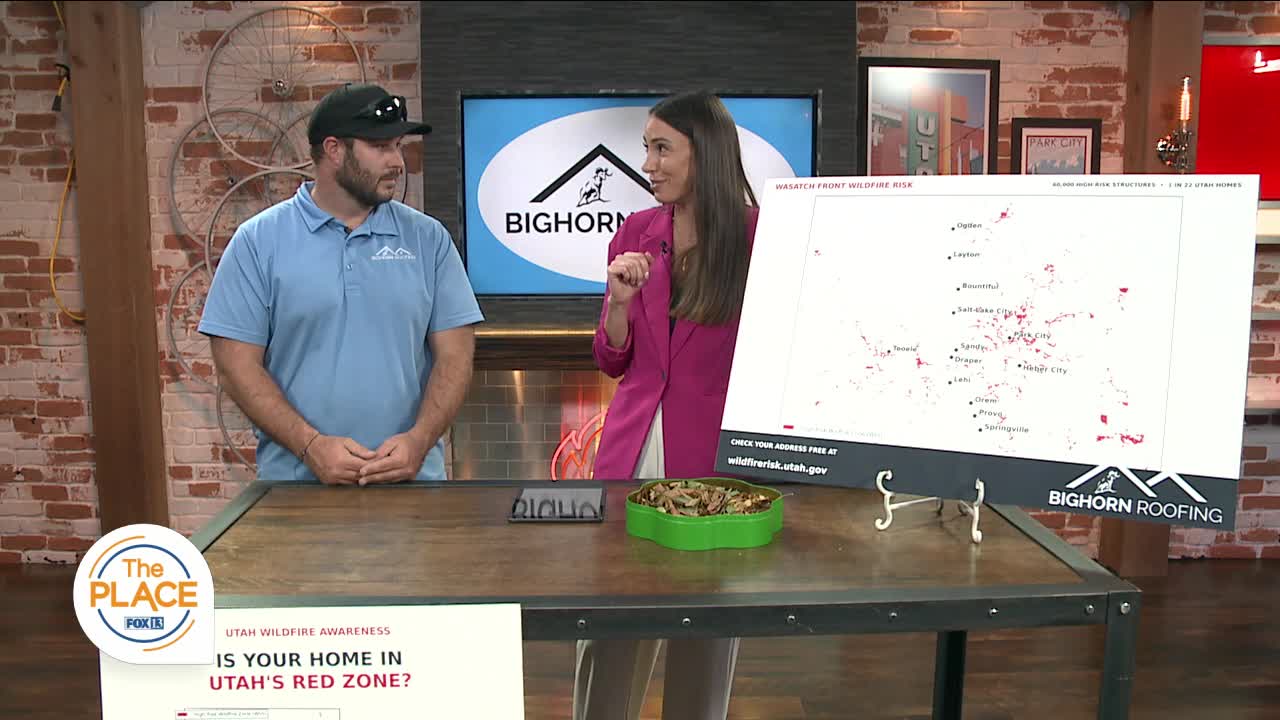

If you watched our September segment with Bighorn Roofing on Fox 13's The PLACE, you heard President and Owner Bryce Rose break down a number that surprised a lot of Utah homeowners: 60,000 homes and buildings across Utah now sit inside what the state officially calls a high-risk wildfire zone.
That is roughly 1 in every 22 Utah homes. And most homeowners have no idea whether theirs is one of them.
The number comes from a new statewide map released by the Utah Division of Forestry, Fire and State Lands under House Bill 48, passed in the 2025 legislative session.
Every structure in Utah was mapped, scored, and rated for wildfire risk.
The 60,000 identified on the Utah High-Risk Wildland Urban Interface (WUI) map represent the top 5% for wildfire risk statewide.
If yours is one of them, the state is asking you to pay attention.
The good news? You can check your address for free in about ten seconds at wildfirerisk.utah.gov. And whether you are inside the red zone or right next to it, there are three no-cost things every Utah homeowner should do this fall, before next year's fire season starts.
What Is Utah's High-Risk Wildland Urban Interface (WUI)?
The Wildland Urban Interface, or WUI, is the state's official term for any area where homes and neighborhoods meet undeveloped land. Brush, grass, forest, foothills. In Utah, that describes a lot of the places people actually want to live. The foothills above Salt Lake City. The benches of Ogden and Layton. The east side of Draper and Sandy. Almost anywhere near the mountains in Park City, Heber, or Provo.
"The state calls these areas WUI zones. In plain terms, it is anywhere homes bump right up against open land. If a fire starts on that open land, the homes closest to it catch first."
Bryce Rose, Bighorn Roofing
What makes WUI zones especially dangerous is how embers behave in Utah wind. During a wildfire, embers can travel up to a mile ahead of the actual flames. They land in gutters, on roofs, against fences, in bark mulch beds. If they find dry fuel, they ignite. That is how homes that seem far from the fire line still end up as total losses. The WUI is bigger than most Utah families realize.
How to Check If Your Utah Home Is in a High-Risk Wildfire Zone
The state built a free public tool for exactly this. Visit wildfirerisk.utah.gov, enter your address, and the map will tell you your structure's risk rating and whether you fall inside the high-risk WUI boundary. It takes about ten seconds and no login is required.
The risk score comes from years of scientific modeling by the Utah Division of Forestry, Fire and State Lands. It factors in wildfire likelihood, weather patterns, ember load, flame-length potential, topography, vegetation, structure density, and historic fire occurrence. Any structure with a Structure Exposure Score of 7 or higher, located within 250 meters of at least two other structures, is included in the high-risk boundary.
Under Utah's new law, the map also plays a role in insurance. Insurers writing WUI property coverage in Utah must use the state's high-risk boundary when classifying a property. Knowing where you stand today puts you ahead of the curve.
3 No-Cost Wildfire Prep Steps Every Utah Homeowner Can Take This Fall
On the segment, Bryce laid out three actions that require no money, no contractor, and no special tools. Just a Saturday afternoon and a willingness to walk your property.
1. Clear Five Feet Around Your Home
The five feet of ground closest to your house is called the immediate zone, and it is where most home ignitions actually start. Embers land in whatever is closest to your siding. Bark mulch. Dry pine needles. A stack of firewood. A juniper bush against the foundation. If any of that catches, your house catches next.
"Embers land in whatever is closest to your home. Give them nothing to catch."
Bryce Rose, Bighorn Roofing
This weekend, walk the perimeter of your house and clear that first five feet. Pull the bark mulch back. Cut back any shrubs touching your siding. Move firewood at least 30 feet from the house. Sweep debris out of window wells. This one step alone measurably reduces your ignition risk during an ember storm.
2. Clean Your Gutters and Roof Valleys
Gutters and roof valleys, the little troughs where two roof planes meet, collect a season's worth of dry pine needles, cottonwood fluff, and leaves. On a normal day it is a drainage problem. During a wildfire ember storm, it is fuel sitting on top of your house.
"Pine needles and dry leaves collect there, and that is basically kindling sitting on top of your house."
Bryce Rose, Bighorn Roofing
Get up on a ladder (or hire someone) and clean your gutters, downspouts, and roof valleys before winter. If you have a lot of tree cover near the roofline, consider gutter guards designed to keep debris out year-round. Bighorn installs these as part of many exterior projects on Wasatch Front homes.
3. Know Your Roof's Fire Rating (Class A, B, or C)
Roofs are classified for fire resistance in three categories: Class A, Class B, and Class C. Class A is the highest and offers the best protection against severe fire exposure. Most modern asphalt shingles from major manufacturers are Class A rated, but not all installed roofs in Utah meet that standard, especially older roofs or roofs installed by contractors cutting corners.
"Most homeowners have no idea what class they have. Ask your roofer next time they are up there."
Bryce Rose, Bighorn Roofing
If you live near the foothills or anywhere inside a WUI zone, a Class A fire-rated roof is what you want. Some Utah jurisdictions now require Class A roofing in WUI zones under updated fire codes tied to HB 48. If your roof is 15 years old or older, or if you do not know its rating, this fall is the time to find out. A quick inspection can confirm what you have and what your options are.
Why September and October Are the Best Months for Utah Wildfire Prep
Timing matters. In Utah, September and October are the ideal window to prepare your home for wildfire, and Bryce was clear about why on the segment.
"Fire activity is winding down, there is no smoke, no evacuations, and you can walk your property and see exactly what needs fixing. By the time we hit next June, you are already behind. Fall is when you get ahead of it."
Bryce Rose, Bighorn Roofing
Utah's wildfire season typically runs May through October, peaking in the hot, dry stretches of July and August. By mid-September, the immediate risk is easing, but the conditions that made this year's season dangerous have not gone away. Drought. Beetle-killed timber. Aging fuels. Continued foothill development. Next year's fire season will start again in about eight months, and homeowners who use this fall wisely are the ones who will not be scrambling next summer.
Fall is also when good roofing contractors have time to actually inspect your roof, replace damaged flashing, upgrade to Class A materials if needed, and get gutters and valleys ready for winter. Once the first storm hits, options narrow and costs go up.
Fire-Rated Roofing and Siding: Materials That Actually Reduce WUI Risk
For Utah homeowners inside or near a high-risk WUI zone, the materials on your home matter as much as the space around it. The right roofing and siding can make the difference between a home that survives an ember storm and one that does not.
The core WUI-compliant materials Bighorn installs on Utah homes include:
•Class A fire-rated asphalt shingles: The highest fire-resistance rating for residential roofing. Bighorn installs GAF and Owens Corning Class A systems as part of standard practice.
•Fiber cement siding (James Hardie): Non-combustible, ignition resistant, and specifically listed for WUI applications by California and other high-risk states. A strong upgrade path when replacing wood or vinyl siding in Utah foothill homes.
•Metal roofing systems: Non-combustible by design and highly effective in WUI zones, especially for homes with complex rooflines where valleys collect debris.
•Ember-resistant vents and ignition-resistant flashing: Small components that make a large difference. Standard soffit vents can suck embers straight into an attic. Upgraded ember-resistant vents and quality flashing seal off the most common ignition points.
Bighorn Roofing is licensed and certified to install these WUI-compliant exterior systems on Utah homes, and the crews are trained on the manufacturer specifications that keep those fire ratings valid. Installing a Class A shingle incorrectly can void its fire rating. Certification matters.
About Bighorn Roofing: A Utah Family Business Looking Out for Utah Homeowners
Bighorn Roofing is a family-owned, Utah-based exterior contractor specializing in roofing, siding, gutters, soffit, fascia, and windows. Every crew is in-house and continuously trained. No subcontractors. Every project is backed by the Bighorn Triple Stack Warranty: a 50-year GAF material warranty, up to a 40-year GAF-backed workmanship warranty, and Bighorn's own Forever Workmanship Guarantee for as long as you own your home.
Bighorn is one of the most credentialed roofing contractors in Utah:
•GAF 3-Star President's Club: The only contractor in Utah to hold this credential. Fewer than 1% of roofing contractors nationwide earn it.
•GAF Master Elite Certified: Licensed to install and warranty GAF Class A fire-rated roofing systems.
•FORTIFIED Certified: Trained to install roofing systems that meet the Insurance Institute for Business and Home Safety's highest resilience standard.
•James Hardie Preferred Contractor: Certified installer of ignition-resistant fiber cement siding, a leading WUI-compliant material.
•Owens Corning Preferred Contractor: Certified installer of Class A Owens Corning roofing systems.
•4.8 stars across 400+ Google reviews: From Utah families across the Wasatch Front.
What ties all of that together is a simple idea: Utah homeowners deserve exterior work done right by people who actually live here, understand this climate, and are still around in ten years to stand behind the work. That is why Bighorn exists.
Schedule Your Free Wildfire-Ready Roof Inspection
If your home is inside or near one of Utah's high-risk WUI zones, or if you just want to know where your roof and siding stand ahead of next fire season, Bighorn offers a free, no-obligation exterior inspection.
Bighorn's crews will check your roof's fire rating, evaluate your gutters and valleys, look at your siding, flashing, and vents, and give you an honest read on your home's wildfire readiness.
About half the time, the answer is that your home has plenty of life left and just needs a few small fixes. That is a good phone call to make, and it is what "looking out for Utah homeowners" actually means.
Visit gobighorn.com or call 801-305-4851 to schedule your free wildfire-ready roof and exterior inspection.
Built on trust. Backed by craft.
Prepared by Bighorn Roofing Marketing | gobighorn.com | 801-305-4851