

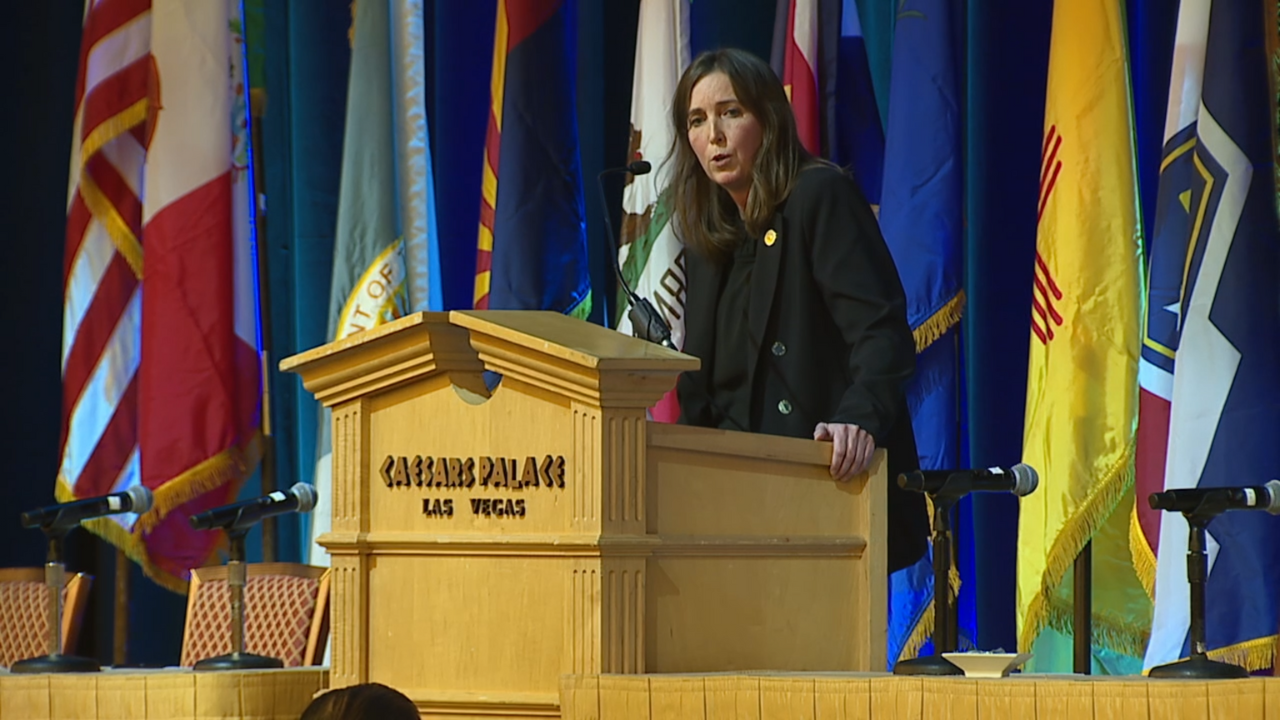


LAS VEGAS — Officials with the Trump administration fired a warning shot at states involved in the high-stakes negotiations over the Colorado River to get a deal done, imposing a new deadline for an agreement.
"The time for grandstanding and rhetoric has passed. The river will not wait for us," Andrea Travnicek, the assistant secretary for water and science at the U.S. Department of Interior said in remarks Wednesday at the Colorado River Water Users Association.
She urged the states to come to their own agreement and give it to the federal government by Feb. 14.
"Give your commissioners room to negotiate and room to compromise and if you can’t do that? Send us representatives who have the authority to best serve your interests but are willing to break through the barriers to get to a consensus deal," Travnicek said.
Acting U.S. Bureau of Reclamation Commissioner Scott Cameron was equally direct in an interview with FOX 13 News and the Colorado River Collaborative. He said the federal government was willing to facilitate and support the states as they worked to their own agreement.
"I’ll tell you one thing: if the federal government has to act in the absence of a seven state deal, all seven states are going to be in a much worse position than if they can arrive at a collective arrangement that works for them," Cameron said.
The states along the Colorado River have been actively negotiating an agreement to manage the river that supplies water to more than 40 million people in the West. Commissioners appointed by their respective states to hammer out a deal have been meeting behind closed-doors in Las Vegas to try to reach consensus. The current agreements expire in 2026.
None of the states' commissioners say publicly they want federal intervention or even years of court battles. The U.S. Department of Interior said it intends to release a highly-anticipated environmental impact statement in the next couple of weeks with some "alternative proposals" should a deal not be reached.
The states have said they are offering cuts, conservation and other measures to meet growing demands and less water in the river. Asked what appears to be the holdup is between the states, Cameron replied: "There are a number of issues from decades past that some people are having some difficulty getting past. And frankly, there are tough decisions that have to be made. It’s not unusual in negotiation process that the tough decisions are made the closer you get to a deadline."
The strong words coming from the federal government appeared to spook many in the crowd gathered here in Las Vegas for the Colorado River Water Users Association. In Utah, the Colorado River supplies a significant part of drinking water for the heavily-populated Wasatch Front, pumped in through the Central Utah Project.
"The Jordan Valley Water Conservancy District? About 40 to 50 percent of its water deliveries depend on the Colorado River," said Andy Pierucci, a Riverton City Council member who sits on the water district's board. "For someone like me who’s on the Riverton City Council? That’s a significant portion of our drinking water."
Beyond a seven-state deal, there are other factors to be considered. Native American tribes must also be consulted.
"I want to make sure things are fair for the Ute Indian Tribe and other tribes that have the resources associated with the river," said Bob Ridley, the Ute Tribe's vice-chair.
There are also agreements with Mexico. Adriana Resendez, Mexico's commissioner on the International Water and Boundary Commission, said her government is ready to talk.
"I would like to reiterate the commitment of Mexico to work with you, the federals, the states in finding a solution," she said.
Cameron said he believed the states could reach a deal, but still offered a warning to them in his interview with FOX 13 News and the Colorado River Collaborative.
"I am cautiously optimistic," he said. "What’s certain is that if in the absence of a seven state deal, everyone has a lot to lose."
This article is published through the Colorado River Collaborative, a solutions journalism initiative supported by the Janet Quinney Lawson Institute for Land, Water, and Air at Utah State University. See all of our stories about how Utahns are impacted by the Colorado River at greatsaltlakenews.org/coloradoriver
