



WEST JORDAN, Utah — Daniel Cervantes was tired of renting.
“The key to building wealth in this country is through real estate,” Cervantes told FOX 13 News in a recent interview.
Cervantes, 28, and his partner found a townhome in West Jordan they could afford — with help from Utah’s first-time home-buying assistance program. It provides $20,000 toward the purchase of a newly-constructed home.
“Without the $20,000, I don't think we would've been able to get the house at all,” Cervantes said.
But the program hasn’t worked as well for families like Rachel Juliatti’s.
“I just get frustrated,” she told FOX 13. “It's like something that every day I would check for houses.”
For buyers and builders
The Utah Legislature created the first-time home-buying program in 2023. Thus far, legislators have provided $70 million.
The program has helped about 3,000 households buy their first homes. There remains funding to assist about 500 more, according to the Utah Housing Corp., a state-controlled agency that operates the program.
The $20,000 the program provides is a loan that can be placed toward the purchase or closing costs. The buyer doesn’t need to repay the money until they sell or refinance the property.
There are some catches.
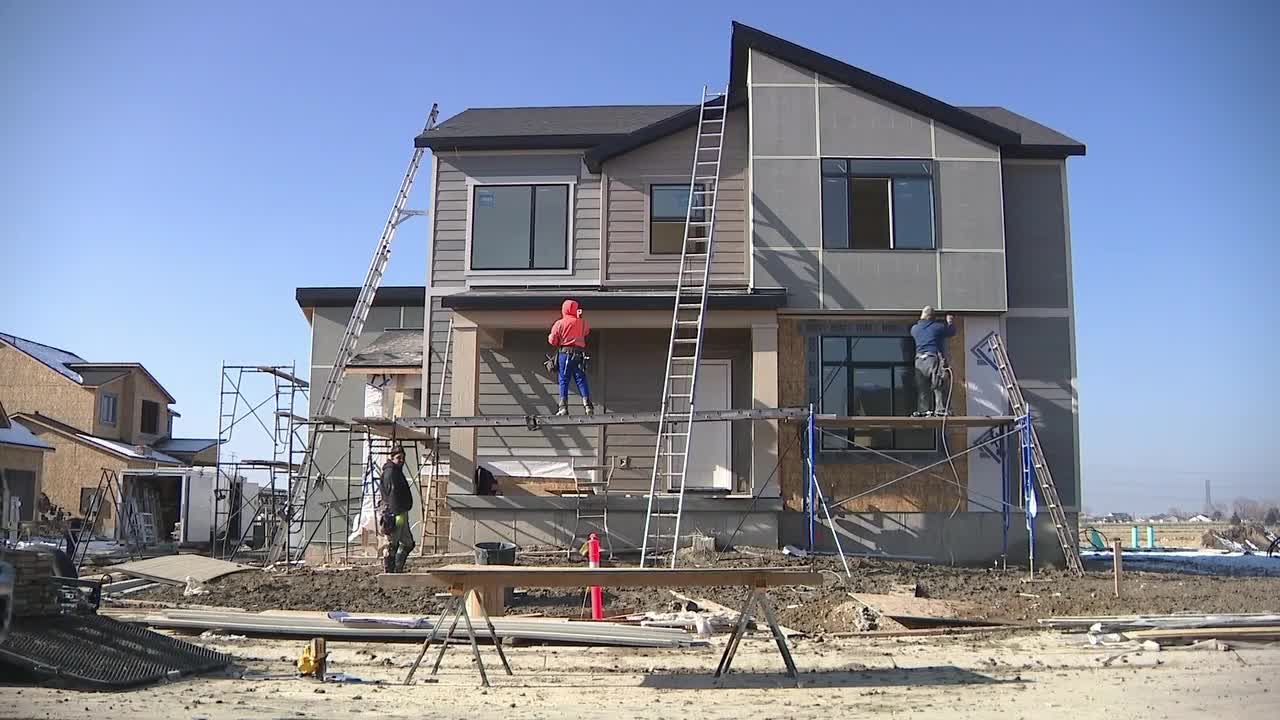
The $20,000 can only be placed toward a newly-constructed home with a purchase price not exceeding $450,000.
Those are the so-called starter homes Utah politicians are pushing homebuilders to build.
“The program is entirely for homebuyers, but it's attacking the supply deficiency issue by incentivizing builders,” said David Damschen, a former state treasurer who is president and CEO of Utah Housing Corp.
Most online housing calculators say that to purchase a $450,000 home, a household would need an annual income of $100,000 to $130,000, depending on the size of the downpayment.
Utah's CROWN program turns renters into homeowners:
More expensive homes tend to be more lucrative for the builders, Damschen explained. Utah is trying to create more customers for the less expensive homes.
“Knowing that a certain set of homebuyers have this on their side of the table, if you will,” Damschen said.
In the hundreds of thousands
What do economists think of the program?
“Utah is also considering supply, which is good,” said Jun Zhu, a clinical associate professor of finance at Indiana University. “The new construction program can give incentive to the builders to produce more affordable housing, and that would add to the supply side as well.”
States like Oklahoma and Nevada have programs offering more toward downpayments and make that assistance available to a wider swath of people. However, by giving incentives to builders, Utah’s program may also slow the rise in home prices, said Cameron LaPoint, an assistant professor of finance at Yale University.
“You're subsidizing home ownership. That's going to increase demand for home ownership,” LaPoint explained. “So, unless there's some sort of countervailing increase in supply, prices are going to go up.”
John Franchi, Nate Carlisle and Spencer Josephy discuss Utah's housing affordability crisis in video below:
But neither LaPoint nor Zhu thinks the program will do much to ease Utah’s housing prices.
“We are talking about maybe helping thousands of families when the need is in hundreds of thousands,” Zhu said.
Damschen points out that Utah Housing Corp. has other programs to help people purchase existing homes and special programs for military veterans and law enforcement.
But Damschen also said government can’t be expected to solve all of Utah’s housing problems. Solutions will take “a collection of initiatives, programs, resources,” he said.
Steppingstones
Cervantes’ townhome has three bedrooms, 3 ½ baths and 1,700-square feet.
“We feel like this is going to be like our stepping stone towards getting something bigger in the future,” he said.
He and his partner are both federal workers. The builder, Ivory Homes, gave them a discount for public employees, Cervantes said.
That helped reduce the purchase price to the $450,000 cap in the first-time home-buyer assistance program. Cervantes said their mortgage payment is about $2,900 a month – more than they were paying renting.
“Our commutes tripled,” Cervantes said. “So sacrifices have to be made per se. We are a little farther from everything.
“But we figured it's worth it.”
Juliatti, her husband and their two children — ages 11 and 7 — had been living in Guam. They moved to Utah in June to be closer to family. Juliatti works as a nurse in Salt Lake City. Her husband is an economist at an investment firm.
“I got to a point that was really impossible to just buy,” Juliatti said. “So, I decided to rent.”
Juliatti said the homes that would fit her family — something with enough square footage, bedrooms, bathrooms, maybe a yard for a dog — would cost in the $500,000 or $600,000 range.
“I want to do something better for my family,” Juliatti said. “I want to provide them something that they can… that I can have until I die.
“Not like a small house that I soon will have to buy another one.”
The family is renting in Farmington, saving and waiting for better incentives from the government.