


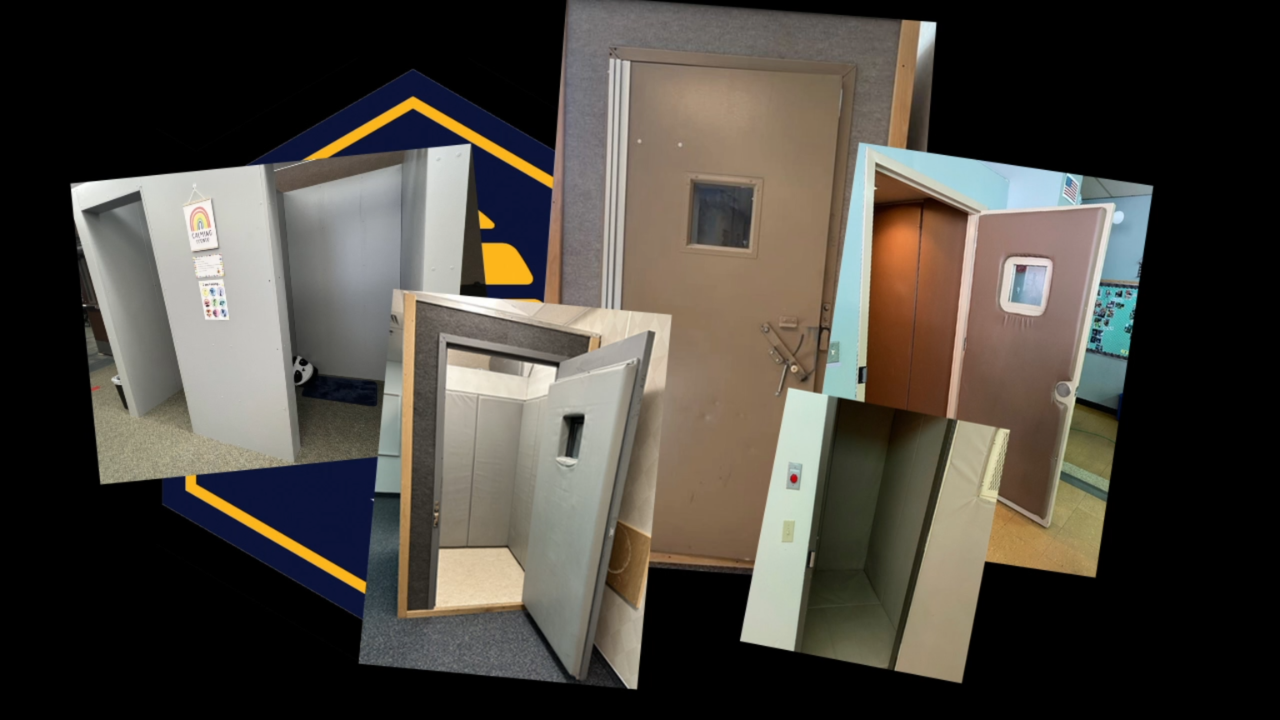

SALT LAKE CITY — After her children's elementary school started placing them in a small, padded room, Alisha Hadden became so concerned that she sent one of her kids to class with a recording device.
“Without audio or video,” Hadden said she felt there was “no way” to know if the school was “appropriately” using seclusion, an emergency behavioral intervention that is allowed only under extreme circumstances when a student poses a safety risk to themselves or others.
“The only accountability I had was because I sent my child with a recorder in their pocket,” Hadden argued before the Senate Education Committee last week.
The South Jordan mom of two children with autism spoke during public comment in support of SB181, a bill that would standardize school seclusion rooms across the state – including requiring them to be equipped with audio and video recording equipment.
“This would give parents the opportunity to make sure that this is being used appropriately and staff the accountability and protection to show that they are using this appropriately instead of traumatizing students and harming them,” Hadden said.
Seclusion is a controversial practice used to isolate students – usually with disabilities – from their peers in emergency situations. While school districts and teachers say it’s used only sparingly to ensure student safety, parents like Hadden have raised concerns in recent months about instances of misuse.
That led state Sen. Luz Escamilla to run and pass a bill banning the practice among kindergarten students last year. Utah lawmakers also set new guardrails around seclusion, including specifying that it can’t be used for “coercion, retaliation, or humiliation” or “due to inadequate staffing or for the staff member’s convenience.”
Escamilla, who’s now sponsoring SB181, said her goal this year is to create a “framework of how those rooms actually need to look.”
Her legislation would set a minimum interior area of 60 square feet for seclusion rooms and a ceiling height of no less than eight feet. It would also require proper ventilation and lighting and that any windows are shatterproof.
“The bill says, ‘Look, if you’re going to move forward as a school to build a new school and you want to go and have a seclusion room, it has to meet this criteria,’” she told FOX 13 News in an interview.
Schools with existing rooms that don’t meet the requirements could continue to operate them until July 2027 if they’ve applied for a grant to modify them, or until July 2028 if they’re actively working toward compliance. The bill would appropriate $2.5 million for schools to retrofit their rooms.
"If schools want to change and retrofit to actually meet these guidelines, there will be some funds available,” Escamilla said during debate of the proposal. “And I think that’s a fair thing.”
A spokeswoman with the Utah State Board of Education, which has not taken a position on the legislation, said she didn’t know how many schools would be affected under SB181. The Utah Education Association has also not taken a position on the bill.
Escamilla, D-Salt Lake City, said the inclusion of recording requirements in seclusion rooms was based on requests from both teachers and parents.
“We’ve heard from both sides; everyone wants video and audio,” she said in an interview. “It’s just, again, more transparent and I think it gives some peace of mind to everyone.”
'BETTER GUARDRAILS’
Utah teachers reported using seclusion 1,148 times in 2025 – a “substantial” increase, according to a school disciplinary report from the Utah State Board of Education, “over the most recent three school years.”
While seclusion is supposed to be used only in extreme circumstances, teachers said that they used it because of “disruption” about 46% of the time. The report attributed another 21% to physical assaults and 17% to “other,” unspecified reasons.
Stephanie Merrill, a South Jordan mother of twin boys with autism, argues the data gives credence to parents who are concerned that seclusion isn’t always being used for the narrow circumstances allowed under state law.
“The rules under the State Board of Education for using restraint and seclusion are pretty clear that it’s got to be an imminent danger to self or others,” Merrill argues. “Disruption really doesn’t qualify.”
Merrill, who has become a vocal opponent against seclusion, has long believed cameras would create more accountability around its use. The requirements currently outlined in Escamilla’s bill, she argues, would help ensure children are safe and aren’t put in isolation for longer than the 30 minutes allowed under state law.
But she wishes the legislation would go even further.
Merrill said she'd like cameras mandated in classrooms as well, to help capture whatever preceded the use of isolation and the process of putting a child in a seclusion room.
“A lot of these special needs students are non-verbal,” she said. “So the video and the audio is going to be their only voice.”
Read more of our coverage of school seclusion in Utah here:
- Now banned in Utah: placing kindergarteners in a secluded room
- Bill that would have banned seclusion in Utah schools now allows it again
- Utah students speak out about their experiences in seclusion
- Are too many kids put in seclusion in Utah’s schools? It’s hard to know.
- These Utah school districts and charter schools put children in seclusion
- Opponents want a timeout on forcing kids into padded rooms in Utah schools
Escamilla said that would require a camera in every room, which could be difficult to implement. She added that she believes previous legislation gives proper guidance to schools around when they can use seclusion.
“I think our last year’s bill actually has that protocol of this being your last resource and an issue of deescalation – you already tried everything and now it’s like a safety issue for the student and the rest of the students,” she said in an interview. “We already defined that last year, so we have to give them time for the implementation.”
During public comment on the bill, Granite School District Superintendent Ben Horsley said he didn’t “want to diminish the concerns that have been presented” by parents like Hadden. But he also sought to assure legislators and the public that seclusion is used minimally and appropriately.
“We have not seen use of seclusion used as a punishment,” he said, noting that the reason a student is put in seclusion is always documented. “This is only as a last-ditch effort to secure the safety of a student.”
He added that he was not aware of “any current violations of state law and state board rule in accordance with these current regulations in the previous few years.”
Horsley said the district had “minor” concerns with Escamilla’s bill. He didn’t provide specifics but said the district would work through those issues with Escamilla in the coming weeks.
Sen. Kathleen Riebe also said during debate of the bill that she's seen seclusion “used very judiciously” during her 25 years in public education.
“I am hoping that this captures any bad actors out there and puts better guardrails around it,” she said.
Escamilla told her colleagues that seclusion is a “complex issue” and that she planned to continue working through any needed changes as the legislative session wears on.
“I appreciate the parents that have come forward with their concerns because they obviously want the best for their children,” she said. “Schools the same, full commitment. We’re just getting closer to a place where there’s enough balance to keep everyone safe.”
SB181 passed through the Senate Education Committee unanimously last week and is now awaiting further consideration before the full Senate.