

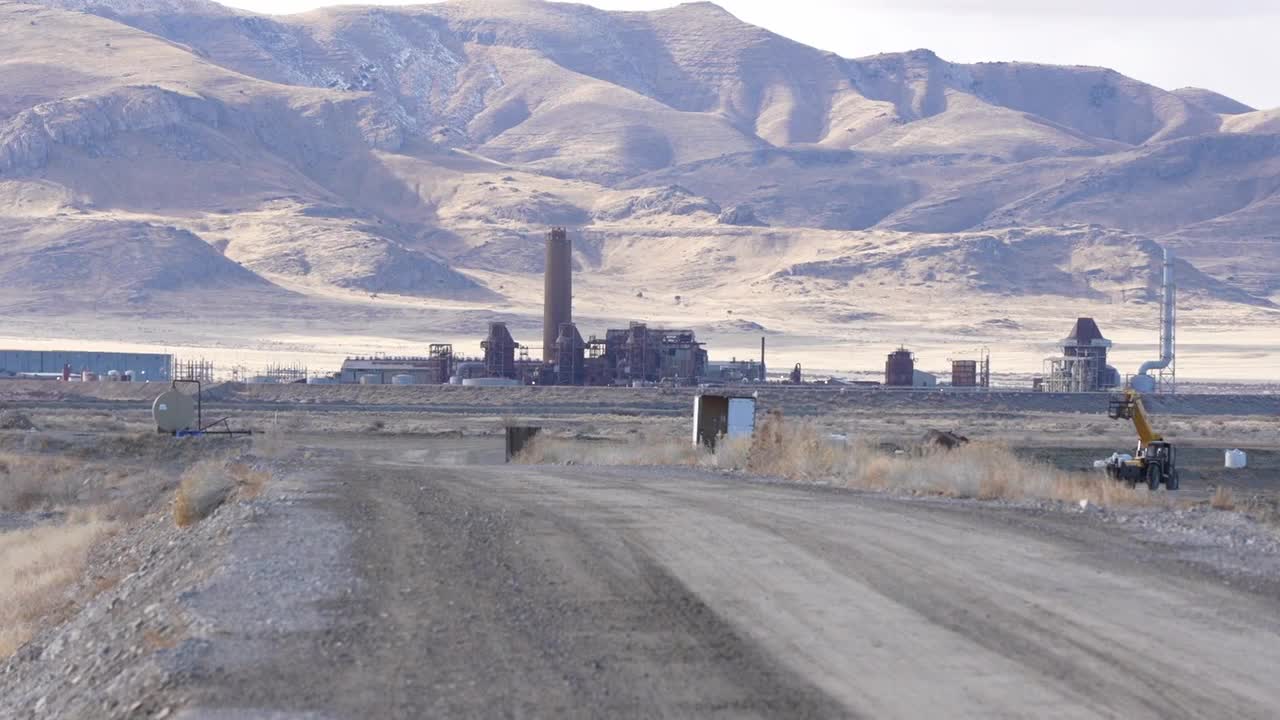


SALT LAKE CITY — The budget chief for the Utah House of Representatives had a substitute motion to make on the legislature's Natural Resources Base Budget.
"It also adds an appropriation from an existing restricted account balance to purchase water," Rep. Val Peterson, R-Orem, said succinctly.
WATCH: Utah buys US Magnesium plant, plans to give more water to Great Salt Lake
Rep. Paul Cutler, R-Centerville, popped up with a question.
"I just wanted to clarify if this allows the purchase of the water rights that’s been mentioned in the news, U.S. Magnesium, that will be a great benefit to the state of Utah?" he asked.
"What this purchase of water will do will be to add some additional water into the Great Salt Lake. This is a very strategic purchase," Rep. Peterson told him.
The House voted unanimously to approve spending $30 million for it. By Monday, the state of Utah is expected to own the bankruptcy assets of U.S. Magnesium, a mineral extraction plant on the shores of the Great Salt Lake.
"Seriously amazing," Chandler Rosenberg with the environmental group Stewardship Utah told FOX 13 News. "I was not expecting this at all. If this does happen? I think this will be one of the biggest things the state of Utah has done for air quality and the lake."
FOX 13 News was the first to report on Tuesday that the Utah Division of Forestry, Fire & State Lands had won a bid for U.S. Magnesium's assets in a federal bankruptcy court in Delaware. The company went into bankruptcy last year, idling its operations. Political leaders want the water for the lake, which continues to decline and presents an environmental crisis for northern Utah.
It's a lot of water that will remain in the Great Salt Lake — about 144,000-acre feet. That's roughly the size of Deer Creek Reservoir, which provides water to more than 1.6 million Utahns.
Rosenberg said the maneuver by the state deserves to be celebrated.
"This is not a small thing. This is a major thing," she said. "We do need to continue to focus on how we’re going to get additional water to the lake. The fact that we could see this water protected, remaining in Great Salt Lake for a long time, is fantastic."
Immediately, Utah's Department of Natural Resources and the Department of Environmental Quality must deal with cleanup. The state took U.S. Magnesium to court in 2024 over fears of a waste pond that could be leaking hazardous chemicals into the Great Salt Lake.
"This has been historically one of the largest polluting companies in the state of Utah and the West, and so there are significant environmental obligations associated with this," Joel Ferry, the executive director of the Utah Department of Natural Resources, told FOX 13 News on Wednesday. "But because it’s on state land, the state was on the hook with this already. Ultimately this is an opportunity for us to start the cleanup process."
The state could still allow mineral extraction work to take place at the U.S. Magnesium site, which could help fund cleanup efforts.
"There’s a lot of new technology associated with mineral extraction and there’s non-depletive technology where you can bring the water in, extract those minerals and then return the water," Ferry said.
On Saturday, hundreds are expected to rally at noon on Utah's Capitol Hill in support of the Great Salt Lake. In the past, the demonstration has not been afraid to call out lawmakers for not doing enough to save the lake. This year, lawmakers have been quick to show their actions.
"Really, the rally has become a pillar of this Great Salt Lake movement," said Rosenberg, who will be speaking at it. "A place where we can come together each year and celebrate what we’ve done and talk about the current context this year and show our decision-makers that yes, this is something our community continues to care about and wants to see action on."
This article is published through the Great Salt Lake Collaborative, a solutions journalism initiative that partners news, education and media organizations to help inform people about the plight of the Great Salt Lake—and what can be done to make a difference before it is too late. Read all of our stories at greatsaltlakenews.org.