

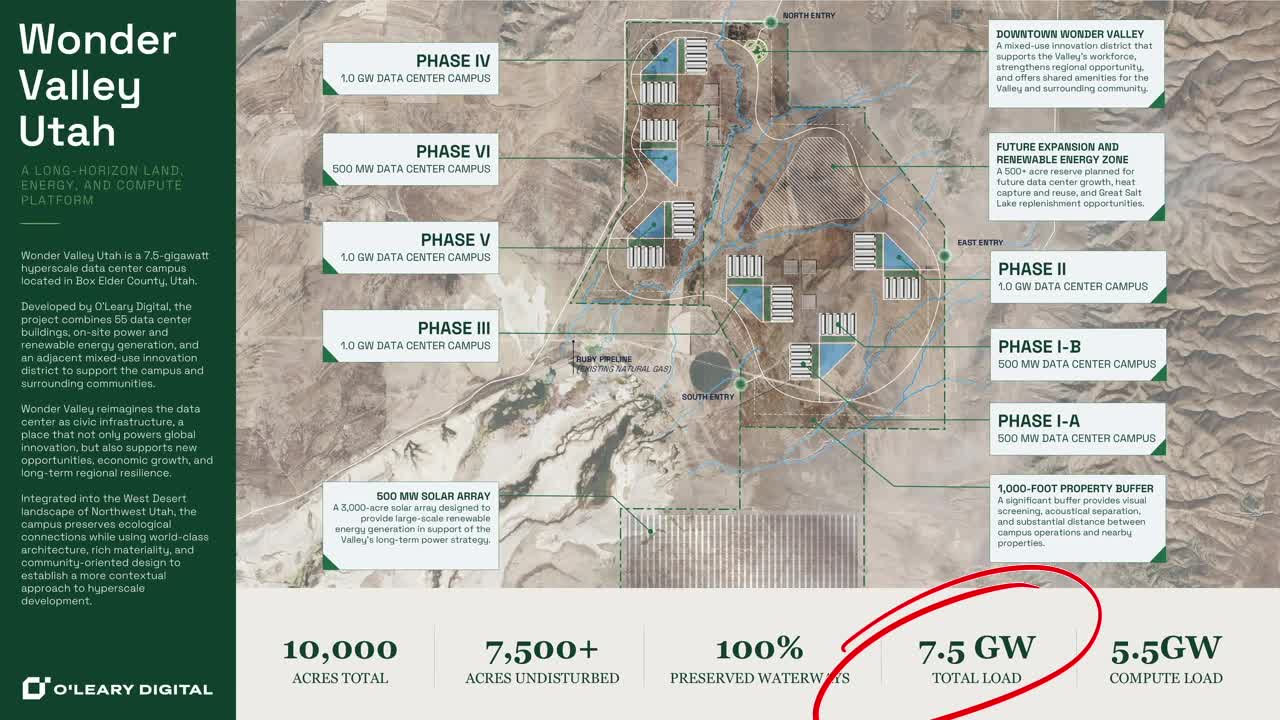


BOX ELDER COUNTY, Utah — Kevin O'Leary's company, O'Leary Digital, released a series of maps to clarify the scope of the proposed Wonder Valley project.
The public conversation between Utah's politicians and O'Leary has focused largely on one aspect of the project: acreage. The original proposal covered 40-thousand acres with two large, unconnected parcels of land and a smaller slice adjacent to I-84. O'Leary said he will limit the project to one 20,000-acre parcel, with about 10,000 acres actually built — cutting the footprint roughly in half, and half again from one perspective.
But acreage tells only part of the story. The bigger number may be the power capacity. The revised full build-out calls for 7.5 gigawatts of power capacity — a 17% reduction from the original proposal for 9 gigawatts.
O'Leary agrees to dramatically reduce Stratos Project data center footprint
The newly released drawings outline six phases of development. Phase one includes a 1-gigawatt, natural gas-burning power plant and a 500-megawatt (one-half gigawatt) data center. An area the plans refer to as "Downtown Wonder Valley" would provide staff and visitors with food, gas, and other services.
Each phase adds more data center buildings. At full build-out — projected 30 years from now — the site would include 55 data center buildings, full infrastructure across 10,000 acres, space for a solar array, open space, and 7.5 gigawatts of power capacity.
That full build-out is three decades away, and at this point, it is not known whether the project will reach phase one. If it does, the natural gas-burning plant in phase one alone would generate enough electricity to power a city about twice the size of Salt Lake City.
Estimates vary, but the most conservative I could find said a gigawatt would power 300,000 households. High estimates say one gigawatt would power more than 800,000 households. The Census Bureau said Salt Lake City has about 93,000 households, with many other businesses and organizations on the grid.