

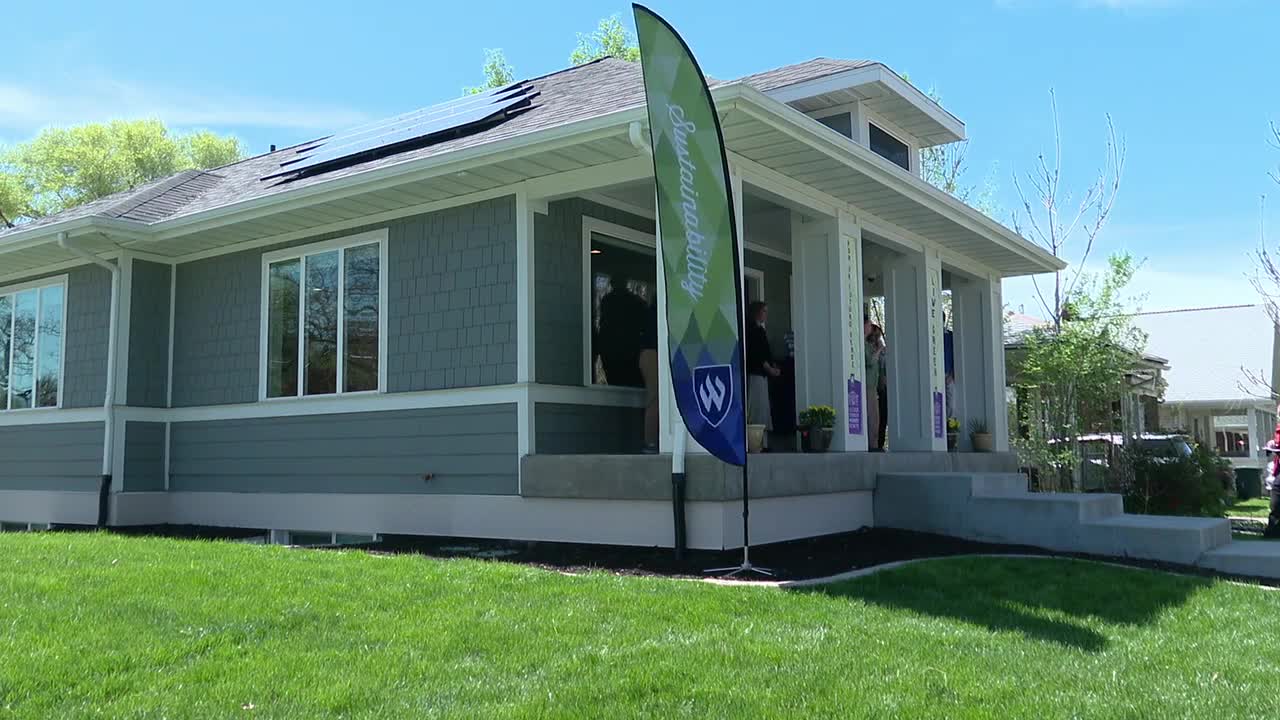


OGDEN, Utah — Students at Weber State University are taking what they learned in the classroom out into a neighborhood in Ogden. Their goal is to help families be energy-efficient and save money with lower bills.
At the corner of 28th Street and Quincy Avenue in Ogden is the Weber State Sustainability home.
"It’s a net-zero, 100 percent electric home," explained Adriana Van Vliet, a student who helped work on it. "We have 39 solar panels. Our heating and cooling is run through a heat pump system.”
The home demonstrates what living solely on solar power can look like. Students and staff will also host free workshops to give people ideas about what they can do in their homes, and provide supplies and consultations for free.
"You can still install door sweeps, you can use caulking tubes to seal the cracks by windows, and that alone is making your house a lot more airtight,” explained Van Vliet. She has lived in Ogden for most of her life and is looking forward to the opportunity to help her neighbors.
The home officially opened on Tuesday with a ribbon-cutting ceremony.
"We're really excited to finally have our doors open and start working with the community more,” Van Vliet said.
Weber State construction students built the sustainable home in 2020 for a competition. A family bought the home, has lived in it for the past five years, and has kept their energy bills low. They sold the house back to Weber State, and it is now a playground for students to show what they've learned and for neighbors to come by and take free classes to try to implement some of these ways.
"This is our ventilation system that pulls fresh air from the outside and then heats or cools that air with the energy already inside,” staff member Joshua Taylor explained while giving a tour of the home to show people how it functions.
Kaylee Anderson is a Weber State alumna and is now a homeowner in Roy. She came by to see how she can make her own home more energy efficient.
"Taking care of our planet is the biggest thing to me,” Anderson said. "You can see pictures and diagrams all day long, but as soon as you see it actually implemented somewhere and see the data and the energy savings that’s actually happening, it helps be like, 'This is actually an opportunity for me.'"
After the tour, Anderson said she already learned something to take home with her.
"They talked about just lowering the automatic water heater temperature from 140 — which is the standard — to 120,” she said. “You don’t ever really need 140 degrees, so 120 is great, and that’s a really easy way to reduce your energy consumption."
Anderson was grateful that she and others got a chance to see how it all works.