

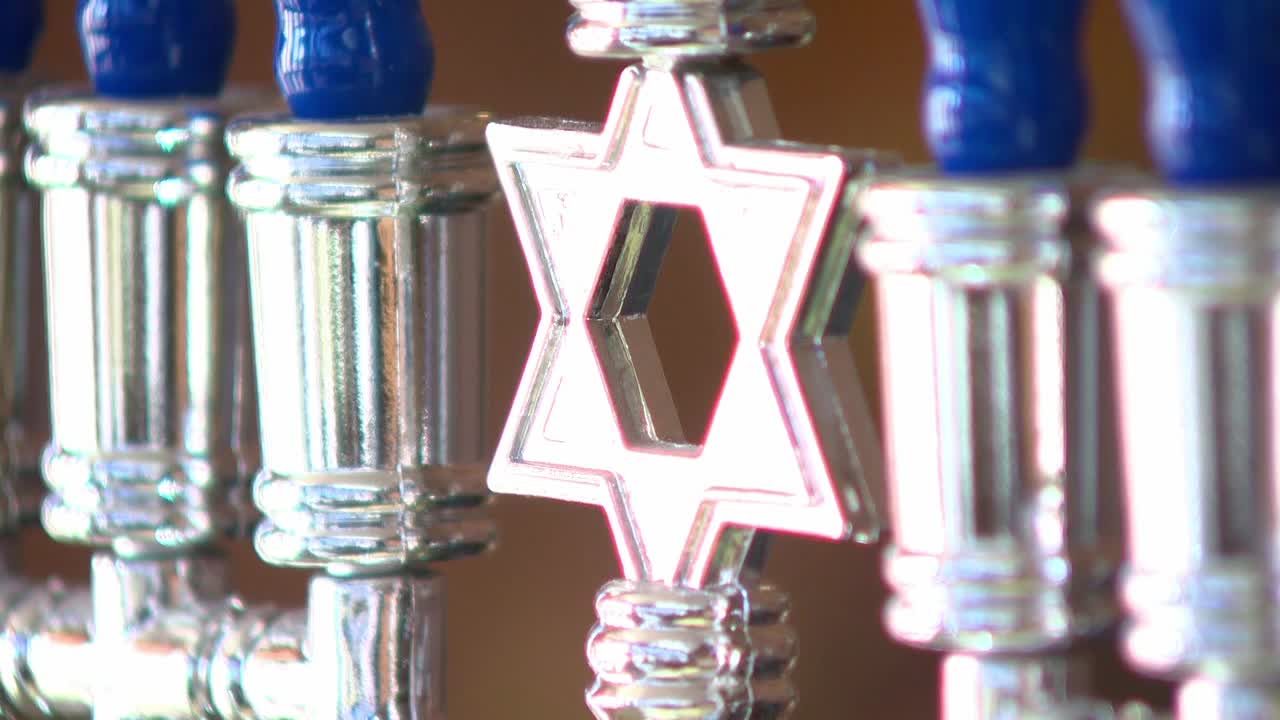


As members of the Jewish community in Utah gathered Sunday night to celebrate the first night of Hanukkah, the holiday was met with heavy hearts.
At Congregation Kol Ami on Salt Lake City’s east side, families lit candles, children laughed in a bounce house, and a holiday market filled the synagogue with energy and joy. But the celebration unfolded in the shadow of a deadly, targeted attack against Jews thousands of miles away.
Earlier in the day in Sydney, Australia, two gunmen opened fire at a Hanukkah celebration at Bondi Beach, killing and injuring multiple people. Authorities say the attack was targeted.
“For us, when one Jewish community is attacked, it really is an attack on every single one of us,” said Rabbi Sam Spector of Congregation Kol Ami. “Our hearts are going out to our brothers and sisters in Australia.”
In a press release Sunday, the United Jewish Federation of Utah condemned the shooting as a "blatant act of antisemitic terror."
"Once again, Jews were targeted simply for being Jewish and for celebrating our traditions and our right to religious freedom," said CEO Alex Shapiro. "We must not ignore efforts to normalize hatred or to cloak antisemitism in political rhetoric."
Spector says attacks like the one in Australia have become disturbingly commonplace for Jewish communities worldwide.
“Unfortunately, these types of attacks have become routine,” he said. “We’re always on edge, kind of waiting and seeing who’s going to be next.”
He noted that acts of violence against Jews often coincide with major holidays.
“So often they happen during what are supposed to be really joyful holidays. It puts a damper on the festival for the rest of the week," Spector said.
In response to ongoing threats, security was visibly increased at Sunday’s Hanukkah celebration. A Salt Lake City patrol car was parked outside the synagogue, and security personnel were on hand throughout the event.
Spector said Congregation Kol Ami invests hundreds of thousands of dollars each year in security upgrades and personnel.
“There are a lot of things we would much rather spend that money on,” he said. “But at the end of the day, the safety of our community is the most important thing we can invest in.”
Spector says what he has heard from Jewish communities in Australia is particularly troubling — a sense that an attack like this felt inevitable due to what he calls the normalization of antisemitism.
“What I’ve been hearing out of Australia is that the community was basically waiting for this to happen,” he said, citing a rise in antisemitic rhetoric and behavior in recent years.
He believes that normalization is not confined to one country or political ideology.
“What we’ve seen in the last decade, but especially the last two years, is a normalization and acceptance of antisemitism in society,” Spector said. “We’ve seen it growing on both the far right and the far left.”
His message extends beyond the Jewish community.
“It’s important for people to be mindful of how their words can be construed, even if they don’t think they’re being antisemitic,” he said. “Words matter. They affect your Jewish friends and your local Jewish community.”
Despite the pain and concern, families at Congregation Kol Ami say continuing to gather and celebrate is itself an act of resilience.
Hanukkah, they say, is meant to symbolize light overcoming darkness — a message that feels especially urgent right now.
