



SALT LAKE CITY — Utah officials are increasing monitoring along the Colorado River after an automated water sampler detected zebra mussel DNA near Potash — a warning sign that officials say they are taking seriously, but not yet considering an infestation.
The detection comes as Utah continues its aggressive effort to keep invasive mussels from spreading beyond Lake Powell.
Bruce Johnson, with the Utah Department of Natural Resources' Aquatic Invasive Species program, says the positive sample is an indicator that the state needs to take a closer look.
“This is an indicator,” Johnson said. “It means we're gonna increase our visits on the river. We're gonna add another sampler just so we can start better tracking what we're finding.”
The sample was collected near Potash, downstream from Moab and upstream from Canyonlands National Park.
Importantly, Johnson says the DNA detection does not mean adult zebra mussels have been found in the Utah portion of the Colorado River.
Utah would need to find actual adult, reproductively mature mussels before officially declaring the waterbody infested.
That distinction is important because Colorado already has an established zebra mussel problem. Johnson says the state has designated the Colorado River as infested as far south as the Utah border, with detections around Grand Junction and Loma.
Lake Powell, meanwhile, is already infested with quagga mussels.
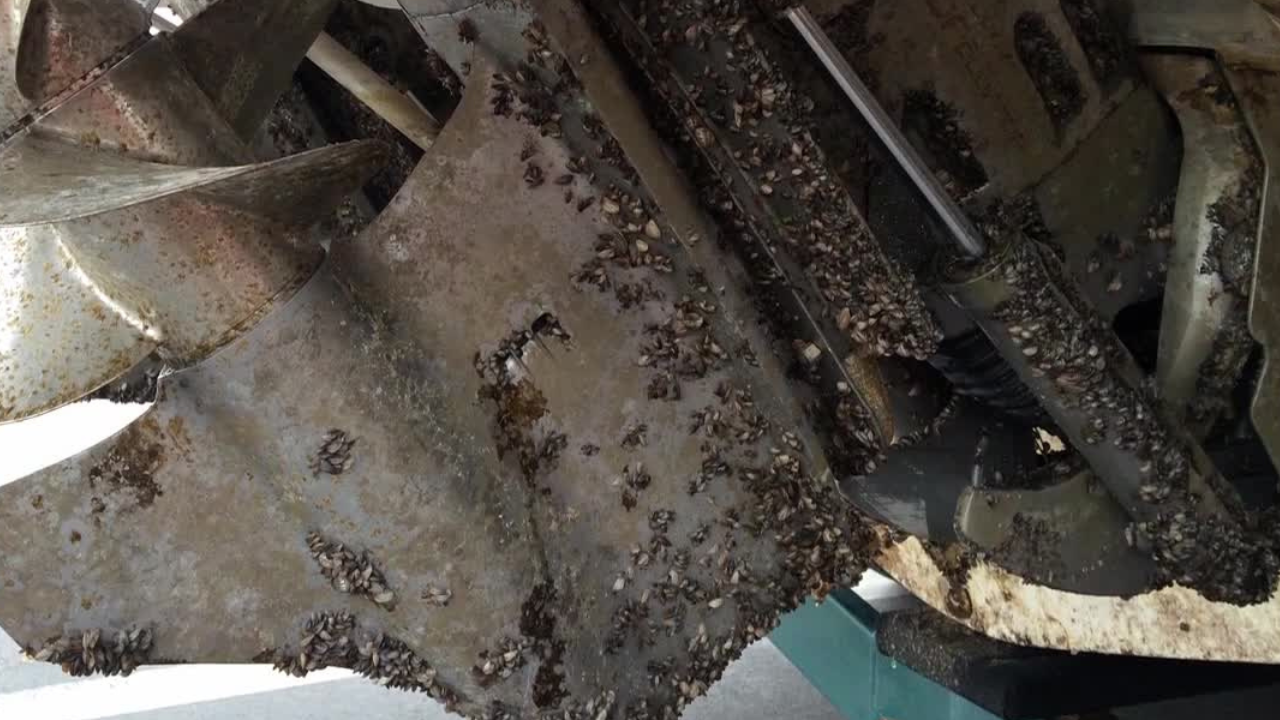
The two species are close relatives, and both can cause major problems once established in a waterbody.
Johnson says mussel larvae, known as veligers, can be transported in water left inside boats. He says there can be thousands of veligers in a single liter of water.
Even small amounts of water left inside a boat can potentially move the species into a new waterbody.
“If they've got water, we have to do some research and find out where they've been, where they were at last water body,” Johnson said.
That's why Utah continues to emphasize its “Clean, Drain, Dry” message.
Over Labor Day weekend, Utah officials and partner agencies inspected 9,418 boats statewide and performed 154 decontaminations.
Johnson says some boaters are still traveling with their drain plugs in place, despite the requirement to remove them during transport.
He also says some watercraft bypass inspection stations, which is a violation.
The concern is not just ecological. Once an invasive mussel infestation becomes established, eradication is generally not considered feasible, leaving communities to manage the long-term impacts.
Johnson recalls a study from about a decade ago that estimated infrastructure impacts from a new infestation could cost around $25 million at a single waterbody.
For now, Utah officials are continuing to monitor the Colorado River rather than declaring an infestation.
Johnson says the state plans to increase sampling and outreach, particularly with rafting companies and other visitors along the river.
“We've been able to prevent ... any additional infestations, especially in Utah, for 14 years now,” Johnson said. “And I consider that a miracle.”
For Utah, the latest DNA detection is a reminder that the invasive mussel threat is still very real — and that keeping them out of new waters depends heavily on what boaters do before moving from one waterbody to another.
Clean. Drain. Dry.
This story was reported on-air by a journalist and has been converted to this platform with the assistance of AI. Our editorial team verifies all reporting on all platforms for fairness and accuracy.
