

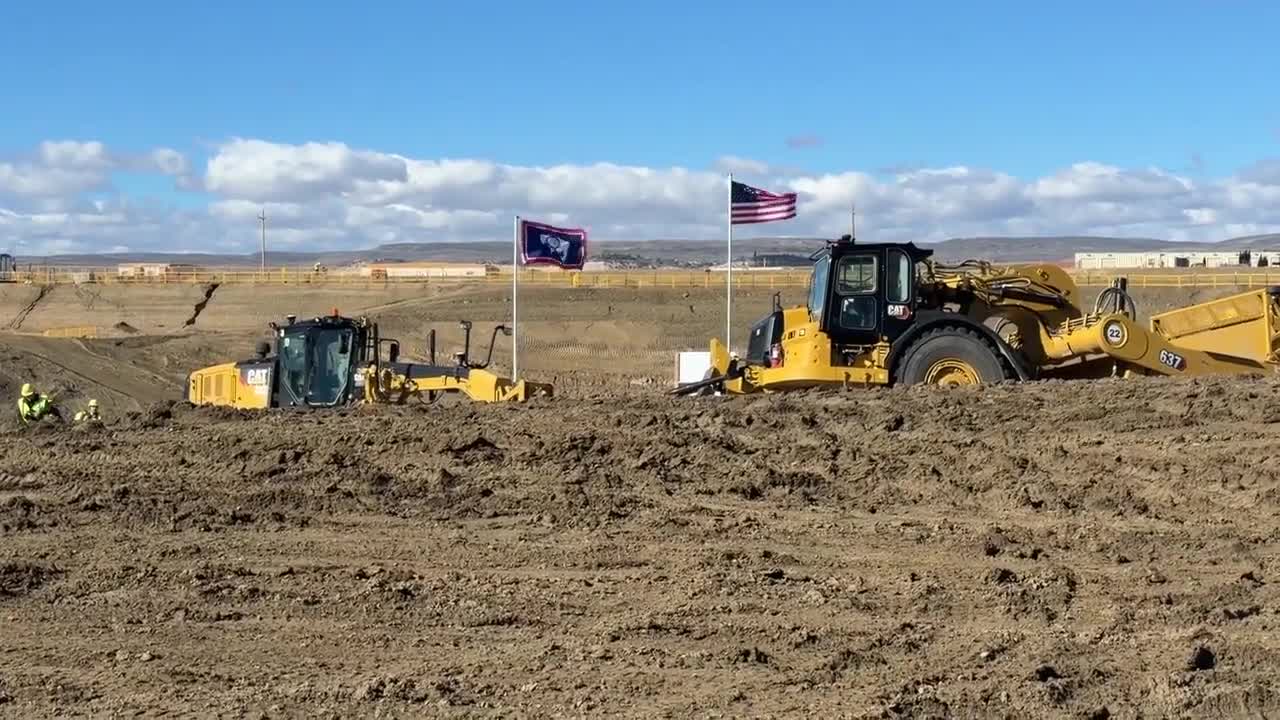


KEMMERER, Wyoming — Microsoft founder Bill Gates hosted the governors of Utah, Idaho and Wyoming at a construction site for a new nuclear power plant.
"We've got our permit, we've got our construction plans, so here we are," he said.
Gates, who also founded the company TerraPower, is behind the nuclear power project being built here in western Wyoming. TerraPower brought the governors and other political leaders to the construction site on Thursday. FOX 13 News was invited to accompany them on the tour.
"It's nice to see it going vertical," Utah Governor Spencer Cox said as he viewed a pit for a nuclear reactor. "This is what we’ve been waiting for. It’s been on paper, it’s been in computers and now it’s real."
TerraPower's Natrium plant is designed to be the next generation of nuclear power in America. It is utilizing new technologies for cooling and storage. When completed, TerraPower officials said the plant will be able to generate 500 megawatts of electricity at its peak — enough to power roughly 500,000 homes.
"The Natrium power plant will use considerably less water than, you know, a water-cooled reactor like today’s nuclear reactors," said Chris Levesque, the CEO of TerraPower, in an interview with FOX 13 News.
That's because it uses salt as part of its operations. TerraPower recently received authorization from the U.S. Department of Energy to begin construction. On Thursday, heavy equipment was at the site clearing ground. The governors are looking closely at nuclear power to meet growing energy demands with population growth and the rise of artificial intelligence.
"This facility right here is kind of the magic of individual capital and the Department of Energy working together on a really fast track to do a very, very, very, very safe facility that’s going to be scalable," Idaho Governor Brad Little said. "Safe, scalable, affordable, those are the criteria we’ve got to have. We know the first nuclear energy’s going to be expensive."
Wyoming Governor Mark Gordon said nearby community concerns have been considered throughout the process.
"The way that we started working on this was allowing communities to compete for this. They all had their concerns," he said, adding that TerraPower has "had the chance to sit down and talk about and continue to have those interfaces."
During Thursday's site visit, Utah Senator John Curtis peppered TerraPower executives with a lot of questions, primarily surrounding the disposal of nuclear waste.
"So I'm sure Congress is going to figure out storage," the senator said to laughter from some in the crowd.
He continued on. "What is your contingency plan?"
"We have proven in the U.S. that used nuclear fuel can be stored super-safely," replied Levesque.
TerraPower signaled it does not plan to reprocess spent nuclear fuel like others, believing it is not as reliable.
"We still think the best thing do do with used fuel is to dispose of it in the ground," Levesque told him.
Afterward, Sen. Curtis told FOX 13 News that he wasn't necessarily concerned, but believed it was important to get answers.
"There’s so much that I want to know and I think Utahns want to know to understand about this," he said. "Many of us come from a generation where nuclear was feared and things are just very different now. The more information, the better."
But some environmental groups are very concerned about the states' nuclear ambitions.
"Who's going to pay the cost and who's going to really bear the burden of this nuclear, of this power source?" Lexi Tuddenham, executive director of the Healthy Environment Alliance of Utah told FOX 13 News on Thursday. "We've already had communities for many, many decades who have been burdened by being the downwinder generation."
HEAL Utah is participating in a protest this weekend in southeastern Utah against uranium mining in nuclear power generation. Tuddenham said she is worried about where nuclear waste would go, pointing to Utah leaders' interest in storing some waste from around the country.
"We see a lot of over-promising and under-delivery from the industry in particular," she said, calling on more investment in renewable energy sources like wind, solar and geothermal.
Gov. Little, whose state hosts the Idaho Nuclear Laboratory, raised other factors to consider as states move into this.
"You’re going to have to have security around your fuel, both your fuel coming in and your spent fuel because we don’t want bad actors to get a hold of it," he said, adding that he is supportive of nuclear power.
If everything goes according to plan, TerraPower said electricity will begin being generated by the Natrium plant in 2031. It would be purchased by Pacificorp for its regional grid, which would include surrounding states.
Utah is a state that has aggressively courted nuclear power as part of its energy portfolio. Experiments are under way, including utilizing small modular reactors. TerraPower's Natrium plant will be a more traditional fission style.
"It's safe, it's clean, it’s going to be less expensive as we build more of these. That’s good for consumers, ratepayers and the citizens of Utah," Gov. Cox said.
Utah's governor confirmed he has sought to lure TerraPower to expand into the state.
"One of the reasons we love TerraPower so much is because they don’t use water like other nuclear facilities," he told FOX 13 News. "The new nuclear, what we’re seeing now, Gen-4 nuclear, is very different from what was being built in the '50s, '60s and '70s. So that’s good."
In a brief interview with FOX 13 News, Gates would not rule it out.
"A lot of our additional reactors will be sited in this area," he said. "So bringing all those partners together over the next year we should have some announcements about that."