

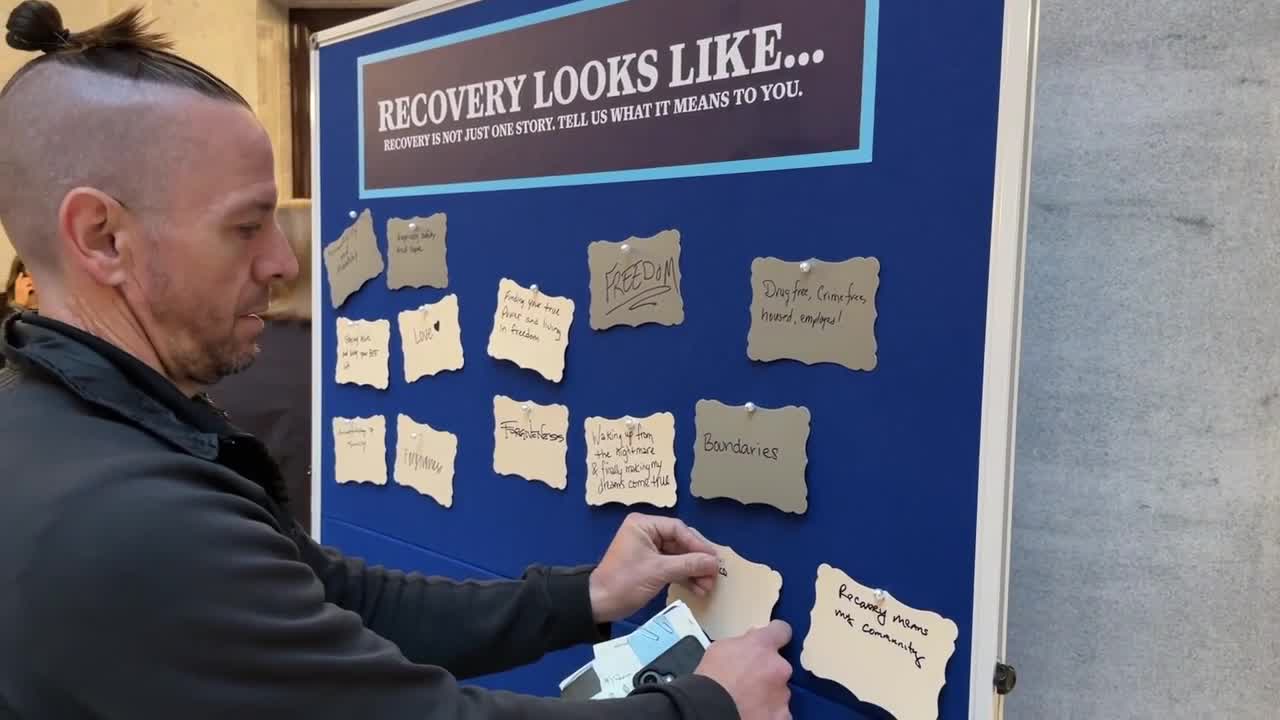


SALT LAKE CITY — Outside the doors to the Gold Room at the Utah State Capitol, people wrote their feelings on what recovery looks like and tacked it to a board.
"Drug free, crime free, housed, employed!" read one card.
"Boundaries," said another.
"Living in gratitude for what you have day by day," said another.
They were written by people who have firsthand knowledge of addiction and recovery. Inside the Gold Room, White House advisors and Governor Spencer Cox signed documents to create a new initiative in the state focused on recovery.
"The Utah Recovery Initiative will launch a whole-of-government approach to transforming how our state prevents and treats addiction," Gov. Cox said Monday.
Utah is the first state to partner on President Trump's "Great American Recovery Initiative." It is a series of executive orders designed to streamline government services for people in recovery or seeking treatment. It also creates a special council that will bring together people with lived experience of homelessness and addiction recovery, as well as state agencies, private sector organizations and faith-based groups.
"It’s about looking at what’s not working, the fractured system we have now with addiction and how we approach it," said Kathryn Burgum, a senior advisor to the president on addiction. "It’s about approaching addiction as a chronic disease like diabetes and other diseases."
Burgum herself is in recovery and has been for the past two decades. She told the crowd on Monday how she grappled with alcohol addiction before finally getting help and encouraged others in the crowd currently in recovery to keep going.
Many of those in the crowd in recovery believed the initiative can be a good thing for Utahns who need help. Destiny Garcia with Clean Slate Utah said she liked a component that includes those with lived experience.
"I struggled with homelessness, addiction and trauma in the past," she said Monday. "I now have nine years in recovery. I think if I had people with lived experience reaching out to me when I was out there on the streets? I may have gotten help sooner."
Tyler Hansen said he was a baseball player who got caught up with Oxycontin, landing him in prison. He is now a therapist and the head of Steps Recovery Center. He said he liked the approach, but believed there would be funding needs.
"The access to care part is kind of what we’re looking at," Hansen said. "Obviously, there’s a lot of treatment centers, there’s a lot of places to go but at the same time there’s a lot of gaps."
Dr. Monty Brooks, the executive director of the Great American Recovery Initiative, told reporters that "faith communities will be equipped with how to get people to existing resources."
"They will partner with us in the federal government to enhance resources," he added.
Gov. Cox said he had already had some initial discussions with faith groups, including The Church of Jesus Christ of Latter-day Saints, about how they can get involved. The state's homeless services will also be heavily involved. Recently, the state pivoted away from the controversial concept of a massive campus for unsheltered people to focusing on those who are the biggest users of health care, criminal justice and other systems.
The new initiative would not change that, said Tyler Clancy, the governor's homelessness coordinator.
"For us? We don’t take a one-size fits all approach. So some programs that do a housing-first model, that’s fantastic. We want to continue that work. But we’re expanding our tool kit rather than limiting it," he told reporters on Monday.
Read the governor's executive order here: