

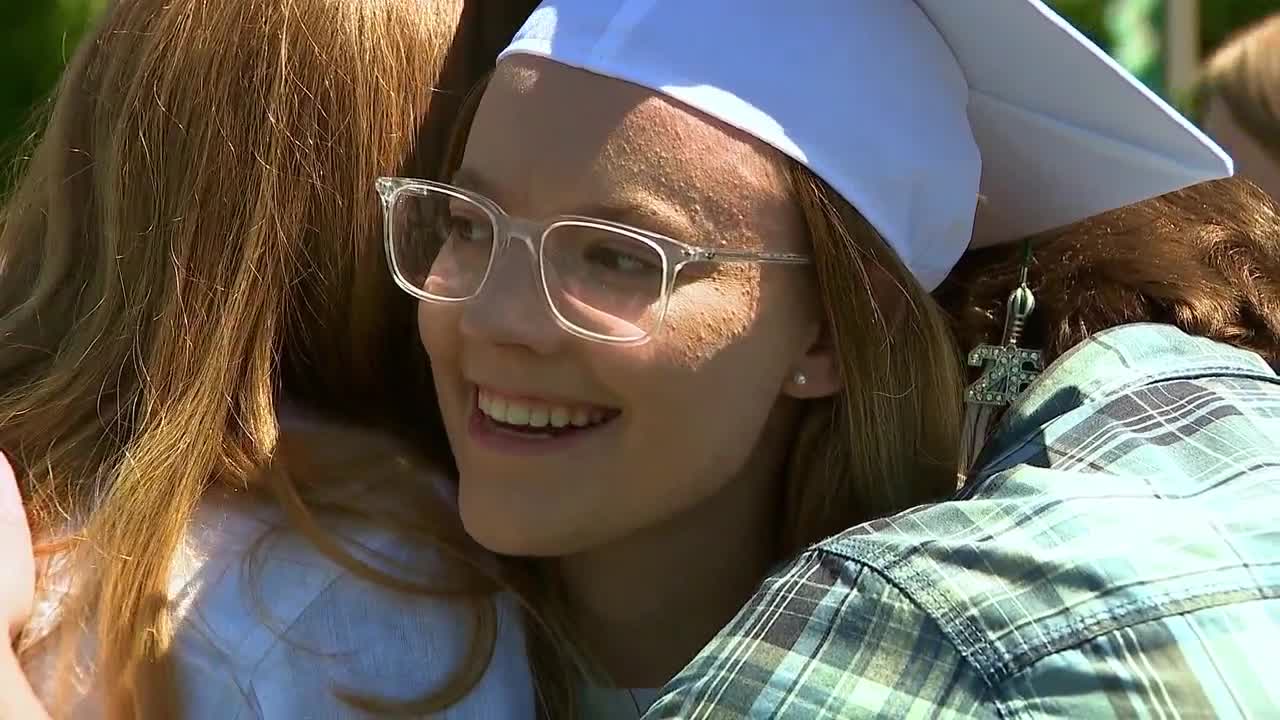


PAYSON, Utah — Gretl Talbot is 18-years-old, a teenager walking across the state at her Payson High School graduation.
Like many others in the audience, this marks her next steps with pomp and circumstance, but unlike her fellow classmates, this day may very well not have happened.
Just a few months ago, getting ready for an ice skating outing on a normal February day, she looked in the mirror and saw her worst fear staring back at her.
The right side of her face was drooping. Her hand had gone completely numb. In that terrifying moment, most teenagers might have panicked or dismissed the symptoms. But Talbot's recent training as a certified nursing assistant kicked in with life-saving clarity.
"I checked the mirror and saw that my right side of my face was drooping, and was like, 'yep, I'm having a stroke,'" Talbot said. "It was the scariest moment of my life, but I knew I had to act fast."
That split-second recognition — and the courage to trust her training over her disbelief — saved her life.
Four months later, she walked across her high school graduation stage, each step carrying the weight of a battle most of her classmates couldn't imagine.
"It is a lot more meaningful now," Talbot said, her voice catching with emotion. "I'm here, and I'm able to graduate high school. In some cases, that's not the case, but in mine, I was able to do it. I made it."
When Talbot called her sister on Feb. 21, urgency rippled through her family. Her mother rushed over as an ambulance screamed toward their home, arriving within three minutes of the call.
At Mountain View Hospital in Payson, the medical team felt the jarring reality of seeing someone so young fighting for her life.
"Anytime we hear those young numbers of anything — and especially needing to be admitted to ICU — we all pause," said Amanda McCoy, the ICU and Cath Lab manager. "Why do we have an 18-year-old having a stroke? I can think of a handful of times that they're in their 20s or younger that really stand out."
The cause was a patent foramen ovale, or PFO — a small hole in Talbot's heart that should have closed after birth but never did. It’s thought that PFOs can create a deadly pathway for a blood clot to travel directly to her brain.
It’s estimated that one in four people has a PFO that never closed, including several members of Talbot's family.
Racing against a narrow treatment window, the medical team administered TNK, a clot-busting medication, within four hours of her symptoms starting.
"Almost immediately, it starts working and just improved throughout the day," Talbot recalled.
McCoy emphasized that Talbot's quick thinking was the difference between recovery and devastating loss.
"Time is tissue. Our brain is tissue," McCoy said. "The longer we go without oxygen to vital organs and tissue, we lose that, and it's very hard to recover. Time was very important. And it was on her side, because she recognized all of the things that mattered."
For McCoy and her team, caring for someone so young brought both heartbreak and determination. They stayed by Talbot's bedside through the critical hours, watching all of the incredible signs of improvement, and working with their young patient who was defying the odds.
"Being in the ICU, we don't always get to write the endings," McCoy said. "It's not always happy endings that we see, despite all of our best efforts."
Four months after that life-altering night, Talbot returned to the hospital — not as a patient, but as a survivor ready to thank the people who helped save her life.
The reunion was emotional for everyone involved. Talbot, now healthy and strong, embraced the nurses who had cared for her during her darkest hours.
"I was really sad, honestly, to leave my nurses," Talbot said, tears in her eyes. "Getting to thank them is really, really special to me, because they're never going to know enough how much I'm thankful for them. They really saved my life."
The experience didn't just save Talbot's life — it revealed her calling. During the reunion, she shared news that brought her nurses to tears: she plans to pursue nursing at BYU-Idaho this fall.
"How could I not go into nursing when I had such great nurses?" Talbot said. "I really want to be able to do that for someone, too. It really hits me hard that I could be a great nurse for someone else on what could be the worst day of their life."
McCoy said she has no doubt that Talbot will make an extraordinary nurse.
"Gretl is an amazing girl and an amazing family that went through a really hard situation," McCoy said. "She's making lemonade out of lemons. I think she will use this experience, plus all the other goodness in her, to help treat others and change the world."
Walking across that graduation stage in her cap and gown, Talbot carried more than just academic achievement. She carried the gratitude of someone who almost didn't make it, the strength of someone who saved her own life, and the determination of someone ready to spend her career saving others.
"I'm really excited because I mean, I'm here. I made it," she said, her smile radiant with the joy of someone who knows how precious each moment truly is.
For her nurses, watching their former patient choose their profession completes a circle of care and compassion that started on the worst night of a teenager's life and transformed into inspiration for countless patients she'll one day serve.
Know the signs: "BE-FAST" could save a life
Medical professionals use the acronym BE-FAST to help people recognize stroke symptoms quickly:
B - Balance (sudden loss of coordination)
E - Eyes (sudden vision loss or changes)
F - Face (facial drooping or numbness)
A - Arms (weakness or numbness in arms)
S - Speech (slurred or strange speech)
T - Time (call 911 immediately)
Talbot's story proves that knowing these warning signs can mean the difference between life and death, especially for young people who might not expect to experience a stroke.
