

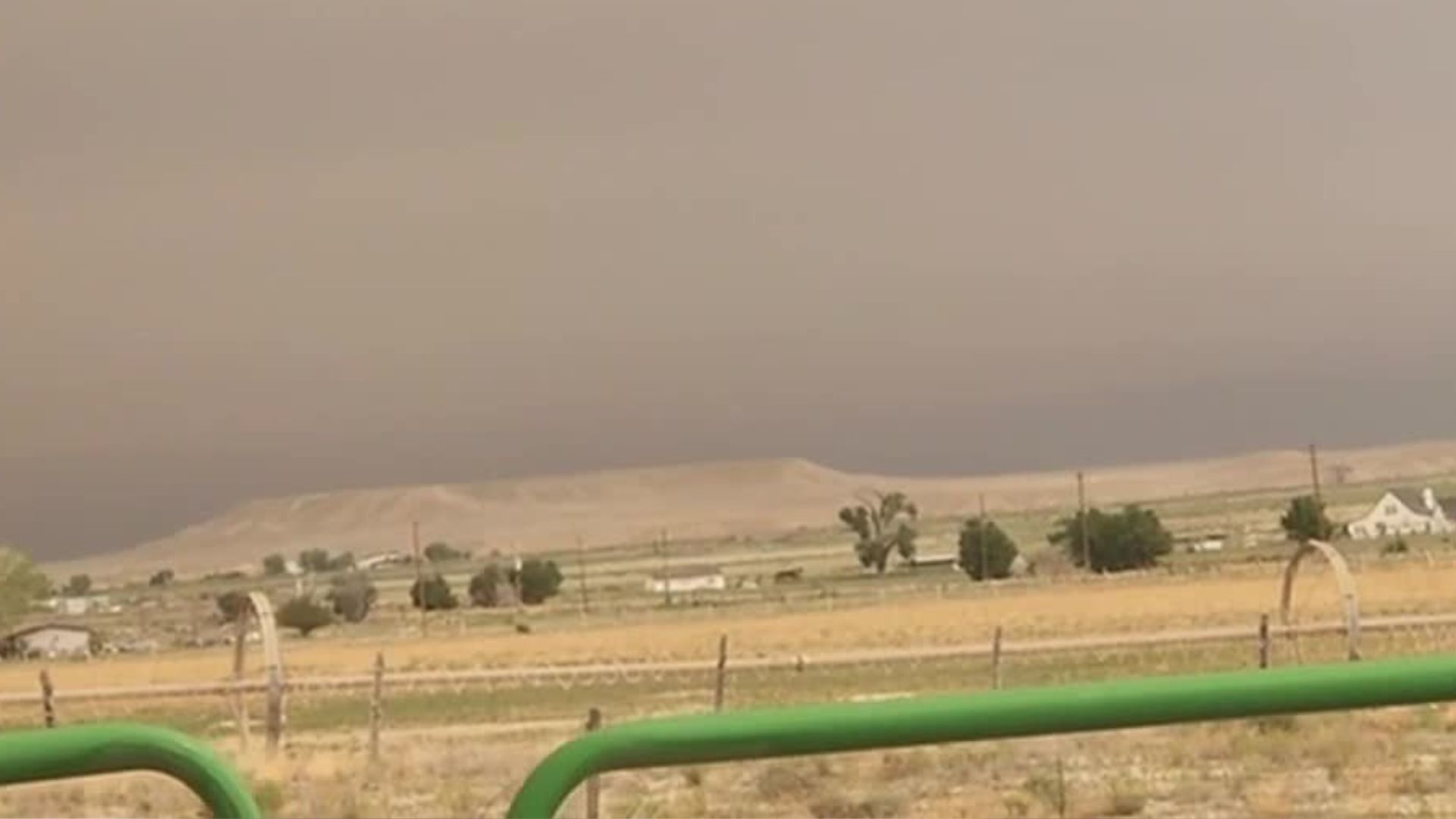


SALT LAKE CITY — Smoke from wildfires burning across Utah and the West is creating hazy skies, reducing visibility and affecting air quality from Salt Lake City to central Utah. Experts say the smoke contains fine particles that can pose serious health risks, especially for children, older adults and people with heart or lung conditions.
Smoky skies have become a familiar sight as multiple wildfires continue to burn across Utah.
In Sanpete County, Centerfield resident Jolyn Chappell described waking up to skies unlike anything she had seen before.
“We couldn’t even see the sky. It was like an umbrella of smoke from horizon to horizon, from the west to the east. The sun was literally pink and you could look right at it.”
Chappell shared video showing thick smoke blanketing the valley and dimming the sunlight throughout the day.
Video from other residents documented ash falling from the sky in nearby Gunnison, where vehicles parked outside quickly became coated in wildfire debris. One white Tesla appeared gray after ash settled across the hood.
According to Chappell, enough ash fell that her family covered their outdoor air conditioning unit to keep the ash from getting inside.
In neighboring Emery County, Sharon Kirchner recorded video showing mountain ranges almost completely obscured by smoke.
“You can’t even see the mountain range from here,” she said. “That’s how bad the smoke is.”
John Lin, a professor in the Department of Atmospheric Sciences at the University of Utah and scientific director of the Wilkes Center for Climate Science and Policy, says what people are seeing is known as PM2.5, or fine particulate matter.
Those microscopic particles are produced when vegetation burns and are released into the atmosphere, where they undergo chemical reactions before spreading through the air.
“We are seeing little particles in the air, and these are either liquid or solid," Lin said.
Lin says wildfire smoke is more than just an inconvenience.
“Wildfire smoke is harmful to us,” he said, noting the most common health impacts include respiratory illness, breathing problems and cardiovascular issues.
With Utah experiencing hot, dry conditions this summer, Lin says wildfire activity is becoming more common.
“It’s kind of the new normal, and we have to be really aware of it,” he said.
Salt Lake City’s geography also makes it especially vulnerable.
“Salt Lake is often known as the crossroads of the West. Unfortunately, we’re the crossroads of the smoky West right now.”
This weekend alone, firefighters continued battling several major wildfires across Utah, including the Johnson Canyon Fire near Tremonton, the Canyon Road Fire near Logan, the Black Canyon Fire near Ephraim and the Widemouth 2 Fire in Millard County.
Health experts recommend limiting time outdoors when smoke is heavy, especially for young children, older adults and anyone with asthma, heart disease or other respiratory conditions.
Chappell said her family canceled outdoor plans with their young granddaughter because of the poor air quality.
“We planned on going on a little pony cart ride, but we decided we’d better wait until the air clears up a little bit. It’s not good to be outside.”
As wildfire season continues, experts encourage Utahns to monitor daily air quality forecasts and reduce prolonged outdoor activity whenever smoke levels are elevated.
