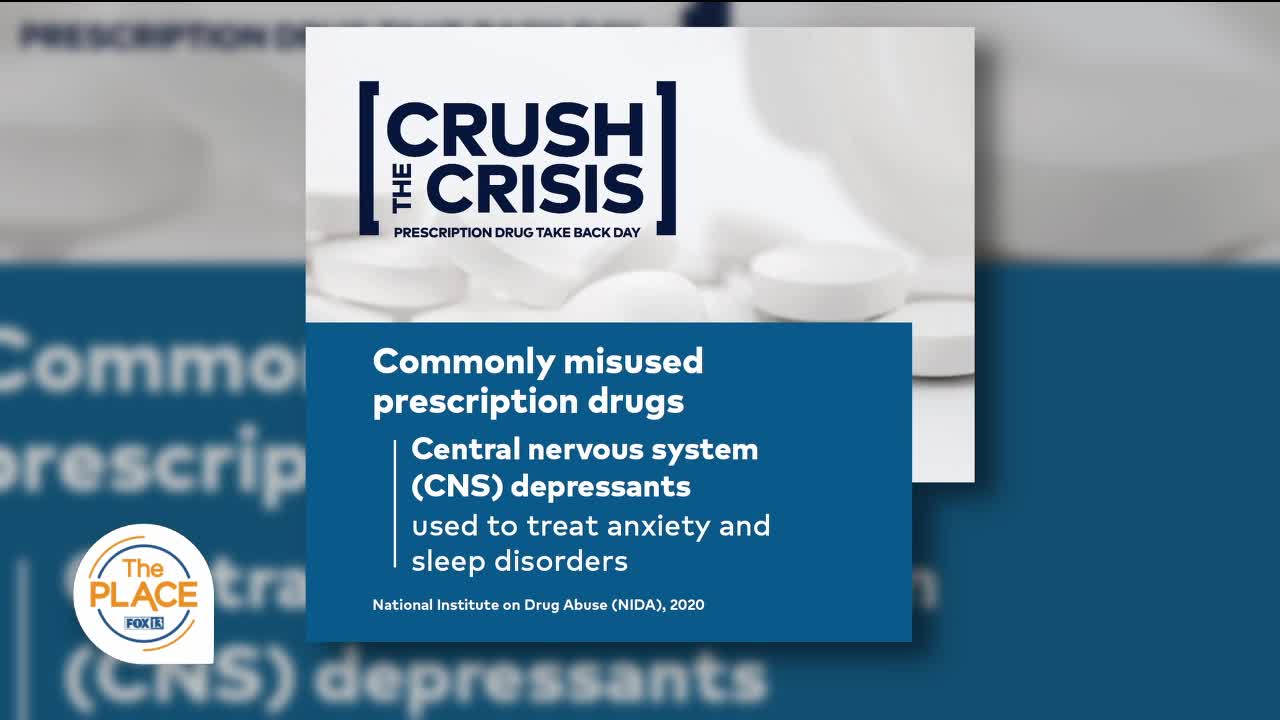

Prescription drug misuse remains a public health crisis nationwide. HCA Healthcare – known locally as MountainStar Healthcare – will partner with local law enforcement agencies on Saturday, Oct. 24 to host its eighth annual national “Crush the Crisis” prescription drug take back day event. Comprised of 190 hospitals and approximately 2,600 ambulatory sites of care, HCA Healthcare develops patient-focused solutions to constrain prescription drug misuse and addiction in the communities it serves.
The 2026 event aligns with the Drug Enforcement Administration’s (DEA) National Prescription Drug Take Back Day.
“HCA Healthcare’s ‘Crush the Crisis’ prescription drug take back day events aim to educate our communities about the risk of prescription drug misuse while providing a safe and anonymous way to dispose of medications that may be left over from previous procedures or other medical visits,” explained Jared Beckstrand, long-time pharmacist at MountainStar Healthcare’s Lakeview Hospital in Bountiful. “As part of our commitment to serving Utahns, we will continue to educate our communities about the dangers of keeping unused pain medicine in their homes and remain committed to providing a safe way for families to get rid of them.”
Beckstrand spoke LIVE Tuesday about the upcoming event on FOX13’s The PLACE. He says a significant number of prescription drug addictions and overdose deaths come from individuals who access unused prescriptions of family and friends.
“Prescription drug misuse is absolutely a public health crisis,” Beckstrand added. “The National Center for Drug Abuse Statistics reports that 13.8 million Americans over the age of 12 misuse prescription drugs in a year. What an incredibly troubling statistic!”
According to the Substance Abuse and Mental Health Services Administration (SAMHSA), an estimated 7.2 million people age 12 or older misused prescription pain relievers in 2025. The 2025 National Survey on Drug Use and Health also revealed that approximately 12.8 million Americans ages 12 and older misused prescription psychotherapeutic medications, including pain relievers, stimulants, tranquilizers and sedatives.
Friends and relatives remain a source of prescription pain relievers obtained for misuse. Those who misuse prescription medications may obtain them by receiving them for free or stealing them from someone they know, going to multiple doctors to get additional prescriptions, and/or filling prescriptions at different pharmacies so that no one will notice how many pills they obtain each month.
Thanks to the cooperation of local law enforcement agencies, five MountainStar Healthcare hospitals will provide convenient drop off options along the Wasatch Front on Saturday from 10 a.m. – 2 p.m. Hospitals that will host drop-off locations include:
Cache Valley Hospital - 2380 N 400 E, North Logan, UT 84341
Ogden Regional Medical Center - 5475 S 500 E, Ogden, UT 84405
Lakeview Hospital - 630 Medical Drive, Bountiful, UT 84010
St. Mark’s Hospital - 1200 E 3900 S, Salt Lake City, UT 84124
Mountain View Hospital will host the event in partnership with South County Cares and will be stationed at nearby Payson Market. The medication drop-off will be conveniently located near the front of the store: 586 N Main Street, Payson, UT 84651
The focus of the “Crush the Crisis” event is to collect:
· Tablets or capsules in any packaging
· Patches
· Medicated ointments, lotions or drops
· Liquid medications (in leak-proof containers)
· Vape cartridges (without batteries)
· Pet medications
Items that will not be accepted include needles, syringes, lancets or illegal drugs.
The safest and most responsible option to dispose of medication is to take unwanted medications to a drug take back site or event. Unused medications thrown in the trash can be retrieved and abused or sold illegally. Flushing medications down the toilet pose a potential health and environmental hazard.
During last year’s October 2025 event, HCA Healthcare – in partnership with local law enforcement – collected 19,846 pounds of unused or expired medications. In total, “Crush the Crisis” events have collected more than 108,500 pounds of medication since launching as an enterprise initiative in 2019. An estimated 13.6 million doses of medication were collected at 150 collection sites across the country.
Drug overdose deaths dropped in the U.S. in 2024 to the lowest levels seen in five years, according to a CDC report published in May 2025. The provisional report from the CDC and Prevention’s National Center for Health Statistics found that nationwide drug overdose deaths fell from 110,037 in 2023 to 80,391 in 2024. Despite the sharp decline – the largest one-year decline ever recorded – any one overdose death is one too many.
Three types of drugs are abused most often:
· Opioids—prescribed for pain relief
· Central Nervous System (CNS) depressants—barbiturates and benzodiazepines prescribed for anxiety or sleep problems (often referred to as sedatives or tranquilizers)
· Stimulants—prescribed for attention-deficit hyperactivity disorder (ADHD), the sleep disorder narcolepsy, or obesity.
Commonly prescribed opioids that you may have in your medicine cabinet include Oxycodone (Oxycontin), Hydrocodone (Vicodin), Codeine, Morphine, and Methadone. Synthetic opioids, including Fentanyl, are the most common drugs involved in overdose deaths in the U.S. An estimated 80% of people who use heroin first misused prescription opioids.
Opioid medications bind to the areas of the brain that control pain and emotions, driving levels of dopamine and producing an intense feeling of euphoria. As the brain becomes accustomed to the feeling, it often takes an increasing amount of the drug to produce the same levels of pain relief and well-being, which leads to dependence and, later, addiction.
Prescription drugs used for pain relief are generally safe when taken for a short time but can be misused by people taking medicine in a way or dose other than prescribed, taking someone else’s prescription medicine, and/or taking medicine for the high effect.
CNS depressants are medicines that include sedatives, tranquilizers, and hypnotics. These drugs can slow brain activity, making them useful for treating anxiety, panic, acute stress reactions, and sleep disorders. Common CNS depressants include Diazepam (Valium), Clonazepam (Klonopin), Alporazolam (Xanax) and Zolpidem (Ambien).
Prescription stimulants are medicines generally used to treat Attention-Deficit Hyperactivity Disorder (ADHD) and narcolepsy—uncontrollable episodes of deep sleep. They increase alertness, attention, and energy. Common types of prescribed stimulants include Dextroamphetamine (Dexedrine®), Dextroamphetamine/Amphetamine combination product (Adderall®), and Methylphenidate (Ritalin®, Concerta®).
Drug overdose deaths involving stimulants rose from 12,122 in 2015 to 59,725 in 2022.
MountainStar Healthcare’s parent organization, HCA Healthcare, uses data from its approximately 47 million annual patient encounters to drive evidence-based care, transform pain management and reduce prescription drug misuse, with initiatives to support patients throughout their care journey.
HCA Healthcare proudly shares clinical insights from its network with the National Academy of Medicine’s (NAM) Action Collaborative on Combatting Substance Use and Opioid Crises. The organization uses the science of “big data” to reduce prescription drug misuse and transform pain management, with initiatives in surgical, emergency and other care settings, including: · Enhanced Surgical Recovery (ESR) is an innovative surgical approach that uses evidence-based pre-, intra- and post-operative interventions to optimize patient outcomes. ESR, which features a multi-modal approach to pain management for our patients, has demonstrated significant improvements in surgical recovery and – importantly – decreased opioid usage. Multi-modal pain management focuses on using two or more different methods or medications to manage pain and reduces the need to use opioids to manage a patient’s pain while recovering from surgery. This approach results in significantly decreased opioid use and opioid prescriptions.
· Electronic Prescribing of Controlled Substances (EPCS) aims to stem increasing rates of opioid-related addiction, misuse diversion and death by making it more difficult for medication-seekers to doctor-shop and alter prescriptions. Physicians have access to aggregated electronic health record (EHR) data that will help them to prescribe opioids judiciously. ECPS allows clinicians to see patients’ medication histories at the point of care, which helps identify patients who may be exhibiting behaviors associated with drug misuse. ECPS also ensures that prescriptions are securely transmitted from clinician to pharmacy without risk of forgery or alteration.
· Prescription Drug Monitoring Program (PDMP) is an electronic database (by state) that tracks all controlled substance prescriptions. All HCA Healthcare facilities have access to the PDMP via their electronic health record. Benefits include identification of patients who obtain opioids from multiple providers, as well as identification of patients who are being prescribed other substances that may increase their risk of being opioid dependent.
Ogden Regional Medical Center offers the only inpatient residential treatment program for addiction services that is affiliated with a hospital in Utah. The residential treatment program provides a level of care for patients after they successfully completed detox and are medically stable. To learn more about the program and others, click here.
For more information about this event and to find out where you can drop off your unused or expired prescriptions, visit HCAHealthcare.com/CrushTheCrisis or call the toll-free number (833) 582-1970.
Those in need of substance use disorder or addiction treatment can call the National Substance Abuse and Mental Health Helpline at (800) 662-HELP (4357). It is a free, confidential, 24/7, 365-days-a-year treatment referral and information service (in English and Spanish) for individuals and families facing mental and/or substance use disorders. Treatment facilities confidentially and anonymously are also available through the Behavioral Health Treatment Services Locator.