



Utah soccer fans might point to two decades of Real Salt Lake or childhood memories of AYSO as evidence that the sport has deep roots in the state. But a historian's research reveals the game's history in Utah runs far deeper than most people realize — back 144 years to 1882.
Roy Webb, a historian known for his books on river running, stumbled onto Utah's soccer history while watching his daughter play. He assumed the sport's popularity in the state traced back to Pelé's arrival in the United States in the 1970s.
"I don't know why I thought that, but I was sure that was the source of it, and that's why I was so surprised to find that it was 100 years before that," Webb said.
His research revealed that Utah's first known soccer team formed in 1882 — six years before Brazilians even began playing the game.
"Soccer was in Utah before it was in Brazil. And that was because of immigrants from the LDS Church," Webb said.
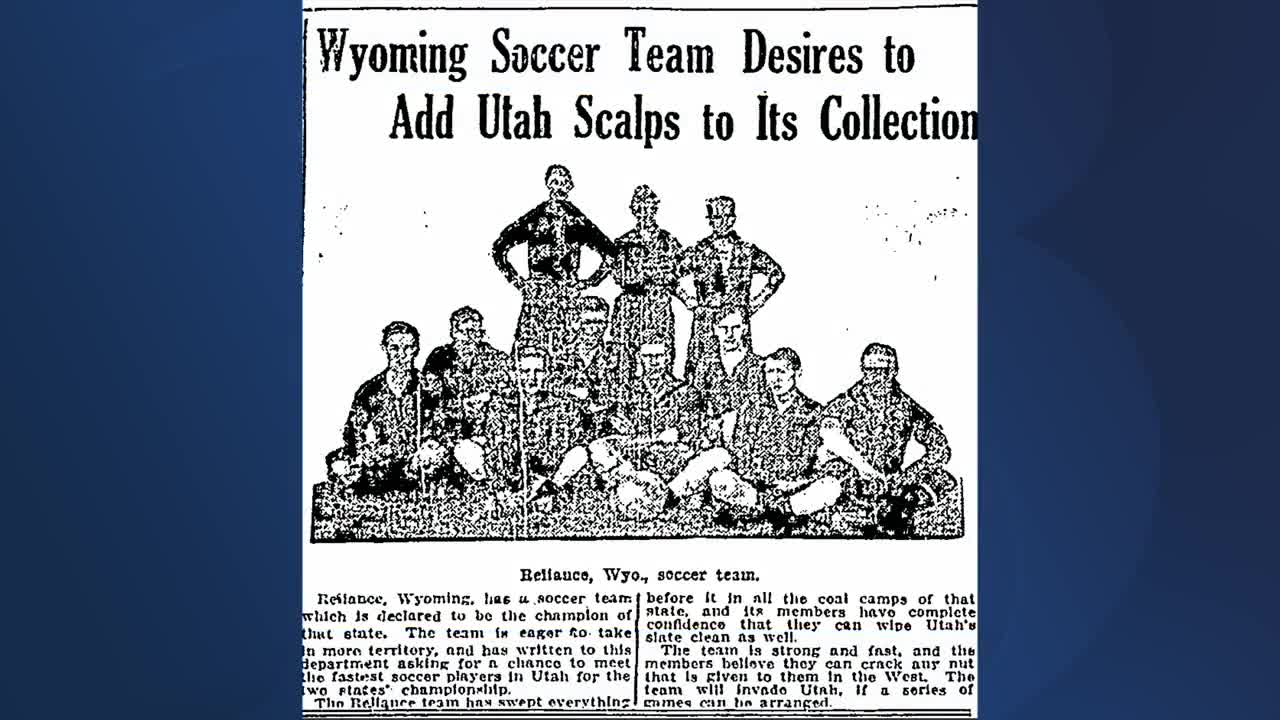
Webb wrote that from the 1890s to World War II, soccer was, "...as big a sport in urban Utah as any other and was played by people as diverse as roughneck miners in hard scramble camps and school kids in small communities such as Panguitch, Monroe, Kanab, and Vernal."
Research in newspaper archives points to a particularly competitive era in Utah soccer, sparked by a silver goblet called the Daynes Challenge Cup, named after Daynes Jewelers, a downtown Salt Lake City mainstay that minted the trophy.
"There was kind of a subtext of rivalry, I think, between the small town people, the tough miners, and the teams from Salt Lake, which were mostly composed of LDS people," Webb said. "And so there's... always that kind of tension in Utah. Once that Cup came out, it gave them something to kind of fight for. If you won the Daynes Cup, you were the best in the state."
The Daynes Cup also focused newspaper coverage at a time when writers were still debating what to call the game itself.
"That tension between soccer, S-O-C-K-E-R, the soccer boys, and association football," Webb said about all the permutations of the name in Utah newspapers of the time.
"What really struck me, too, is the amount of coverage that it got," he explained. "There were articles every day and sometimes more than one in the newspapers, and there were a lot more newspapers then, of course, The Salt Lake Herald, the Herald Telegram, the Tribune, the Deseret News."
The Intermountain Republican was among those papers, and the writing of the era was colorful, if blunt. A recap of the opening game of fall 1906 between Salt Lake and Eureka read:
"It was easily seen that neither team was in condition, and play suffered in consequence. At no stage did the play rise above the mediocre standard. Too much wild kicking being indulged in."
"It makes you wonder, especially with those miners, how much wild drinking was involved," Webb joked of the clip.
That game was played two years before Henry Ford began making the Model T. The drive from Salt Lake to Eureka covers about 85 miles and takes roughly an hour and a half today.
Getting to a match in 1906 was a far greater undertaking.
In 1908, Ogden made the finals against Salt Lake, and the two teams tied twice — meaning players and fans made the trip back and forth multiple times before Salt Lake ultimately claimed the Cup.
World Wars I and II paused the competition, but the Daynes Challenge Cup remains the top prize in the Utah Adult Soccer Association today. The original trophy was stolen while at a jeweler for engraving in the 1980s.
One thread connects Utah soccer across nearly 150 years: waves of immigrants bringing the game with them.
"Why soccer got so popular now is because of the infusion from Latin America," Webb said. "So many people came, and they brought it with them too, just like the earlier wave of immigrants had."
