



MURRAY, Utah — Children who struggle with spelling may not need more memorization — they may need a deeper understanding of how words work.
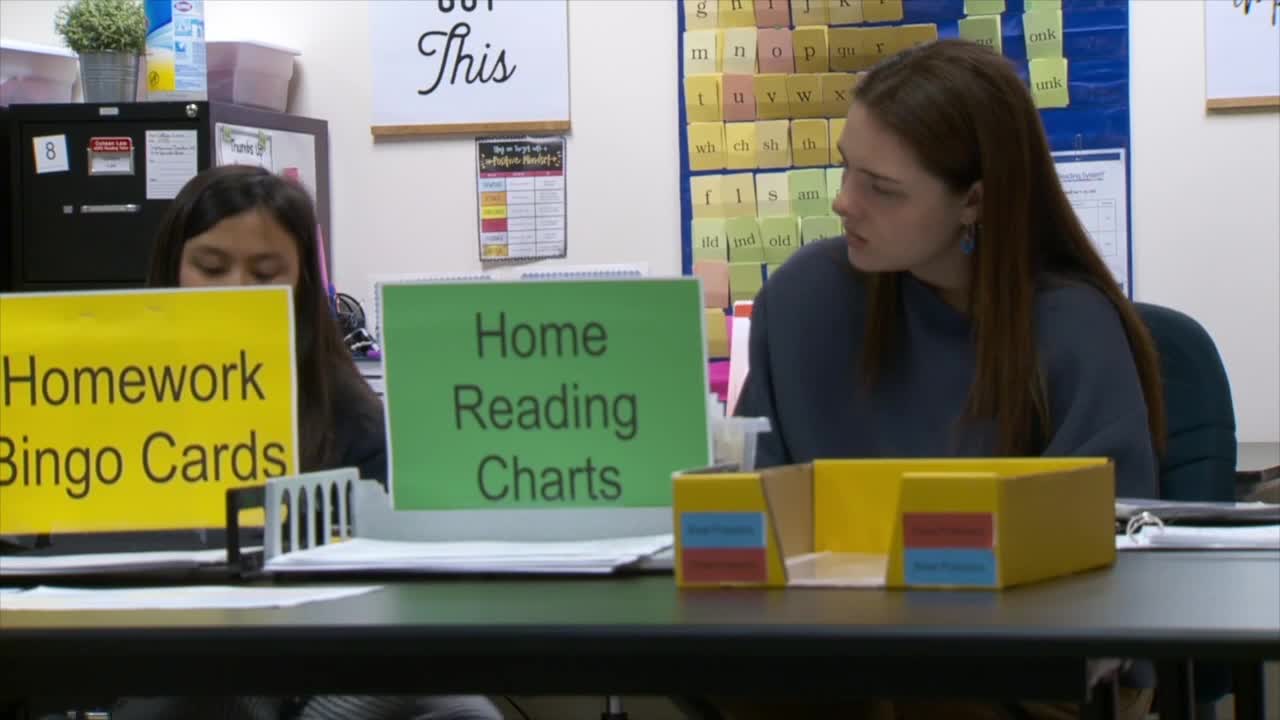
At the University of Utah Reading Clinic in Murray, Director Dr. Kelly Patrick says reading and spelling are far more intertwined than most people realize, and that treating spelling as an afterthought to reading is a missed opportunity. "They're highly correlated," Patrick said. "If you do well in reading, you tend to do well in spelling."
Patrick says the two skills actively reinforce one another, and that separating them in the classroom can send the wrong message to students.
"They're very related tasks that actually support each other," Patrick said. "We want to keep them together when we're teaching too so that students don't have a sense that they're learning two completely different tasks."
At the clinic, children work on mastering the fundamentals of print — learning that letters are not just shapes, but symbols that connect the brain to sound patterns and word meaning.
"If you back it up and look at our print system from a child's perspective, they look like curves and straight lines," Patrick said. "That's not natural. We don't, we're not born knowing what those are, so you have to learn what sounds match with what symbols, and it's not always a 1-to-1 correspondence. You know, we can talk about how people think English is crazy. It actually isn't. If you stop at letter sound correspondence, yes, we do, we don't match up that great, OK, but that's because we have another layer which isn't the meaning layer."
That meaning layer is called morphology — the study of how meaning is built into words. Patrick says strong spellers carry a "toolbox" that goes beyond phonics to include word history and structure.
Take the word "sign." Most children wonder why there is a silent "G," but a strong speller does not simply memorize it — they look for meaning. Connecting "sign" to "signal" or "signature" reveals why the "G" is there, because it becomes audible in those related words.
"If you have a network and a system to approach it and then make connections where you don't have to memorize everything, that's what makes a good speller," Patrick said.
That kind of deeper word knowledge also pays off in competitive settings like spelling bees. "In the spelling bee, it's very good to know the derivation. It gives you a sense," Patrick said. "Many words from Greek, for example, like to use that short i sound, the it, like in gym or gymnasium. They like it's representative with a y. So if you know that word came — gymnasium came from Greek, you're on a better path."
Patrick says the stakes of early literacy go well beyond spelling tests.
"How they succeed in those foundational skills can greatly impact how they view themselves in school, how they want to participate or not, um, over the course of their entire school career," Patrick said.
This story was reported on-air by a journalist and has been converted to this platform with the assistance of AI. Our editorial team verifies all reporting on all platforms for fairness and accuracy.