



SCIPIO, Utah — Every time I drive any distance beyond a daily commute I see intriguing places.
What's the reason for a freeway exit here?
A campground down THAT road?
That last one used to strike me every time I drive to Richfield or Torrey, or Boulder, or lots of places! A gravel road off highway 50 going to a small, intriguing mountain range I now know are called the Pahvants.
Maple Grove Campground.
I looked it up a couple of times and saw rock climbers really like it, so when I finally took the turn, I was looking for lanky folks with helmets and harnesses.
I found several big multi-generational family groups playing games and preparing food. One of the groups, the Wardles, took me in with enthusiasm.
Karen Wardle, the matriarch on duty in the group, talked to me next to her husband and surrounded by grandchildren who were always in motion.
"There's a lot of undiscovered places in Utah, and people need to go out and see it," she said in a pretty perfect mission statement for Max Tracks!
Maple Grove makes sense to me now. The gravel road off Highway 50 between Scipio and Salina leads to a burbling stream that emerges straight from a field of wet grasses on the mountainside.
The mountainside itself has a lot to offer. The kind of cliffs made of craggy bumps and outcrops. Future boulders getting slowly sculpted by wind and water.
The campsite is also home to a warren of forts the kids showed me, though practical adult eyes can only see dense places of cover at the base of trees!
My next stop was well known to the Wardles, especially Karen.
"Yes, my grandfather worked there at the boat dock and my grandmother worked in the little restaurant," Karen told me.
"Fish Lake is a beautiful, beautiful spot," she said.
Fish Lake is unique in this incredibly dry part of the world. A big, deep, natural mountain lake. It's been on my list...but I get stuck in my ways. I go south for the desert and north for mountain lakes.
Driving to Fish Lake takes you up a valley and over a ridge. As you crest the summit, you look into a high mountain valley. You look across an open bowl giving way to aspen and a lake that on this windy, cold day looks ominous. I imagine when the sun shines (which is most of the time) the lake glimmers from the vantage, but I'm kind of into the the ominous look!
If you are a Utahn who loves visiting Jenny Lake in the Tetons, or Fremont in the Wind Rivers, you may feel like you are seeing an old friend you had never met. It's a surprise of familiarity.
I knew there was an old lodge on the lake, which I pictured as quaint. I was wrong.
Fish Lake Lodge is in a more vaunted category with the great log structures celebrated in American and Canadian National Parks.
In my mind, the columns supporting verandas on mansions in the east should be jealous of the beams harvested from the neighboring mountains and dragged across the winter ice at the height of the Great Depression.
Verle Duerden first saw the place in 1983, covered in snow.
"We got in here, we started a fire in the fireplace. I saw this and thought, 'We can do this,'" said Verle.
He gathered investors and bought it.
"We're actually at 8,700 feet. This lake is the largest lake at this altitude in North America," Verle told me.
The lodge needs renovation, and it's not the kind of thing you accomplish with a trip to the hardware store.
Verle hopes to make it a museum. This little valley has a long history of native habitation, european exploration, pioneer settlement and an evolution to a unique outdoor destination.
Karen Wardle will be glad to know Verle has big plans to fix the place up.
"If I had all the money in the world, if I was a millionaire- Oh ... I'd restore it," she told me back at Maple Grove.
With all that history...it wasn't until the last half century that biologists gradually discovered something beyond anyone's imagination in this place.
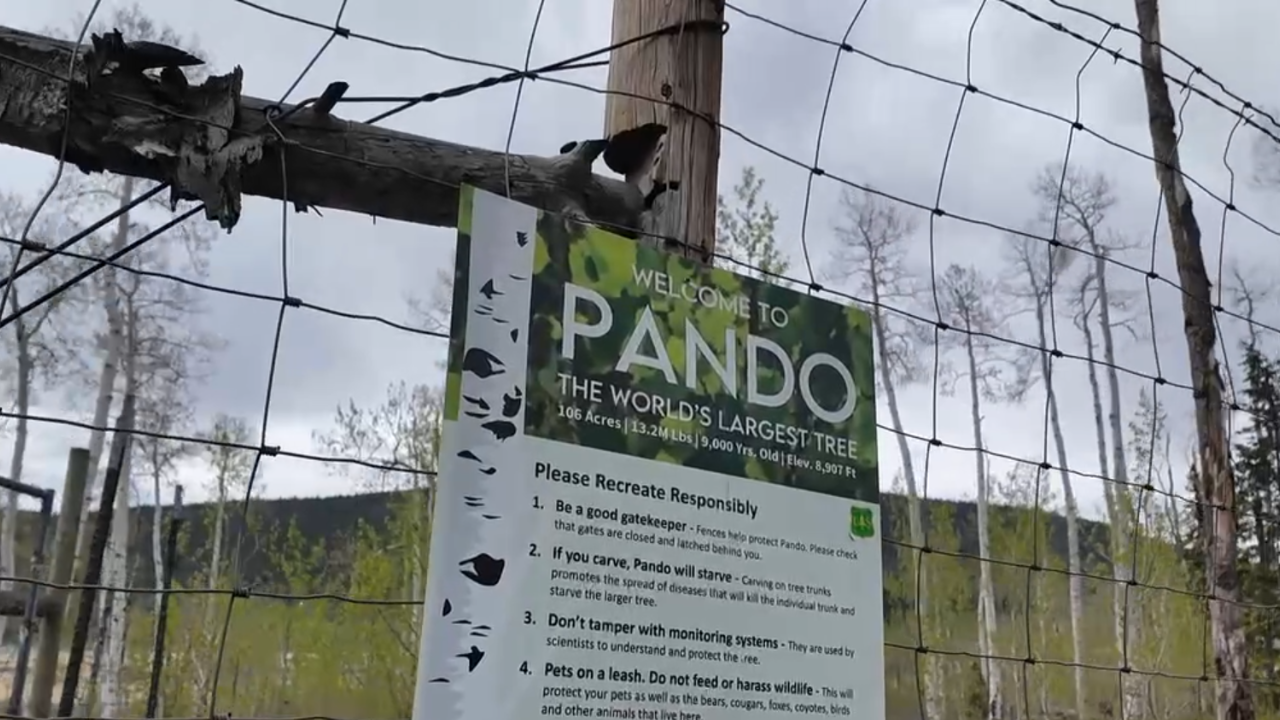
The world's largest organism lives along the southeast edge of the lake. It's named "Pando", and It's officially called an Aspen "clone." Not a name I like much because it evokes images of test tubes and mad scientists. In this case, the word clone indicates that one tree that took root thousands of years ago kept duplicating itself through it's root system. What look like individual trees are part of an interconnected whole. A grove that is a tree, multiple and singular.
The estimates I found say Pando is nine thousand years old on the low end, and maybe twice that. For half of Pando's existence, human beings had yet to invent writing.
That's humbling and hard to comprehend. The same living thing, same DNA, continuing to exist for millennia.
I walked through the grove, the only person there. I wasn't experiencing intense emotions because Pando's uniqueness is something I can only know because I trust the science. It inspires a sticky kind of awe. It's stuck with me and I get re-humbled in retrospect.