

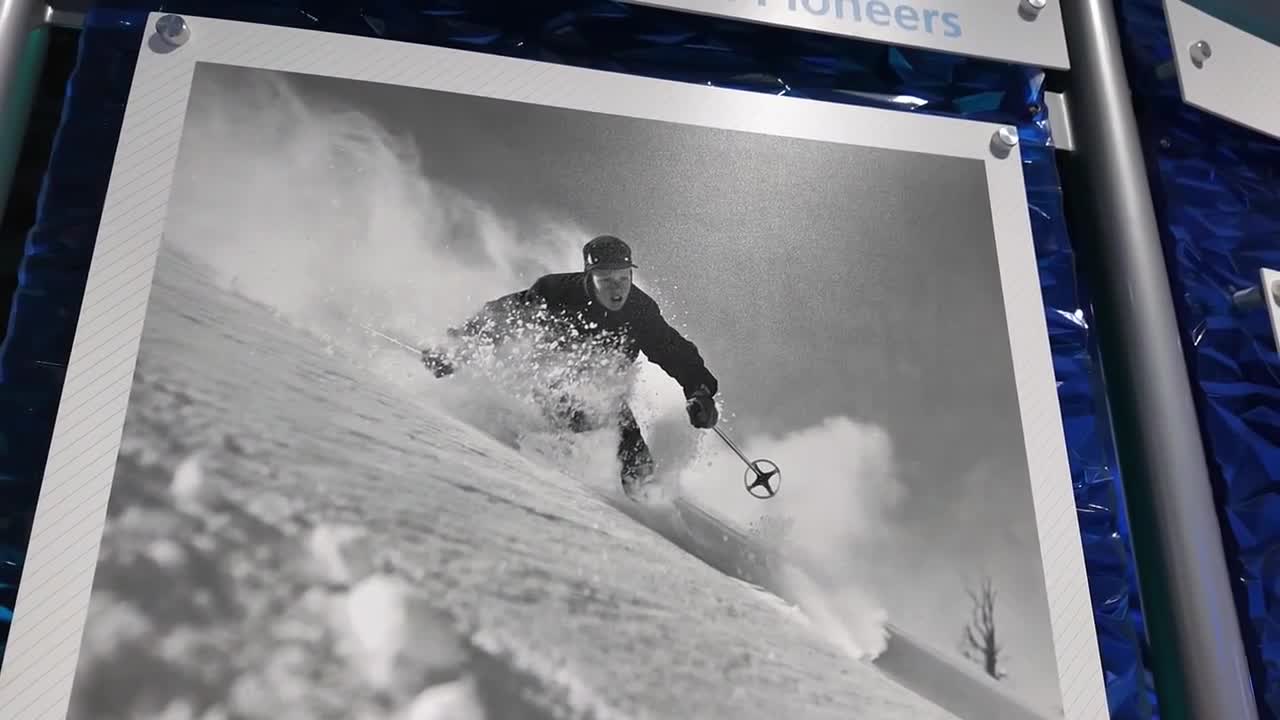


PARK CITY, Utah — It ended up being a staycation for Max Tracks after I started chasing a fun story and realized I wanted to take a weekend to see the places I was learning about.
I have heard and seen the name Alf Engen over the course of my life in Utah, but I'm not an avid skier, so I don't naturally find myself at the many places where this extraordinary Utahn is honored.
As a non-avid skier, maybe I was perfect to reveal Engen's secret second life as a... soccer player!
Let's back up a second and introduce you properly.
Alf Engen was a Norwegian immigrant to Utah, and not just any Norwegian immigrant. When visiting the Alf Engen Museum in Park City, you'll see how the Norwegian press made a big deal about saying goodbye to the ski jumper and soccer star.
Engen arrived in Utah when he was 22 years old, and already an accomplished skier on his way to becoming the best ski jumper of his time, and some would say, of all time. Engen supported himself and his family as a professional ski jumper, but he never abandoned his other sports love.
When he arrived in Utah, Engen found friends and a way to keep fit in the offseason with an amateur adult-league soccer club called the Vikings. This was in the 1930s, when Engen, his two brothers, Sverre and Corey, and the rest of the Vikings put together a three-peat for the Utah Soccer Championship.
The Vikings still play in Utah's adult soccer league, and they proudly proclaim their longevity on the right sleeve of their kits with a patch that reads: 100 years-1922-2022.
But when I spent time with the current players last month, they had no idea about Engen's role in their history.
Current Viking player Eli Booth noticed the patch on his kit marking the club's centennial when he joined the team in 2024.
"I was surprised when I saw the 100 years on the kit. I was like, 'There's no way this has been around for 100 years,'" Booth said.
Booth and his teammate, Parker Hull, had heard Engen's name, as had several members of the Vikings, but they heard it because they had skied Alta, with the Alf Engen Ski School and Engen's name associated with a popular ski run there. They had no idea they were on Engen's old team, and were thrilled to learn about it.
Engen's son, Alan, told me soccer was woven into the family's life in his earliest memories. Alf took Alan with him to games, where he would ride in the car with Alf and his brothers. It was always a party when they were together, while Alan had no idea why they were laughing.
"I couldn't understand a word, because they all spoke Norwegian. Every one of them. When they were together, they didn't speak English at all," Alan said.
That experience resonates with Parker Hull today. His father currently manages the Viking club.
"I actually grew up coming to Vikings games," Hull shared. "My dad started playing on the club when I was, like, 10 years old."
"To Dad, a good part of his life was centered around soccer,"
Alan Engen shared how a good part of his father's life was centered around soccer. In the 1930's the team strategy of the Vikings was straightforward.
"Their job was to feed the ball to Dad," Alan said.
Engen's skill on the field was so striking that it once caught the attention of Notre Dame football coach Knute Rockne, a fellow Norwegian-American.
"[Rockne] came out here to Salt Lake. He flew out here to watch Dad in a game. Dad kicked a goal from center field. He kicked it all the way and made it, and Knute Rockne was so impressed that he offered my father, after the game, a scholarship and a place on the team if he wanted to be a kicker for Notre Dame," Engen said.
I researched newspaper archives for Utah Soccer History in order to share interesting stories while FOX 13 aired the 2026 World Cup. When my research made it to the 30's, that one name, Engen, showed up everywhere.
When Alf came to Utah, soccer was a big deal locally. Every newspaper... and there were a lot... covered the big games. There were half-page stories with pictures of Engen as he prepared to face the "German All-Stars" and there were detailed accounts of games leading up to awarding the championship cups for the different seasons.
The Strand Cup was for one of those championships, and sits in the trophy case at the Alf Engen Ski Museum, alongside the dozens of skiing accolades.
"I used to watch him and my uncles play out in the backyard," said Alan. "They'd have a big ball, and they'd bounce it on their head and their feet, and they'd see how long they could keep it up in the air — they were good. They were good."
Alf played for the love of it.
"Dad did it for the love of the sport. And because it was a great way to keep himself fit," Alan shared.
For my staycation, I spent a morning on the pitch, watching the modern-day Vikings face Kita, another local powerhouse populated by Bosnian immigrants. That immigrant influence remains central to Utah's soccer community. Along with Kita players speaking Bosnian, Latinos fuel a lot of the current interest in the sport in Utah.
Soccer unifies all of the elements of various diasporas.
For Hull and Booth, the appeal of the game hasn't changed.
"When you step on the field, doesn't matter what you do for work, doesn't matter how much money you make. Just matters that you're there, you have some cleats on, and you're ready to play soccer," Hull said.
"We just get to come out, and there's people from everywhere, all over Utah, all over the world," Booth added.
At an off-the-beaten path park with a historic marker south of Interstate 15 near Jeremy Ranch sits the site of Ecker Hill, where Engen soared farther than any human in history to that point.
The sportswriters at the Salt Lake Tribune named Engen "Utah's Greatest Athlete of the 20th Century," although he never knew that, having died in 1997.
Alan said his dad never lost his love of sports, and recalled his father's reflections on aging.
"He says, 'Alan, I've gone from champ to chump,' and that was his words. I can't do the things anymore. I know how to do them. I'm still a kid in terms of knowing how to do them; I just can't do them anymore," his son said.
Now in his 80s, Alan was a standout athlete himself as an All-American skier for the University of Utah, so you can hear his empathy for how his father felt at the same age. You can also hear the admiration for a man he knew more as a legend who never acted like he was special.
"I was lucky enough not to have to look to somebody else to be my hero," he said, "and my man that I looked up to. It was my own father."
