



ESCALANTE, Utah — Between the towns of Escalante and Boulder, Utah, Highway 12 does something unusual for a state highway: it climbs to the top of a sandstone ridge so narrow that the road is essentially the ridge.
They call it the hogback. If you drift, you don't go into a ditch. You go 400 feet down — roughly the height of the LDS Church Office Building in Salt Lake City.
I love it because it's spooky but doesn't feel death-defying...my comfort zone.
Please don't let all that scare you away. The hogback is a brief but memorable stretch of a highway I recommend for your bucket list.
The rest of the highway isn't spooky, just spectacular as it winds up and down the impressionistic rock dunes that define so much of Utah's Canyon Country. It is, in my book, one of the prettiest roads in the world.
When I was a kid, my family camped at Calf Creek, which sits right along this stretch. The campground doubles as the trailhead for Lower Calf Creek Falls, one of Utah's most beloved hikes.
The quiet town dreamer
Back then, Escalante was a quiet ranch town with a sawmill for lumber harvested off nearby Boulder Mountain. They didn't particularly seem to want visitors.
Things have changed, as I learned from a man I never would have pegged as a local business mogul and philanthropist.
Brent Cottam owned the place where I stayed, Canyon Country Lodge. I only knew that because I struck up a conversation with the really nice woman who makes breakfast for guests.
She was a local and had the kind of vivacious personality I was ready to put on camera. Alas, camera shy.
But...
"You need to talk to Brent."
"Who?"
"Brent's the owner."
I don't go around seeking big-wigs on Max Tracks. Too often they share talking points instead of conversation. "He's over there..." she said, pointing to a guy ambling through the lobby in a track suit.
Brent is the kind of big-wig who keeps a small town going. Unassuming. Dedicated. You only realize you are looking at a visionary with energy to spare when you sit with him for a while.
Brent's Escalante history goes back generations, so he was ready to answer the big question.
"How do you say the name of this town?" I asked. "I say Esca-LAN-tee or Esca-LANT," he told me.
Of course, the proper way to say the last name of the Catholic Friar namesake of the town is closer to, "Esca-LAWN-tay," but the town is 150 years old and Father Escalante never came near the site of the town on his landmark trek from Santa Fe to California.
They deserve the pronunciation they've established, just like I pronounce my own name "Roth" even though they laughed at me in Germany when I was in college and said it should sound like the word WROTE. Sorry but it's ROTH who WROTE this story.
Brent Cottam's thought he was ending his part of the family's Escalante legacy when he went to college. He swore he'd never come back — then got married, had a kid, and suddenly understood why his parents stayed. "All of a sudden I was like, wow, I think that's where I want to raise my kids," he told me.
He came back and threw himself into it. He teaches and coaches at the high school. He drives a school bus. He delivers gasoline around the county in his truck. He owns the convenience store and the Lodge, where we sat and talked — and where he mortgaged just about everything he owned to make the lodge happen.
"I finally just mortgaged my wife's house and my little business and the farms and the water," he said. "I've mortgaged it all."
The risk was real. His wife was, in his words, maybe a little hesitant.
What worries him most isn't the mortgage — it's the school. He says enrollment has dropped from about 150 students in grades 7-12 to about 100. Without young families, he says, the town hollows out in ways you can't mortgage your way back from.
Because of all that, he does another thing in his non-existent spare time. He organizes the Escalante Canyons Marathon. He's shot the starting gun each October for 13 years now.
The proceeds are for local schools...and 26.2 miles is pretty much the length of Highway 12 from Boulder to Escalante.
He's done all the marathon things to make it official. A good time qualifies you for the Boston Marathon. Of course, getting a good time on the up-and-down course is tough. There has to be a trade off for running one of America's most spectacular byways.
The joy of false starts
Hell's Backbone Road branches off Highway 12 and leads, eventually, to a wooden bridge: 100 feet long, 14 feet across, with a 1,500-foot drop to the canyon floor below.
I'd never seen it. This was going to be the day.
The road turns to dirt a few miles in. The dirt turned to snow.
I drove well beyond the point where my inner voice asked, "Am I being an idiot?"
I wanted to make the loop, which goes back to Escalante, but my father's voice was also playing in my head from the last Max Tracks when he saw I jumped in a warm lake on a cold winter day and said, "That was dumb."
Of course, he's the one who demonstrated to me one of the great joys in life is to get out of the truck and jump in a cold lake.
Still, there's a version of discretion I'm slowly developing, somewhere between common sense and stubbornness. I turned around.
Same story on the Hole-in-the-Rock Road near Escalante. I've been on it a few times to get to some spectacular canyon backpacking trails, but I'd never been to the historic "Hole-in-the-Rock" where determined pioneers with covered wagons decided to punch a hole down a cliff rather than doubling back.
Have you guessed already?
This time I drove too far through melted snow, AKA mud, until it got so boggy my version of discretion kicked in.
That wrong turn was a blessing. It led me to turn on a side road to somewhere I'd never heard of.
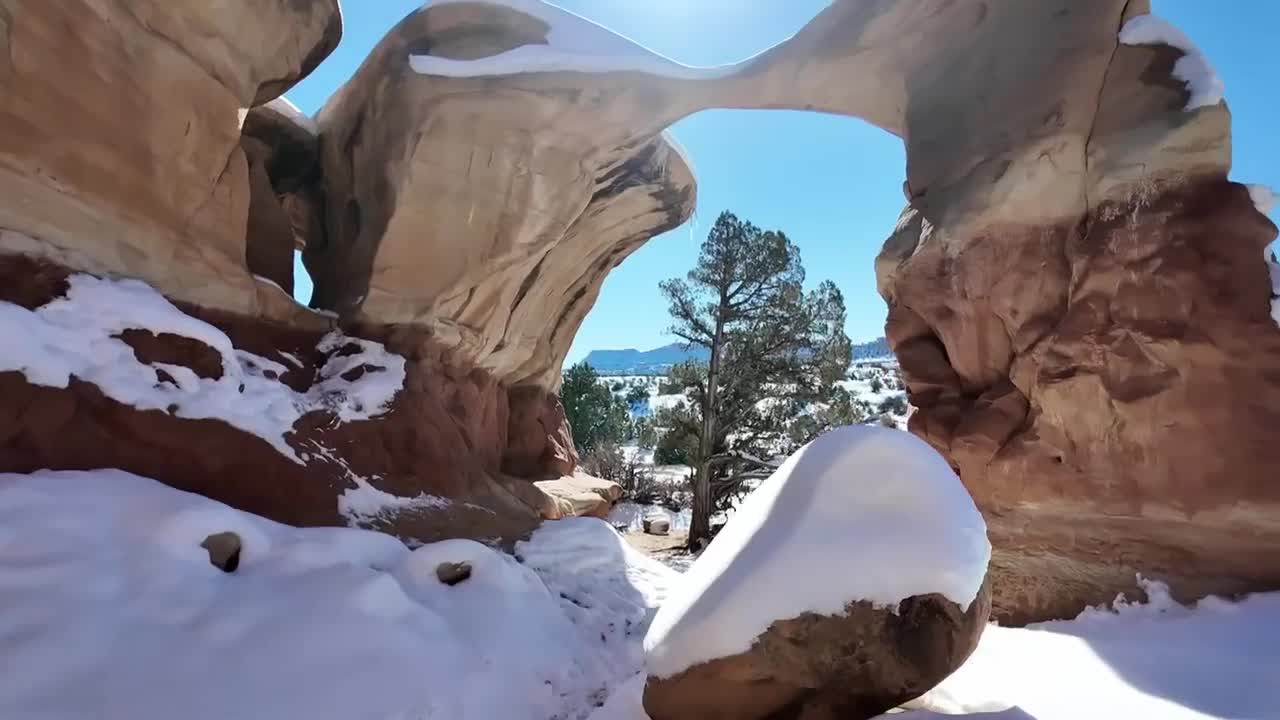
Devil's Garden is a wind-and-water-sculpted playground of red sandstone, hoodoos, and natural arches hidden in what looks like miles of open desert between the main road and the immense ridge of stratified rock aptly called the "Grand Staircase."
I oohed and ahed through the 'garden' of rocks (locals call it "Devil's Rock Garden").
Then I made lunch in the parking area. I stoked my pizza oven with wood. I had packed two cheap frozen pizzas, forgetting I would not have a way to keep them frozen.
My solution, cook both and have a LOT left over.
Two Maxes and a slice of pizza
At Devil's Garden, a group of hikers arrived at the trailhead just as I was figuring out my pizza situation. I did what any reasonable person would do: I shouted across the parking lot offering them slices.
One of them — Matt — was a recently retired Salt Lake City firefighter who'd moved to Boulder. He was spending a Saturday with his dad, his daughter, his stepdaughter, and his daughter's boyfriend.
Whose name was also Max. "Oh," the stepdaughter said. "Another Max."
That's what Max Tracks does for me. Forces Max the loner to be Max the trailhead greeter. If I wasn't working, I would have done everything the same, except the conversations. These moments reaching out take me from longed-for solitude to unexpected contentment.
Matt was clearly relieved in this new chapter of life, away from his years racing to emergencies at all hours, which is something I understand in my bones, even though I'm not in a life-saving profession.
But I took the chance to tell him that Salt Lake City firefighters saved my mother's life on a January day 16 years ago. I'm sure there are plenty of people who have the same gratitude for lives he saved.
Utah's landscapes create unpredictable interactions. A generational rancher meets the firefighter or nurse or lawyer who wants to go somewhere to just breathe.
At the beginning of another storied Utah backway, the Burr Trail from Boulder to Hanksville, I saw the visual representation of one of the unique cultural collisions that defines life in southeastern Utah.
Filming the road-sign...my camera caught a guy who looked like a cowboy in work clothes standing in the back of a pickup truck--a scene that would have been familiar to Brent Cottam's grandfather.
When the truck pulled off, someone else was approaching in the distance. It was a bicyclist riding at a good, steady clip in full aerodynamic kit.