



HELPER, Utah — There's a rock that looks like it's about to tip and crush whatever happens to be below it at the moment. But it's been there longer than anyone can remember, a sentinel marking the beginning (or end, I suppose) of the Book Cliffs, which happens to be the world's longest continuous escarpment.
The rock is called Balance Rock...and its seemingly unlikely endurance serves as a perfect symbol for the town under its shadow.
Helper, Utah, once rivaled Price as the hub of Carbon County. That was back when immigrant coal miners populated the saloons and boarding houses, and the rail yard rumbled with trains weighed down by the ore they mined.
The yards lost some steam. Carbon County has no more working coal mines, though miners still dig coal out of mountains in Emery County to the South.
Helper felt the blows, was even knocked down, but it got up and found new energy from people who saw the shine under a layer of coal dust.
I drove into town with Chaco, my black lab, by my side and with no plan except to look around and start asking questions.
The proprietor of the local grocery store, the Pick and Rail, gave me great information as I paid for new poop bags and a squeaky duck toy. He did not want to be part of the story, but explained his generational roots dating back to Italian immigrants around the turn of the 19th to 20th century.
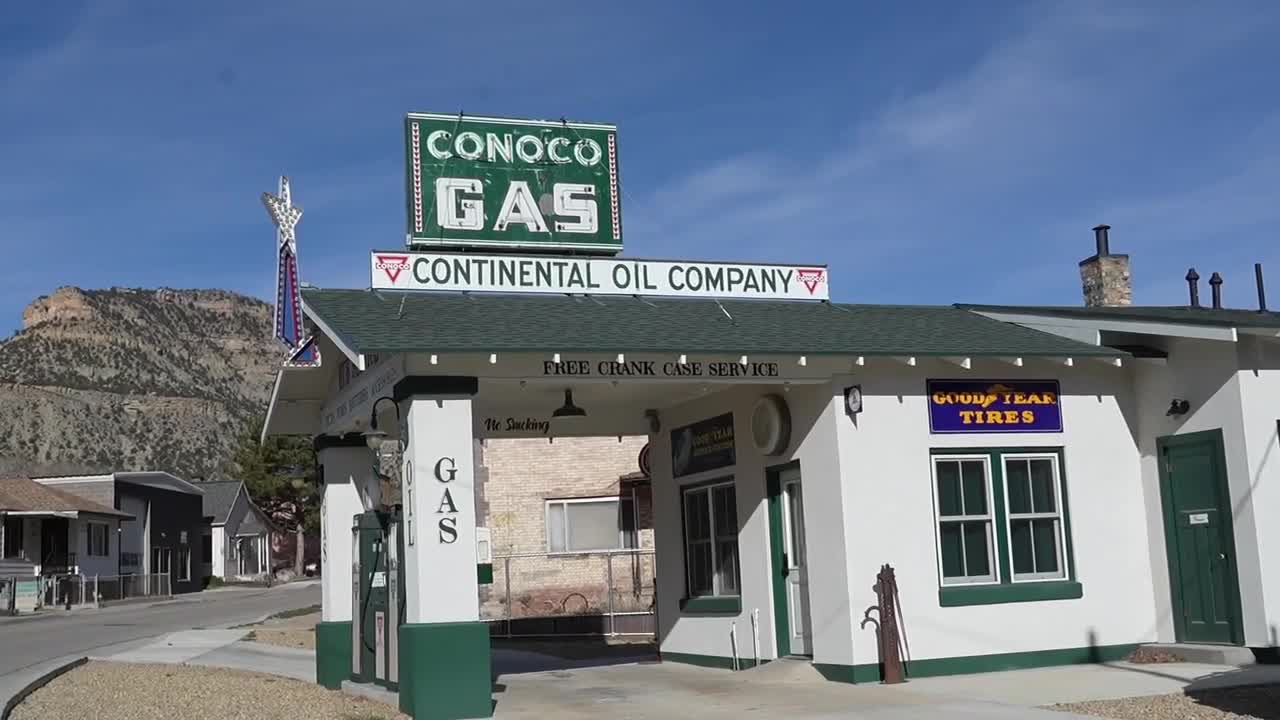
I asked him about the collection of retro gas stations sprinkled around the town, each sporting genuine vintage signage, old pumps, and even cars appropriate to the eras they harkened to. "Oh, that's Gary DeVincent," he said, and told me where I might find the person who sounded like a one-man revitalization commission.
Turns out he was just that, except maybe for the "one-man" part. I walked into Vintage Motor Company on Main Street to see a museum-level collection of classic motorcycles, mostly Harleys with some Indians and Triumphs mixed in. I didn't see anyone else, but I heard activity in the adjacent workshop.
It wasn't Gary DeVincent, who was away on a rare vacation. It was Gary's brother, Bobby DeVincent, who turned out to be a fantastic tour guide with encyclopedic knowledge of every item in the shop and of Gary's extensive renovations of buildings on Main Street and beyond.
Our tour began with Bobby DeVincent showing me a 1947 motorcycle that looked like it just arrived from the factory. It was a Harley-Davidson Knucklehead — prompting the obvious question: "Why's it called that?"
"These parts on the engine look like human knuckles," he told me, demonstrating with his own knuckles.
Bobby works for his brother, Gary, at the Vintage Motor Company, in a restored 1906 building on Main Street. Their shared love of old Harleys comes from their father, who was stationed in Hawaii as an MP during the attack on Pearl Harbor. He survived in the saddle of his army-issue Harley. After spending the rest of the war in a tank, he came home determined to have a Harley for the rest of his life.
Gary and Bobby grew up chasing old bikes. They used to restore them in American Fork, until the city widened their road, prompting them to find a new home. That brought them to Helper — and their arrival added a new dimension to a revitalization they already saw underway.
Gary bought crumbling storefronts on Main Street. He restored vintage gas stations and decorated them with his vast collection of mid-century Americana collectibles. He leases them out, building landmarks as a business model.
In one instance, a Vietnam veteran heard what was happening at one of the old Conoco stations and told them the car that had been sitting in the bay when the station closed was still his. If Gary was going to restore the station, the car should go back inside. Gary bought the car, and it sits in its old bay, as the brothers work to restore it.
Bobby, on his generous tour of their properties, showed me the back of their headquarters in an old silent-film theater. He pointed out the sobering Depression-era rules still posted where they found them. Travelers were welcome to stay, have a couple of meals, rest for 10 hours, if they would then get back on the train and leave.
The DeVincents came to a town already undergoing a renaissance, well-represented by a young couple who moved to town as newlyweds in 2003.
Ben and Melanie Steele were thinking about moving to New York City for Ben to pursue his career as an artist.
But Ben's mentor from the University of Utah, artist David Dornan, gave him advice that inspired a new direction. "He goes, you move to New York, you're in this big art world — but pretty soon you're working three jobs to pay for your apartment and you're not creating art anymore," Ben Steele recalled.
If you're searching for the catalysts of Helper's renewal, Dornan would be high on the list, along with open-minded elected leaders and the inherent charm of Main Street.
Ben and Melanie chose Helper.
Now Ben's work hangs in major galleries around the country. Their store on Main Street is part gallery, part gift shop, and entirely their own personality. Ben's work spans media, and one of his signature series is a growing collection of thematic crayon boxes. Their labels and colors convey social messages and celebrations of the environment and cultures.
One proudly displayed in prints, on t-shirts, and murals, is a crayon box depicted as a giant monument on Main Street with vivid realism. It's called "Made in Helper," and it comes with 27 colors — one for each language reportedly spoken here when immigrants came seeking work.
Melanie Steele told me why she thinks this rough-and-tumble old industrial town has become a haven for artists. "If you are up for being with the misfit part of town," she said, "It's always been this immigrant, transitional community. It's just how it was set up originally, and that spirit's never changed."
In case you're wondering about the name: Helper is where railroad crews would attach a second, "helper" engine to coal trains before the steep climb up Price Canyon. The town existed and exists to give things a push when they need it.