



SALT LAKE CITY — According to the digital watchdog Pixalate, which is behind the new database called “Know Your Developer, 73% of parents are concerned about their child’s location being tracked.
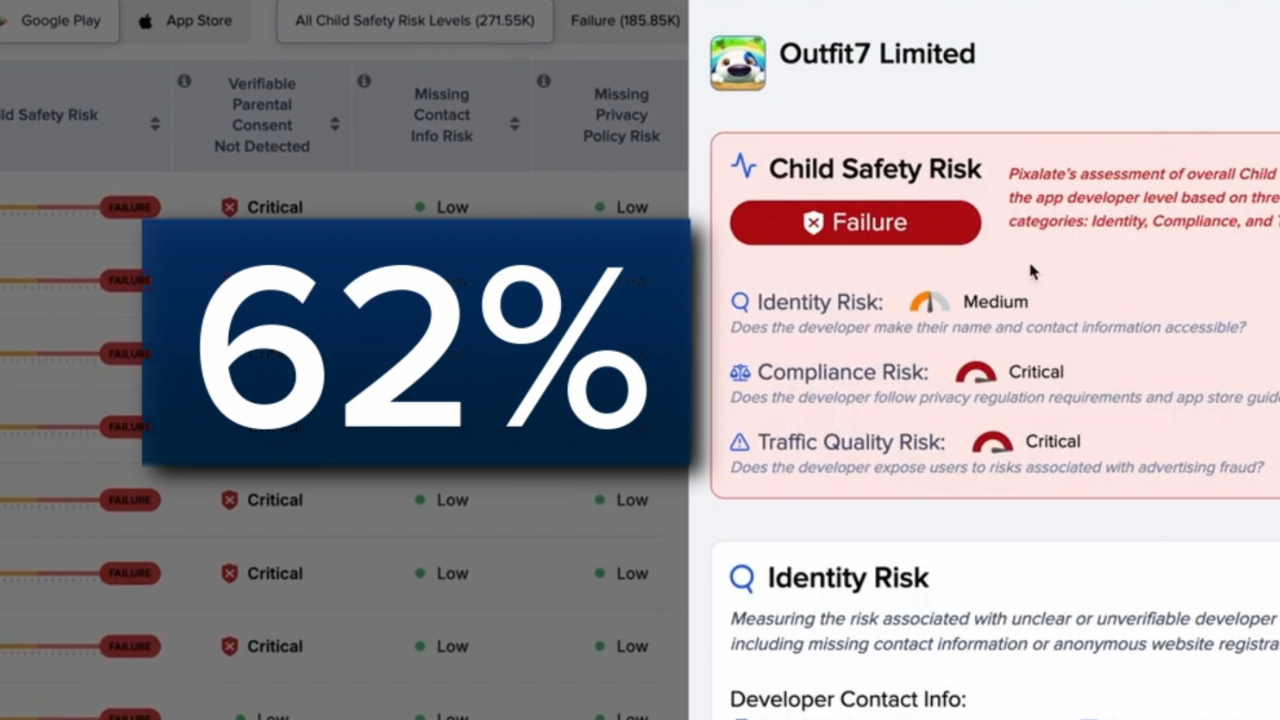
“Know Your Developer” indexes more than 350,000 ad-funded apps from the Google and Apple stores, breaking them down by critical online safety risk areas, including verifiable parental consent, failure to post a privacy policy, unsafe advertising risks, and security risks, among others.
According to Pixalate's VP of platform growth Tyler Loechner, Pixalate has flagged 62% of app developers for child safety risks, including tracking a users’ location.
“In the app stores, you can see apps rated by stars, 4.5 stars, 4.3 stars,” said Loechner. “Our database rates the developer on risks, specifically privacy risks through the lens of children’s online privacy.”
Loechner says parents might assume Apple and Google are checking whether their kids’ apps are tracking their children’s information.
That is not always the case.
Pixalate has a team of educators and lawyers that manually download and review apps from the Google and Apple stores to determine if the app is child-directed.
“That’s important because under the Children’s Online Privacy Protection Act, an app has to be child-directed or mixed audience, which means children are part of the audience and if it is child-directed, certain laws apply to it and one of those laws is the requirement to obtain verifiable parental consent," he said.
Our Rescue is an organization that works to prevent internet crimes. According to their director of survivor engagement, June Haskell, the team’s most shocking finding was that 99% of the apps that they checked did not obtain the required verifiable parental consent.
“There’s not a lot of regulation and we work hard in the anti-trafficking online exploitation (space) to put those boundaries in place and guardrails and there’s not a lot of them,” said Haskell.
Haskell said a tool like “Know Your Developer” is helpful for parents for research and to feel more confident about their child’s online safety.
“Do your homework, find out how does this app work, what does it do. And importantly, how does this app give the outside world access to my child?” said Haskell.
Something to note, Pixalate said that just because an app is removed from the store and can no longer be downloaded, does not mean that it was removed from a user’s device.
So users might be using apps that were removed for violating an Apple or Google store policy and the user might not know about it.
If you want to check out the “Know Your Developer” database for yourself, click here.