



CAMP WILLIAMS, Utah — A quadcopter drone crept through the sky until it was ready to drop its payload – a water balloon.
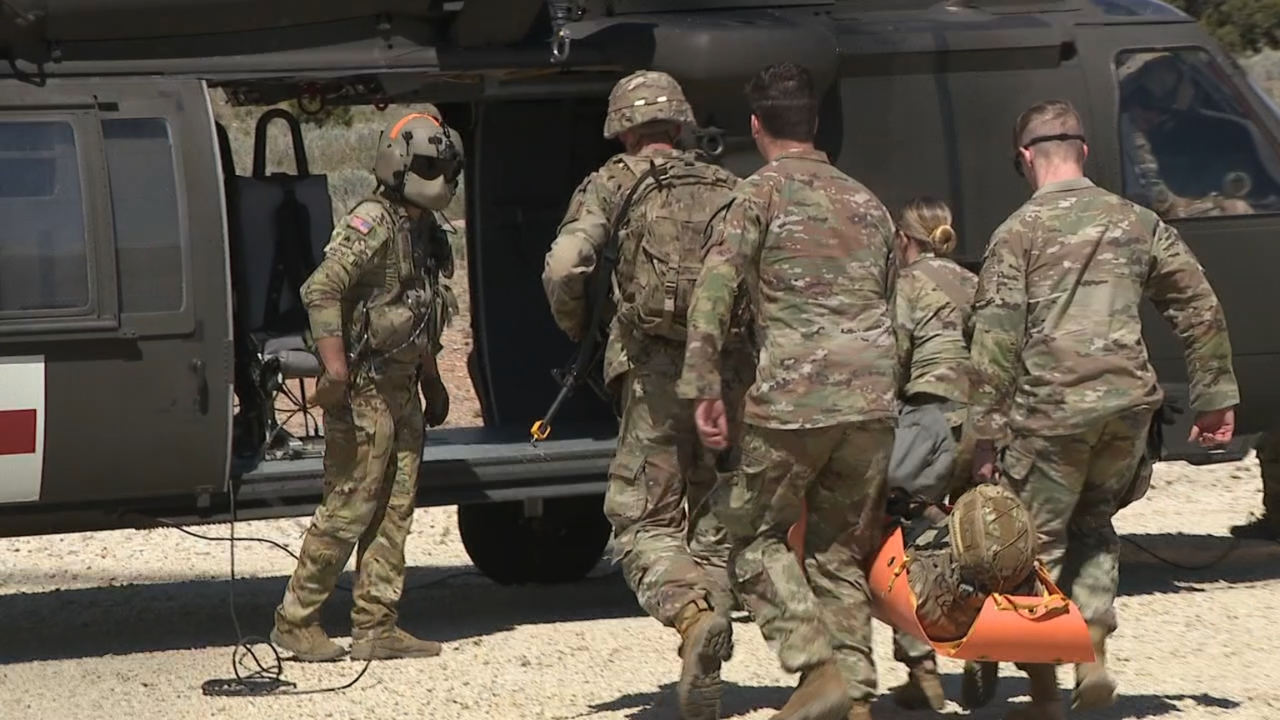
The wet ordinance simulated a grenade being dropped onto Utah National Guard soldiers. Nearby, a Blackhawk helicopter flew away with some more soldiers playing the roles of patients.
It was all part of Operation Wolverine. It included the Utah National Guard as well as personnel from Hill Air Force Base and local law enforcement. Drills spanned from Camp Williams to Dugway Proving Ground to a shopping center and the Central Utah Water Conservancy District.
“Joint Exercise Wolverine is a very large exercise involving almost every unit in service in the state of Utah,” explained Lt. Col. Rob Dent, of the Utah Army National Guard.
“I don’t think what we’re doing today is in relation to anything going on in the world right now,” Dent added, “but it is a reality that we could be facing a domestic terrorism situation and this exercise is the perfect scenario to prepare us for that.”
Among the drills at Camp Williams, soldiers practiced rescuing victims from rubble while under fire. Inside a makeshift hospital, soldiers and airmen triaged manikins dressed as patients as the lights flickered and the sounds of booms banged through speakers.
“This exercise represents kind of a historic first, in many ways,” said Patrick Tucker, the science and technology editor at Defense One. He has been reporting on national security exercises.
“It incorporates elements of air combat wings and also special operations forces, which aren't typically utilized in a National Guard domestic exercise like this.”
Tucker said military planners are concerned about cyber or bombing attacks on civilian infrastructure like water treatment plants.
“This is the sort of thing that is becoming increasingly likely, especially in the era of drone proliferation,” Tucker said.
A news release describing Operation Wolverine said Utah leaders were practicing to defend a “contested homeland.” At his monthly news conference, Gov. Spencer Cox said the exercise is not meant to prepare for an internal threat.
“It's us preparing for foreign adversaries,” he said, “and what could and hopefully never happen someday.”
“Their ability to hijack our infrastructure, for example,” Cox added. “That's one of the things that we're drilling on is what happens when we can't control electronically the infrastructure in the state.”
Ben Winslow contributed to this report.