



BULLFROG, Utah — As Ryan Bretz’s fishing boat skimmed across the water, he read the numbers on the depth gauge fastened above the steering wheel.
The display showed about 160 feet of water in Lake Powell’s main channel.
“So there's plenty of water here, right?” Bretz said.
In the center of the lake, yes. The water is still deep enough for any boat and all the skiers it can tow.
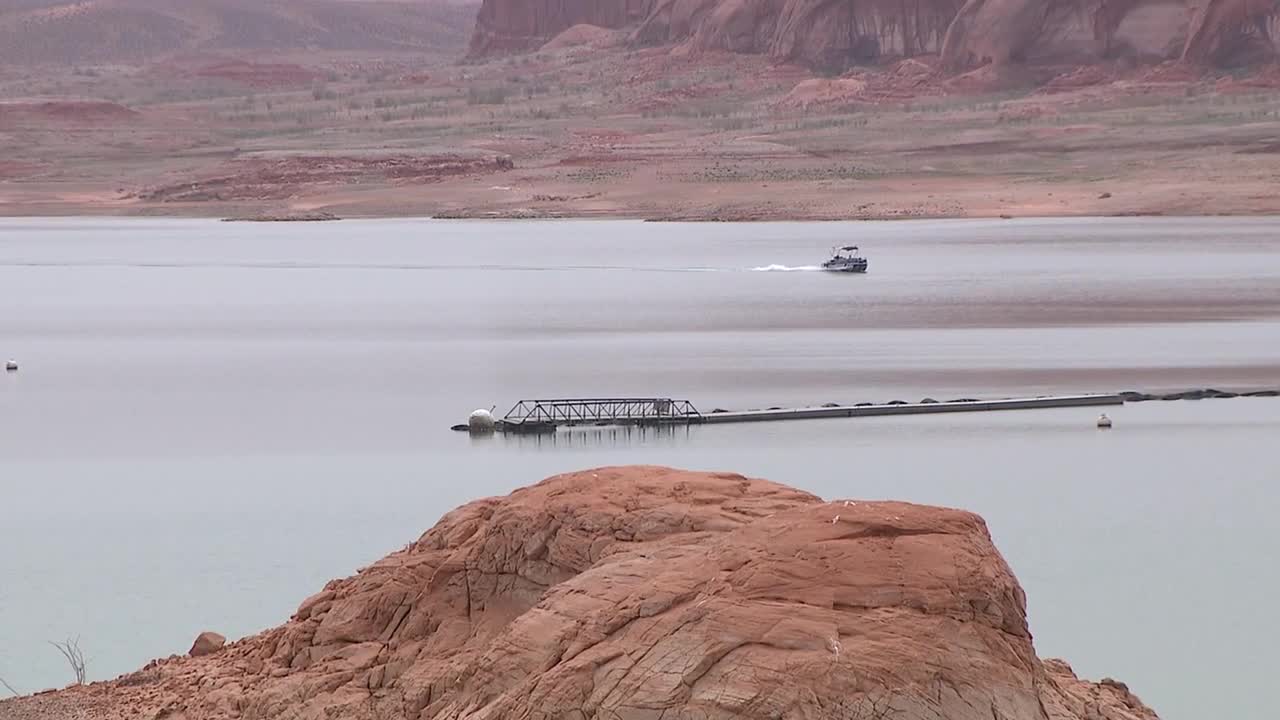
The edges of Lake Powell are a different story. At Bullfrog Marina, where Bretz keeps the houseboat he shares with other owners, water has declined so much that the marina’s operators plan to move the docks this month.
The docks — and the boats tied to them — will be towed 3 miles up the lake and added to Halls Crossing Marina. When FOX 13 News recently rode on Bretz’s fishing boat, journalists found the Bullfrog gas dock already floating at Halls Crossing.
The marina move may be the biggest change to recreation at Lake Powell since its creation in the 1960s. It will also impact the economy around Bullfrog and nearby Ticaboo and Hanksville.
WHAT TO DO
Boaters — who own fishing crafts up to houseboats the size of mansions — are still wondering what services will be available at Halls Crossing for them and their vessels.
“Our biggest concern is are we going to get it out in the fall?” said Tana Gaia.
Gaia and her husband have a cruiser at Bullfrog. It’s one of the boats about to be towed into the dock at Halls Crossing. She’s been coming to Lake Powell off and on since the 1970s, but sees a scenario where that ends.
“We debated on whether putting [the boat] in or selling,” Gaia told FOX 13. “We thought we would just see how it goes this summer.”
Halls Crossing is an extra hour drive from Gaia’s home in Salt Lake City. And then, this autumn, when Lake Powell’s water level could descend even further, it’s not clear which ramps will be open for Gaia to retrieve her boat and store it for the winter.
There would be ramps on the south end of Lake Powell – where Utah meets Arizona – but her boat can’t make the 90 miles across the water. The National Park Service removed the mid-lake fueling station in 2022 as water levels dropped then. The station has not been replaced.
Halls Crossing, according to Google, has no restaurants, motels, or marine services.
Bretz is waiting to hear whether Halls Crossing will have enough electricity to power his houseboat’s air conditioning on those days Lake Powell reaches 100 degrees. If not, he’ll have to start his generators.
“We use about a gallon of fuel per hour,” Bretz explained. “Fuel is about $8 a gallon right now.”
The lake’s main concessionaire, Philadelphia-based Aramark, is overseeing the marina move. FOX 13 sent questions to a spokesperson.
On whether Halls Crossing will have enough electricity to power boats’ air conditioning, a spokesperson replied in an email: “At this time, it is too early to confirm final electrical supply levels or timing at Halls Crossing.”
And as for what boat ramps will be usable in the autumn, the spokesperson replied: “We recommend boat owners monitor official [National Park Service] communications for the most accurate and up-to-date information related to fall access and boat removal.”
Robert Knowlton, the vice president of operations for Aramark’s southwest district, spoke with FOX 13’s Amy Nay last month. He said the goal is to have infrastructure moved to Halls Crossing by June 1.
“We had discussed relocating the infrastructure over to Hall's Crossing back in 2022,” Knowlton said, “as potential options and, and now it's just come up again and it's coming sooner than we expected.”
OFFSHORE BUSINESS
Back at Bullfrog, Tim Kelley is thinking about what more his employer can be doing.
Kelley is the director of operations for marine services at Offshore Marina. It works at Bullfrog and has garages and offices a few miles up the highway at Ticaboo.
“We're prepared for the worst,” Kelley said. “We're also prepared to help out and take advantage of any new opportunities that pop up.”
Kelley and his staff may be on the water more often to provide mechanical and maintenance services to boaters, he said.
The company he works for also operates a lodge. Kelley expects bookings to decrease there. And – with fewer boaters driving to Bullfrog – the restaurant and gas station the company owns may see fewer customers, too.
But the company also rents off-road vehicles and provides other services to people who want to do things on dry land. Kelley sees the possibility that business will increase there.
“What drives the traffic – or lack of traffic – in years like this is the narrative that's in the news,” Kelley said. “It's always, ‘Everything's going away. We're not be able to do anything.’”
Other Lake Powell lovers have made similar points. They want the public to understand there’s still plenty of water for vacations and other fun.
Bretz’s houseboat is named “Enchanted Island.” He calls Lake Powell his favorite place. The new complexities might mean fewer trips to the lake this summer, but he’s not ready to quit coming here altogether.
When asked about how Lake Powell has been managed, Bretz sidestepped old debates.
“There's not a bumper sticker slogan answer for this,” Bretz said. “I mean, it goes back to the Colorado River Compact. It's 100 years old now.”