



When there aren’t enough staff to care for the older or disabled Utahns who rely on nursing homes for care, some residents don’t receive showers for days.
Others experience long wait times for help or are left lying in their own feces, federal inspection reports show.
In other cases, the consequences are more severe. Experts say issues like sexual abuse and patients wandering out the door without anyone knowing are more common when a facility doesn't have enough employees. Sometimes, they say, the outcomes of understaffing can even be fatal.
“We look at it as a question of life or death,” said Barry Toone, an attorney with the Elder Care Injury Group, which is pursuing medical malpractice complaints against several Utah nursing homes. “If you don’t have enough people to take care of these residents, things will get missed. Mistakes will get made. And those mistakes have very real consequences.”
A FOX 13 News review of thousands of pages of federal inspection reports and dozens of complaints filed in court since 2019 reveals that staffing emerges frequently as a concern among regulators, employees and residents in nursing homes across the state.
“Staffing is the root cause of almost all concerns that we see in facilities,” agreed Alianne Sipes, the state of Utah's Long-Term Care Ombudsman.
Federal data show about a third of Utah’s 97 nursing homes currently have “below average” or “much below average” staffing ratings from the Centers for Medicare and Medicaid Services (CMS).
Rules created under the Biden administration sought to create a minimum staffing threshold for nursing homes across the country. But the federal government recently repealed that mandate, amid both legal challenges and heavy lobbying from the nursing home industry.
The Utah Health Care Association was among those opposed to the staffing standards, pointing to “workforce shortages” in Utah and across the country.
“We would love to hire more nurses and nurses’ aides, but we cannot find qualified caregivers to fill open positions,” wrote Allison Spangler, the group’s president and CEO in an email to FOX 13 News. “Nursing facilities are still grappling with a historic labor crisis coupled with a growing caregiver shortage.”
While the industry is pursuing solutions, she argues that a staffing mandate was unlikely to “magically solve the nursing crisis.”
But with the rule’s repeal, advocates for residents say understaffing will now remain the status quo in many facilities.
"What you're going to do is see those residents that are languishing and suffering without enough staff continue to do so,” argues Sam Brooks, director of public policy with the National Consumer Voice for Quality Long-Term Care. “You’re going to continue to see residents that are not being fed on time, not getting their medicine on time.”
'I was heartbroken’

Lesa Fonoti remembers her mother, “Leu” Togiola, as a “strong, independent woman.” Togiola went “all out for her family and friends,” and particularly loved showering them with beautiful, handmade ribbon leis.
The pair were so close that Togiola “gravitated to where I was at, whether I liked it or not,” Fonoti said with a laugh, recalling how mother followed daughter when she moved to Utah.
But after Togiola suffered a stroke in 2020, Fonoti knew her mother “wasn’t safe being home alone."
Fonoti couldn’t afford to stop working. So she made the difficult decision – “out of love and concern” for her mother’s well-being – to move Togiola into a nursing home in Taylorsville.
There were tight restrictions on visitors to nursing homes during the pandemic. So Fonoti, a registered nurse, applied for a job working weekends at the facility, in an effort to see her mother more frequently and ensure she was receiving good care.
Fonoti, who had spent most of her career working in hospitals and had never before worked in a nursing facility, said she immediately saw red flags.
“This type of system is just stretched so thin,” she said in an interview with FOX 13 News. “What happened to my mom, I feel like that's what ultimately cost her her life."
In early April 2023, Fonoti received a call from the nursing home (where she no longer worked) about a bruise on Togiola’s left thigh. A scan later showed her femur was broken.
But “despite the reported pain and bruising,” a lawsuit Fonoti filed against the nursing home alleges the facility left her mother in bed, “suffering with a broken leg for at least 12 hours” before transporting her to the hospital.
The complaint also contends the nursing home had no documentation explaining how the injury could have happened to an immobile patient like Togiola. The facility “never investigated the source or cause of the bruising, and never determined how the injury occurred,” the complaint alleges.
When Fonoti met her mother at the hospital, she saw the bruising for the first time.
“I was shocked; I was angry. As her daughter, I was heartbroken," she recalled through tears. "And as a nurse, I knew this wasn't something my mom could have done on her own. She completely depended on staff for care.”
At the hospital, doctors recommended Togiola undergo surgery.
“But unfortunately my mom, she pretty much crashed during recovery,” Fonoti said. “And she passed later that night.”
She was 79.
Fonoti’s lawsuit alleges, among other things, that the facility – which was known at the time as Sandstone Taylorsville – failed ”to budget for and provide sufficient staffing levels to meet the needs of residents."
The facility is now under new management and has a new name.
Sandstone Healthcare Group, the management company that operated the facility at the time of Togiola's death, did not respond to multiple written requests for comment. FOX 13 News also left voicemails for an attorney representing the facility but did not receive a response.
Gunnison Valley – the government owner of the nursing home through the state’s Upper Payment Limit program – is also named as a party in the lawsuit but declined to comment on the case, citing privacy concerns. State records show the facility has received $34.4 million in federal funds meant to improve care at the facility since 2019.
Both Sandstone and Gunnison Valley have denied claims of wrongdoing in court filings.
'I don’t have anyone else to work’
After a Provo nursing home sent a resident to the hospital with acute sepsis, an employee told federal regulators the facility “was so short staffed” they had been unable to check catheter bags.
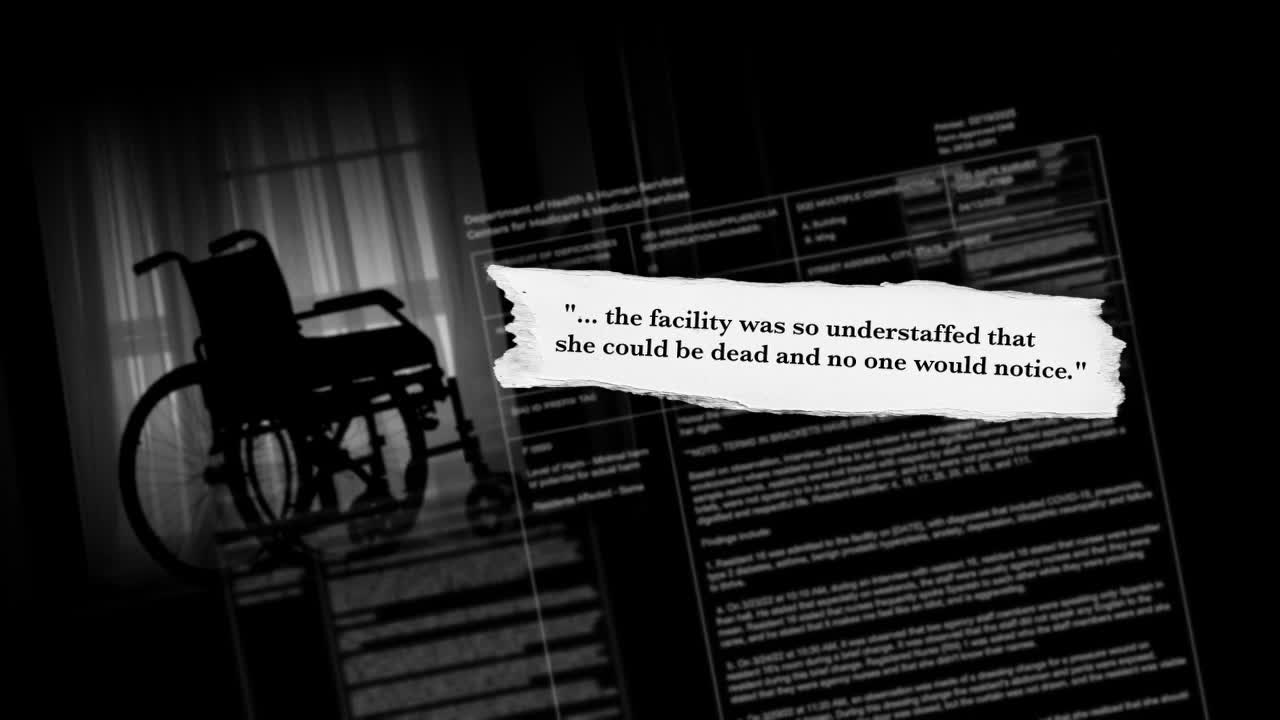
A resident at an Orem center cited for not having enough employees told inspectors “the facility was so understaffed that she could be dead and no one would notice.”
And an Ogden facility allowed a nurse who had previously been disciplined for missing narcotics to continue working with patients, despite reports from colleagues that she was “regularly sleeping on the job” and concerns from one resident who “did not feel safe” under her care.
Records show the facility didn't send the nurse home, even after she came to work appearing intoxicated – her eyes “red, watery and dilated” as she repeatedly scratched at her chest and face.
“I don’t have anyone else to work,” an administrator told inspectors, “and agency nurses charge $85 an hour.”
Federal regulators cited each of these facilities for not providing enough staff to meet resident needs. FOX 13 News found at least 15 examples of Utah facilities cited for insufficient staffing since 2019.
Lori Smetanka, executive director of the National Consumer Voice for Quality Long-Term Care, notes that nursing homes are required under federal rules to have “sufficient” staff. But she believes that vague standard offers nursing homes a lot of leeway.
“Facilities have been given a lot of discretion in how they staff a long-term care facility," she said in an interview with FOX 13 News. “And unfortunately, far too many of them have not provided the staff that are necessary for people to have all of their needs met.”
Her group was in favor of now-repealed staffing rules that would have established minimum standards for hours of care provided per day in nursing homes and required a registered nurse to be onsite 24 hours a day, seven days a week.
“It would raise that bottom level up where residents are being most harmed, and bring [facilities] up to a higher standard,” Smetanka said, noting that many facilities were already meeting those requirements. “And it would ultimately save lives.”
One analysis by researchers at the University of Pennsylvania estimated that implementation of the staffing rule would save about 13,000 lives per year, based on estimates of the relationship between nurse staffing hours and mortality rates.
They estimated the rule would save up to 100 lives each year in Utah. A 2024 report from the American Health Care Association showed 30% of the state’s nursing homes weren't providing the proposed hours of care per resident per day, and about 70% didn’t have a registered nurse available 24/7.
But the nursing home industry lobbied hard against the staffing rules.
The American Health Care Association and the National Center for Assisted Living characterized the requirements as an “unfunded mandate” and a “one-size-fits-all rule amid a historic and nationwide labor shortage.”
The Utah Health Care Association said implementation would have cost the state's nursing homes an additional $15 million per year and required them to hire 310 additional staff members. It said facilities would also need to slash the number of nursing home beds available in Utah by 625 to meet the standards.
Spangler, with the Utah Health Care Association, said in an email that the rule was “completely unattainable for nursing facilities to comply with” amid workforce shortages.
“We need targeted investments, not blanket mandates, to grow our long-term care workforce,” she added, noting that the association has been working with Utah policymakers to help them “better understand our unique population and labor market situation.”
Smetanka, in response to criticisms of the rule, argues that the nursing home industry exaggerated its impact. She noted that implementation was delayed to give nursing homes time to comply and that it also included exceptions for facilities that demonstrated they were trying to meet the requirements.
"These are multibillion-dollar industries,” she added. “And to say that a staffing rule that will assure better patient care is going to cripple them, I think, is really ridiculous.”
'These residents deserve better’
If better staffing levels won't be imposed at the federal level, Nate Crippes, an attorney with Utah’s nonprofit Disability Law Center, hopes state lawmakers will look at ways to address the issue instead.
“Ultimately I don’t see why we shouldn’t have higher staffing ratios to ensure the level of staffing appropriate to keep people safe,” he said in an interview. “If there is a way to ensure better staffing ratios, I think we should.”
Sipes, who stressed that she was speaking in her capacity as an advocate for residents through the Long-Term Care Ombudsman’s Office, said she’d also like to see the state implement a minimum staffing requirement.
“What would that look like? What impact would that have on facilities’ ability to function, and what impact would that have on the quality of care and life of the residents?” she asked. “Those are all really good questions worth exploring.”
Advocates for residents say staff turnover is another area for improvement.
WATCH: Lori Smetanka explains the consequences of high staff turnover in nursing homes:
The average Utah nursing home has a 51% staff turnover rate, according to CMS data. That means about half the employees leave every year. The national average is 46%.
Smetanka notes that turnover can create a vicious cycle that makes it more difficult for facilities to provide quality care and retain staff, since chronic understaffing can lead to low morale and burnout.
“We do hear from staff that one of the reasons they leave is because the workload is too heavy,” Smetanka said. “When you're responsible for, you know, 15 to 20 residents — which happens in a lot of facilities — it's too much for a person. And, you know, people want to provide good care.”
The National Consumer Voice for Quality Long-Term Care found that nursing homes with turnover between 50% and 59% are cited for abuse one and a half times more often than those with a lower turnover rate of 30% to 39%.
The organization notes research showing high nursing turnover is itself related to “poor pay, lack of benefits, high workloads, inadequate training, poor management, and lack of career advancement.”
"When a facility is chronically understaffed, it leads to burnout,” noted Toone, with the Elder Care Injury Group. “It leads to morale problems in the facility. It leads to high turnover. All of those problems make it incredibly difficult to keep good staff, to retain the kind of staff that you need to be able to retain and to attract good staff.”
The American Health Care Association said in a 2024 fact sheet that nursing homes across the country are doing “everything they can to recruit and retain more caregivers” — including increasing wages by 27% since the beginning of the pandemic.
A recent analysis the Utah Department of Health and Human Services shared with FOX 13 News noted that the average wage per hour for nursing staff at Medicaid facilities has also increased “substantially” in Utah – rising from $23.98 in 2020 to $30.41 an hour in 2024.
As a nurse who has seen the effects of understaffing firsthand, Fonoti believes improving these issues would help better protect Utah families moving forward.
“Important things won't be missed,” she said. “Less turnover, because less burnout. You know, I truly feel like it would start with more staffing.”
She hopes that by pursuing her lawsuit – and by speaking out publicly – that she can help promote a conversation about ways to improve care in the state for patients who rely on Utah’s nursing homes.
"No family should have to go through this,” she said. “No one should have to lose their mom, their loved ones like this, like the way my mom went.”
“I feel like these residents deserve better,” she added.
Read more from the FOX 13 Investigates team's ongoing coverage of Utah’s elder care systems:
- Deaths of older adults in long-term care often underexamined, advocates say
- These Utah nursing homes received millions through a program meant to improve care
- State audit: Millions meant to improve Utah nursing homes were never spent on care
- What are your discharge rights from a long-term care facility? It depends.
- Older adults are being discharged out of long-term care facilities — and into homelessness
- 'More psych than we can handle': Utah nursing homes struggle to address residents' mental health needs
- ‘It should never happen’: Vulnerable adults sexually assaulted inside Utah nursing homes
- Why FOX 13 News is reporting in-depth on gaps in Utah’s elder care systems
- Consensual sex between residents, employees in long-term care raises concerns
- Q&A: Utah’s Long-Term Care Ombudsman is ready to advocate for you and your loved ones
- Utah’s Adult Protective Services is substantiating few cases of elder abuse
- What you should know before choosing a nursing home
- Older adults are wandering away from Utah care facilities, sometimes with tragic outcomes
- Critics say taxpayer dollars for nursing homes should be spent on care, not new buildings
- Nursing homes receiving millions in extra taxpayer funds face allegations of poor patient care