

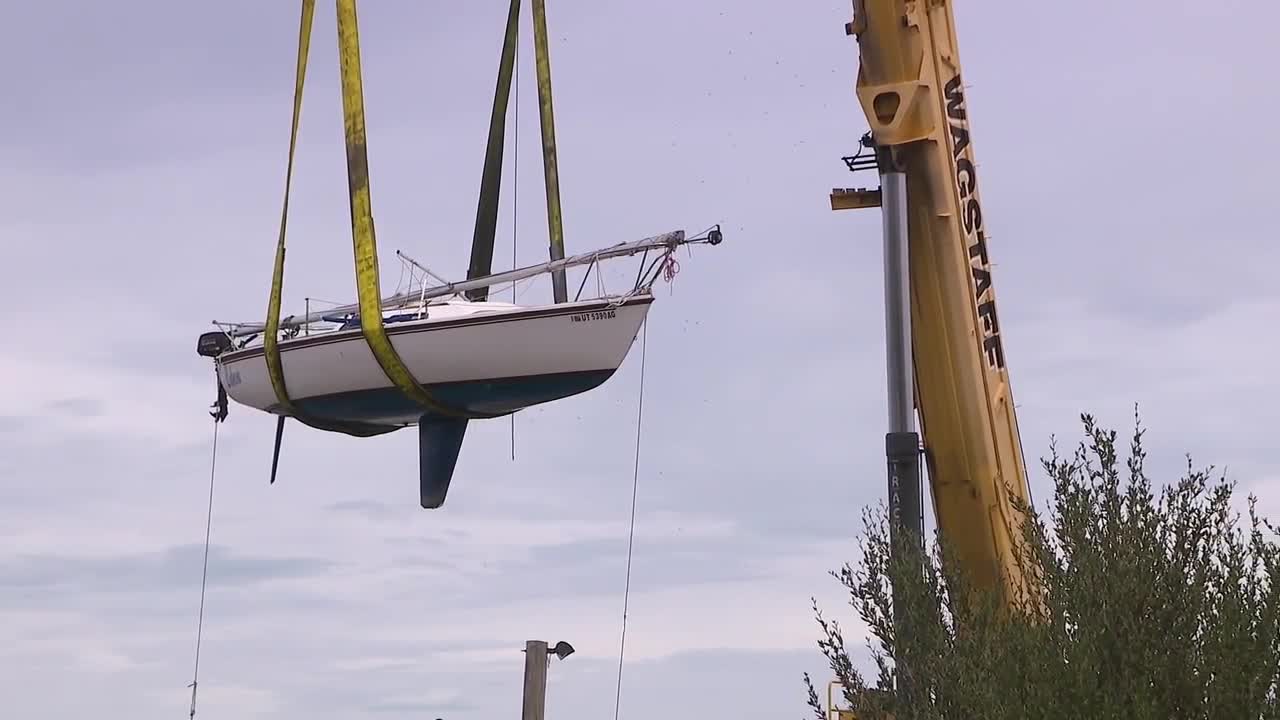


SALTAIR, Utah — This is the third time Kevin Hively's sailboat has been pulled out of the Great Salt Lake Marina.
"It’s really a treasure. It’s fun to sail out here," he said of the Great Salt Lake. "I’m going to miss it."
On Saturday, a crane pulled 24 boats out of the marina because water levels are getting too low. Sailboat owners pooled their resources to hire a crane to get out before boats get stuck in the mud and start corroding. Utah State Parks, which operates the marina, said the boat slips can also be damaged.
"I'm in three feet of water now, but if I stay in, I won’t be able to stay in through the winter," Hively told FOX 13 News.
More boats are expected to be pulled in the coming months. But access to the lake will not be shut off, said Ally O'Rullian, a spokesperson for Utah State Parks.
"People can still launch their boats from the boat ramp here at the Great Salt Lake State Park. Also, people can still recreate on the water. You can paddleboard, you can kayak, you can participate in the ranger programs," she said.
But what happened on Saturday is a sign of the continued crisis facing the Great Salt Lake. The lake dropped to a record low in 2022, impacted by water diversions, drought and a changing climate.
"This year, we had that record low snowpack, so now we’re not going to see the lake rise as much," said Michael Sanchez, a spokesperson for Utah's Division of Water Resources. "We do not anticipate it hitting that record low, that 4,188 [feet elevation], but we’ll see how it plays out."
A shrinking Great Salt Lake presents a significant ecological threat to Utah and surrounding states with reduced snowpack that supplies drinking water, toxic dust storms and other harms to public health, wildlife and the economy. In response to public pressure to save the lake, Utah political leaders have pushed conservation measures and legislation designed to reverse the lake's declines.
President Trump has pledged a billion dollars in his budget to Congress to save the Great Salt Lake. On Friday, Governor Spencer Cox sported a "Make the Lake Great Again" hat as he met with stakeholders and Utah's congressional delegation to strategize ways to ensure the state gets that money and other efforts to help the lake.
"We’re grateful for President Trump putting a billion dollars in his budget," Gov. Cox told reporters. "We have a long ways to go with Congress."
The governor met with stakeholders and members of Utah's congressional delegation on Friday to strategize ways to help the lake and ensure that the state gets the money. The money could be used to purchase water rights for the lake and other infrastructure improvements to help raise levels.
"It’s going to be difficult," Congressman Blake Moore told FOX 13 News. "A billion dollars is difficult in any situation and any appropriation request. What you’re seeing here is a strategic plan."
There are signs of progress. More and more agriculture producers (Utah's top water user) are switching to newer technologies that grow crops with less water. There is an emphasis on reducing outdoor watering in residential areas to help the Great Salt Lake and the Colorado River. Environmental groups have teamed up with the state to lease and purchase water for the lake.
FOX 13 News has learned that with the state government's purchase of the bankruptcy assets of U.S. Magnesium — a sizable water user on the lake — state water officials discovered they got more water than they originally calculated. That water will stay in the lake instead of being used for mineral extraction.
"We now have basically secured over 500,000 acre-feet of water rights to the Great Salt Lake," Gov. Cox said. "We have another 300,000 acre-feet we’re working on that are close to being under contract. That’s 800,000 acre-feet of water."
Environmental groups have expressed optimism.
"We are grateful for the leadership of Utah’s congressional delegation, Governor Cox, and other federal and state leaders in recognizing the importance of sustained federal investment as a key step toward addressing the challenges facing Great Salt Lake,” Marshall Johnson, the chief conservation officer at the National Audubon Society, said in a statement. “Building on decades of conservation and restoration work at Great Salt Lake, Audubon is ready to help turn this commitment into lasting progress through science, partnerships, and on-the-ground action that benefits birds, communities, water resources, and Utah’s economy.”
But as he readied his boat to be pulled out of the Great Salt Lake Marina, Hively said he thinks Utah political leaders can do more.
"I think the Great Salt Lake needs water rights to a healthy level and that healthy level is determined by scientists," he said.
This article is published through the Great Salt Lake Collaborative, a solutions journalism initiative that partners news, education and media organizations to help inform people about the plight of the Great Salt Lake—and what can be done to make a difference before it is too late. Read all of our stories at greatsaltlakenews.org.