

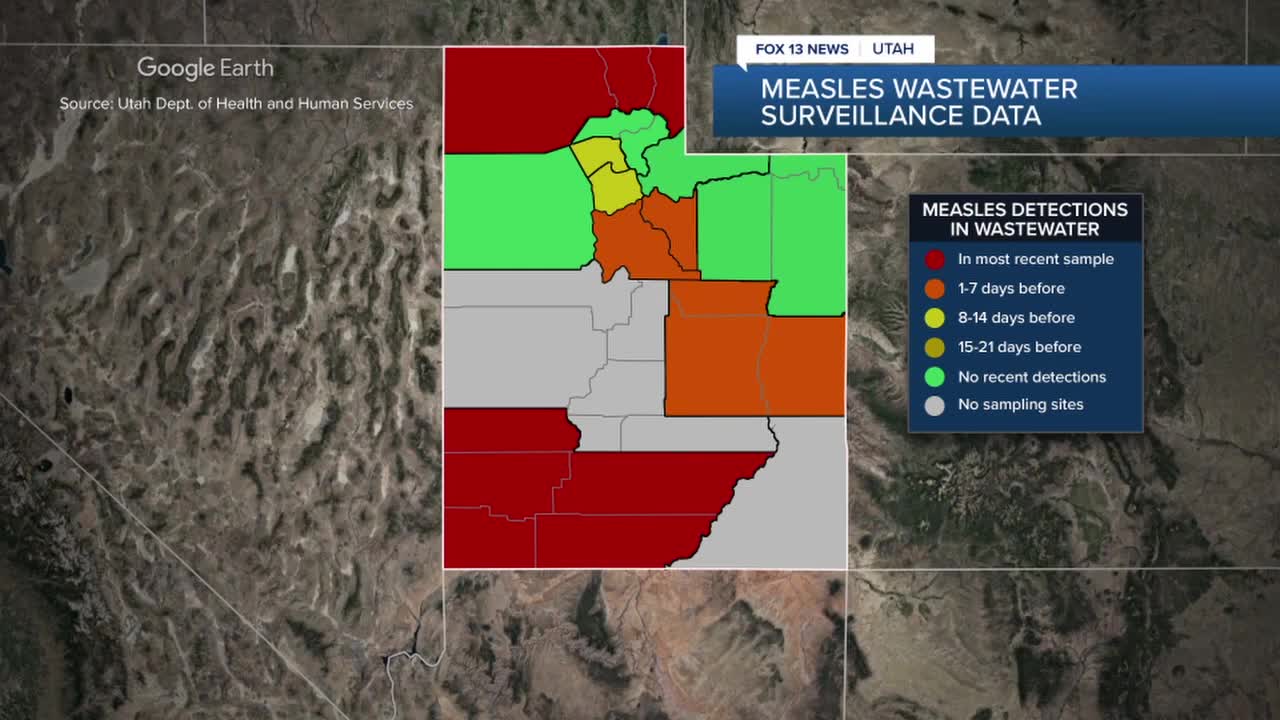


Wastewater surveillance, a public health tool that expanded rapidly during the COVID-19 pandemic, is now being used in Utah to help track the spread of another highly contagious disease: measles.
The testing analyzes wastewater for traces of viruses, allowing health officials to monitor disease activity across entire communities. Epidemiologists say it can provide earlier warning signs of outbreaks and fill in gaps left by traditional surveillance methods that rely on reported cases and contact tracing.
“It started with COVID, and that’s how wastewater surveillance as a sort of long-term, broad-scale public health surveillance tool really got going,” said Nathan LaCross, manager of Utah’s wastewater surveillance system. “For us, and really nationwide, almost every state has a program like ours in some fashion.”
LaCross says wastewater data is now being used to supplement measles surveillance statewide. While traditional methods remain critical, he says they often fail to capture the full picture.
“Just having additional data available is proving, in some ways, more reliable than some of the more traditional data streams,” LaCross said. “The data we get from clinical case finding and contact tracing is extremely valuable, but we know it is also extremely incomplete.”
Despite the expanded use of wastewater surveillance, there are significant gaps in where testing is currently taking place in Utah.
According to state data, there are no active wastewater sampling sites in large portions of central and southeastern Utah. The Central Utah Health Department, which serves six counties — Juab, Millard, Piute, Sanpete, Sevier and Wayne — is not currently included in the state’s wastewater surveillance testing network. San Juan County is also listed as not reporting any sampling.
WATCH: Utah sees climbing measles count amid public exposure concerns
LaCross says those gaps are largely due to cost.
“We don’t have any current sampling sites there, no,” he said. “We had to scale back when we went from sampling once per week to twice per week because it is about twice as expensive to do.”
In a statement provided to FOX 13 News, the Central Utah Health Department said the decision to discontinue wastewater testing in its district was made by the Utah Department of Health and Human Services and that the local health department was not consulted.
The full statement reads:
“Wastewater surveillance testing for diseases, including measles, is directed and conducted through the Utah Department of Health and Human Services (UDHHS) and the Utah Public Health Laboratory (UPHL), in cooperation with local sewer districts. The decision to not conduct wastewater testing in the central health district was made by UDHHS; the Central Utah Health Department (CUHD) was not consulted at any point. Upon inquiry regarding this decision, the CUHD was informed by UDHHS that previous wastewater surveillance testing was discontinued because it was not cost effective to test within the health district. When CUHD inquired about the possibility of measles wastewater testing, UDHHS indicated that a lack of funding would not allow for bringing on testing sites in central Utah at this time.
"CUHD feels that regardless of whether wastewater surveillance is being conducted, the message around measles response in central Utah remains the same. Measles cases have been identified in the health district and throughout the state, and therefore, it is essential for individuals to be vigilant in protecting themselves from the virus. Vaccination has been, and continues to be, the best protection against contracting measles. CUHD encourages the public to be fully vaccinated in order to build herd immunity and limit further community spread of the virus.”
Even without wastewater data from the region, measles cases have been identified in central Utah in recent weeks through traditional surveillance methods, including clinical reporting. Health officials continue to emphasize vaccination as the most effective way to prevent infection and reduce community spread.
“We study diseases in populations and how to make them less severe and ideally prevent them altogether,” LaCross said. “That’s a tough ask, but that’s always our gold standard.”
The Utah Department of Health and Human Services publishes wastewater surveillance data through a public online dashboard, allowing residents to track disease trends as data becomes available. Measles data was recently added and is currently reported at the local health department level.
The dashboard can be viewed on the DHHS website HERE.
