



ROY, Utah — Dave Reynolds was in second grade at Lakeview Elementary in Roy, Utah, on January 28, 1986, when his teacher wheeled in a TV to watch what was supposed to be a historic moment in space exploration.
"We were very excited—there was going to be a teacher that was going to go up into space," Reynolds said.
Instead, Reynolds and millions of other schoolchildren watched in horror as the Space Shuttle Challenger exploded 73 seconds after liftoff, killing all seven crew members aboard.
"We all kind of sat in silence as the rocket lifted off and tragically exploded," Reynolds said. "The teachers knew what was going on, but as 8-year-olds, we really... we knew something had happened that was tragic because of the way they were behaving, but we didn't quite understand and be able to grasp it.”
Commander Francis Scobee, Pilot Michael Smith, and astronauts Judith Resnik, Ronald McNair, Ellison Onizuka, Gregory Jarvis, and teacher Christa McAuliffe lost their lives when a failure of a booster joint caused the explosion in what became one of the most defining moments in the space shuttle program.
But it was also a defining moment for Reynolds.
"If I had to trace that back to a singular point, it was the launch of the Space Shuttle Challenger," Reynolds said. "Something in me changed that day, and I thought: 'This is what I want to do.' With my little 8-year-old self, this is what I want to do. I want to be involved in this somehow.”
Reynolds wrote to Morton Thiokol, the Utah company that built the boosters for the shuttle program.
"To my surprise, two or three weeks later, I received all sorts of packets and pictures and stories about the Challenger and the Challenger crew," Reynolds said. "The most prized possession that they sent me was a poster.”
The poster was given by Morton Thiokol to employees as motivation to redesign the boosters and get the shuttle program flying again.
"I just found it so moving that I clung onto that poster like it was made out of gold," Reynolds said.
Reynolds carried that poster from his childhood home to college and into his early career in rocketry, using it as motivation to apply to every job he could at NASA.
"The second [an opportunity] opened up, I jumped on it and ended up working on the Space Shuttle program," Reynolds said. "So, I supported 22 shuttle flights. And to this day, I keep this poster hanging on my wall.”
The final shuttle mission launched in 2011, but Reynolds' career was far from over.
"If you look at the shuttle program, it did exactly what it was supposed to do, which is... it was a work truck," Reynolds said. "It went to space, it came back home. We've kind of grown beyond that at this point. It's now time for NASA to explore further.”
Today, Reynolds serves as the SLS Booster Program Manager at Marshall Space Flight Center, overseeing the boosters for NASA's Artemis mission to return humans to the moon for the first time since 1972.
"As a program manager, it's my role to accept the risks that go along with that, but I'm not going to accept a risk that I don't think is fully managed," Reynolds said.
Safety remains the top priority, especially given the lessons learned from Challenger.
"Safety in our program is absolutely paramount," Reynolds said. "This is the first time that we have flown humans to the Moon since 1972. It's a huge responsibility in this role to make sure that this crew flies safely and returns safely. The drive to get us there cannot overcome the safety aspects of keeping us safely there.”
The safety improvements actually start with lessons learned from Challenger itself. Reynolds explained how the original joint design allowed the rocket to flex during flight, and if the O-ring became too cold, hot gases could escape from inside the motor.
"After the Challenger, one thing that they realized was that as the rocket flies, it flexes,"
Reynolds said. "And if this O-ring—in the case of Challenger being super cold—allows any of those hot gases to escape from the inside of the motor to the outside of the motor, that's when you have a problem.”
Engineers added a capture feature to prevent the joints from flexing and extra O-rings to ensure nothing could escape, but the connection to the shuttle program goes even deeper.
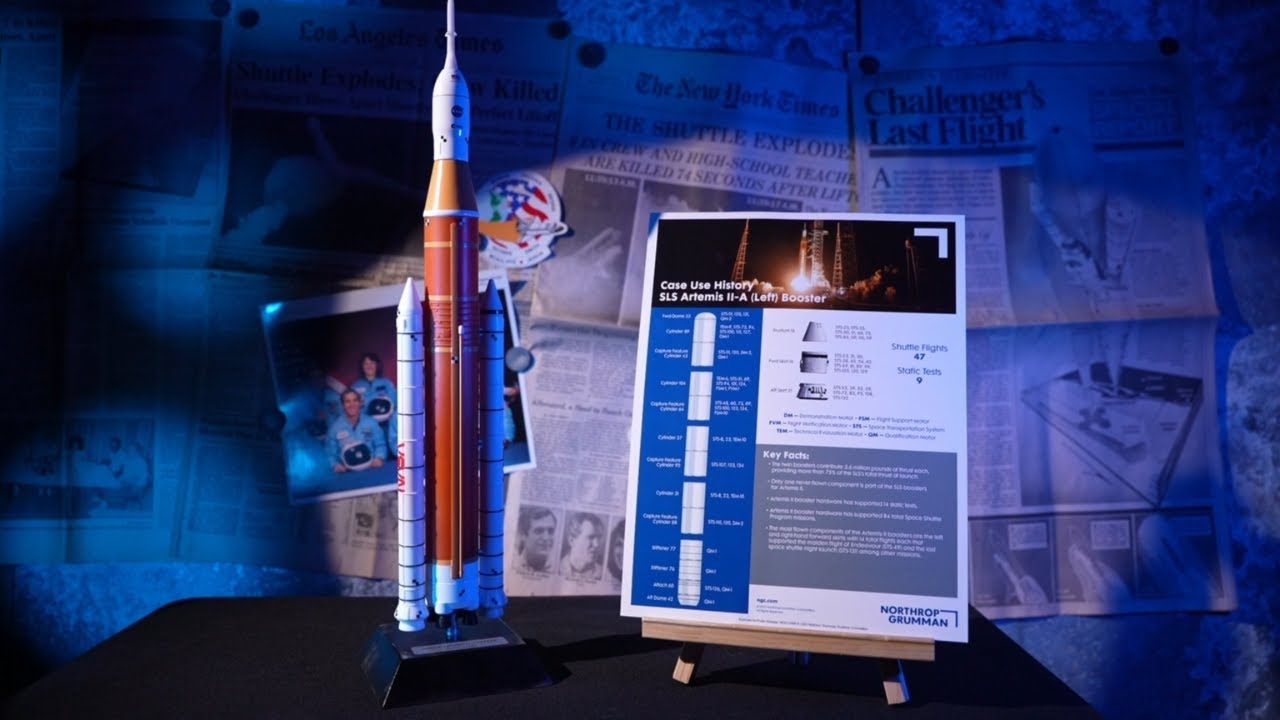
"Today, the cylinders that we are flying—those metal cases that we are flying on the SLS—many of them flew on the Space Shuttle," Reynolds said. "They are not new; they are reused Space Shuttle hardware. They are the literal joints; they are the redesigned joints that flew again and again and again on the Space Shuttle.”
Just days ago, NASA rolled out the Artemis 2 rocket to the launch pad, paving the way for mankind's return to the moon in the coming weeks.
"We practice, practice, practice, and ultimately, when the day comes, we'll push the button and we'll let this thing go," Reynolds said.
For Reynolds, the journey from that tragic day in second grade to leading NASA's next major mission represents both a personal achievement and a tribute to those lost.
"I want to keep this as a reminder to myself that mistakes aren't acceptable," Reynolds said. "The Apollo 1 crew, the Challenger crew, the Columbia crew that we have lost over the years—we have learned many, many lessons from those tragedies and, being exploration-driven, have incorporated those onto the SLS program.”
In conclusion, Reynolds has a message for the next generation watching the upcoming launch.
"I think I just want to talk to the 8-year-old that's out there," Reynolds said. "Because somewhere, I guarantee there is an 8-year-old that is about to watch this launch. And 8-year-old, if you feel a drive to explore, you never know where you can end up.”
"You never know what poster is going to end up on your wall 40 years later that is inspiring you on a daily basis," Reynolds said.
