

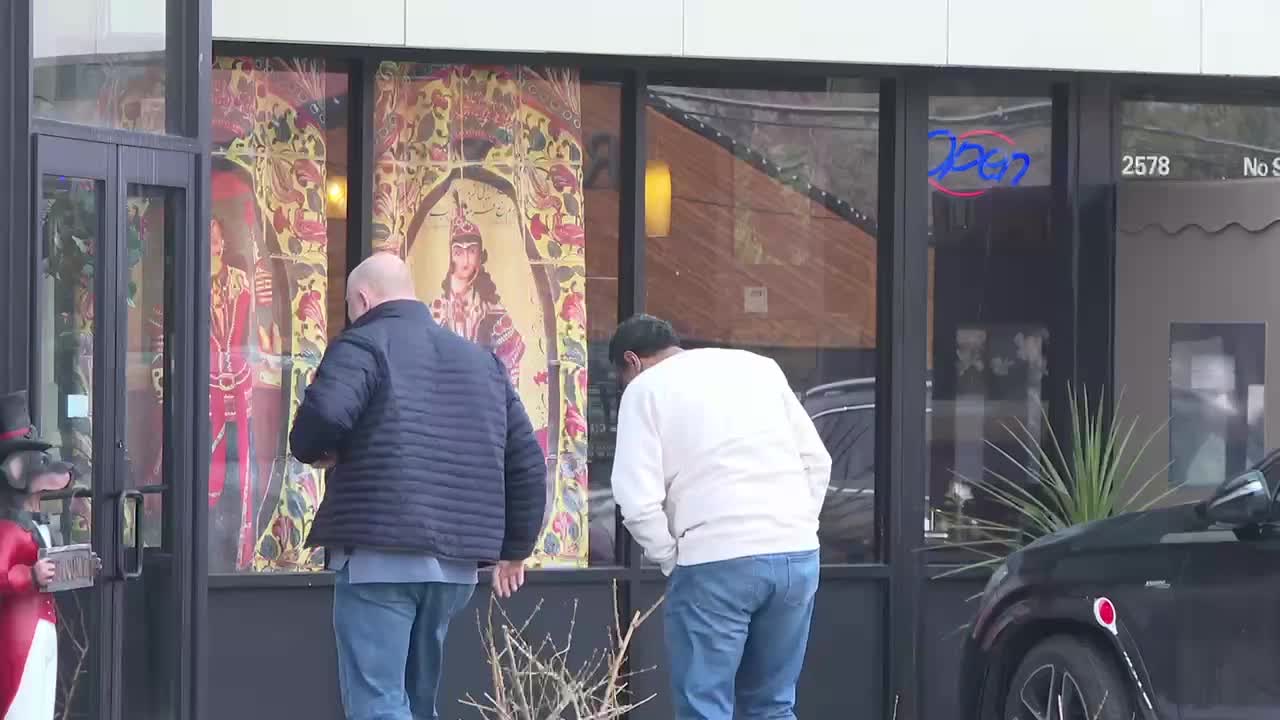


COTTONWOOD HEIGHTS, Utah — Cottonwood Heights is 6,600 miles away from Tehran, Iran, where the ruling regime has reportedly killed thousands of its own citizens who have tried to topple it. But for Salt Lake City’s Iranian community, the distance is much closer.
Sumac Cafe is a Utah place to hear the voices of Iran.
"We have to be voice for those 82 million people who have no voice," said Nasrin Mohammadi, a decades-long Utahn born in Iran.
The cafe is named for the reddish-purple spice that grows plentifully, not just in Iran, but here in Utah.
"Same flower. Isn't that crazy? So much similarity, but we don't have our freedom back home. Here we do. And I wish they could all have it," explained Melina Nazari, whose family owns the cafe.
Iran restores phone service after deadly protests as Trump threatens tariffs:
As a child, Nazari escaped Iran as a refugee and is now a U.S. citizen. She remembers being arrested at the age of 11.
"We were having fun. This lady came and grabbed me. And they were saying, 'Where's your hijab? Why are you not wearing a hijab? You're going to pay for this.' I'm like, 'Why? What is going on?' So they took me to this very cold, ugly room," she recalled. "When I remember that moment... I'm just... get very emotional."
"Younger people like me, they've been through a lot back home. They've been dead, they've been shot, they've been kicked. They've been slammed in the same room as I was in."
Census estimates say there are 500-700 people in the Salt Lake City area who were either born in Iran or identify as Iranian or Persian. And while Melina doesn’t remember an Iran without an Islamic regime, Nasrin Mohammadi does.
Like many, Mohammadi came to Utah for an education and attended the University of Utah for engineering in 1975. She returned to Iran the week before the hostage crisis began, only to manage to escape back to the U.S.
There have been uprisings since those events nearly a half-century ago, but Mohammadi says this current crisis is different.
"The first time it was political. The second time it was freedom. The third time is economy," she said.
Although Mohammadi can speak up, others we talked to said they were worried about sharing their voices over fear of reprisals on their families back home. It doesn’t help that with the internet and communication being cut off from the outside world, people like Melina have no idea how their families are doing thousands of miles away.
"I hope my grandma, my grandpa, my dad are okay back home," she said. "My friend, my best friend. I haven't heard from them. This morning, I just woke up, grabbed my pillow, started crying because this is not fair to my people."