

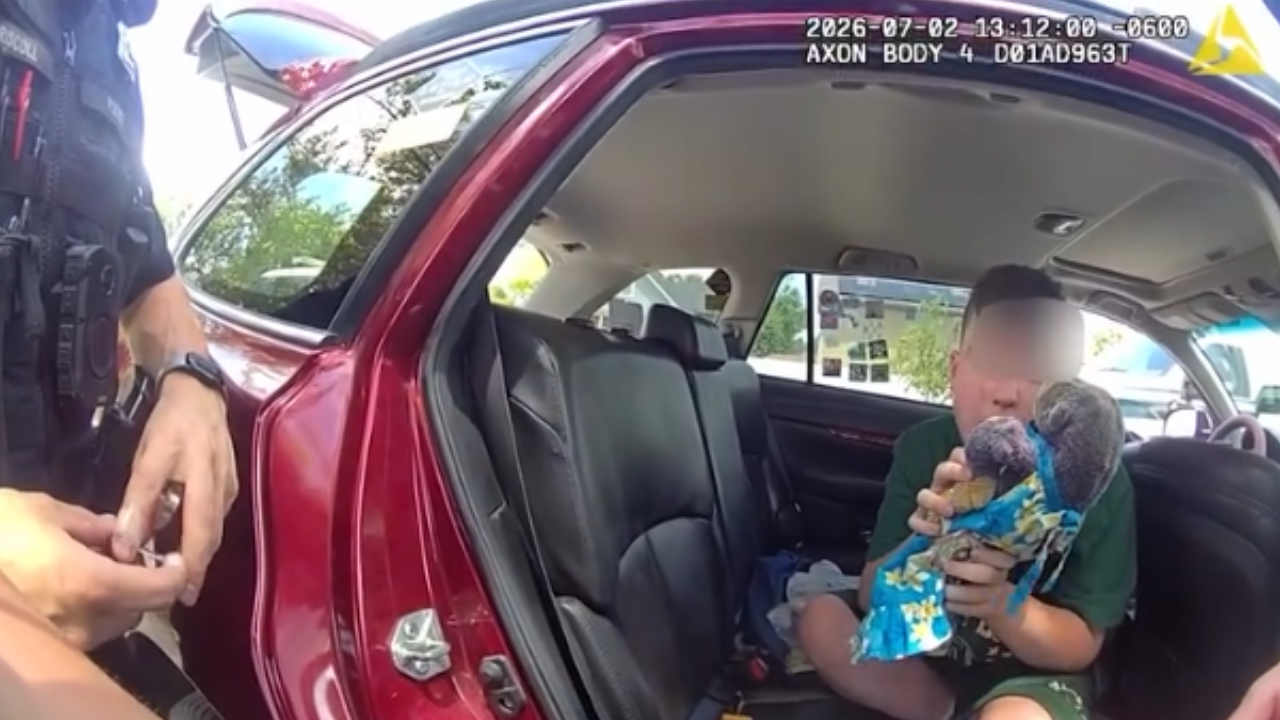


SALT LAKE CITY — A call initially reported as an assault on an elderly woman ended with an autistic child drawing pictures and calmly talking with Salt Lake City police officers.
Body-camera video released by the Salt Lake City Police Department this week showed officers arriving at the home for what was dispatched as an assault in progress.
Once there, officers quickly determined the situation was not what they had expected. Instead of a crime, they found an autistic child in crisis.
The video shows officers assuring the child they were not going to hurt him and asking family members to give him space.
One officer remained with the child and slowed the interaction while another went to a patrol car to retrieve a sensory bag.
The bags contain fidget toys and other items intended to redirect a person’s attention and help reduce sensory overload.
“Hey, Ronan, do you want this?” an officer asks in the video while offering him a fidget toy.
Officer Greg Lovell said many Salt Lake City patrol officers carry the bags, which were provided through the Autism Council of Utah and KultureCity.
The officers continued talking with the child without rushing him. They offered him toys and drawing materials and gave him time to settle down.
Within minutes, the interaction had changed.
The child began drawing and talking with the officers. At one point, he told them he was no longer having a tantrum.
One officer said the encounter reinforced why she keeps several sensory bags in her patrol car.
“I didn’t have one of those bags one day and I needed one,” she said in the video. “Now I make sure there’s like four or five in my car.”
Salt Lake City police responded to about 174 calls involving autism last year, according to the department. Police said the bags are one tool officers can use, but recognizing what is happening and adjusting their response are also critical.
That same focus on reducing sensory overload is central to the work being done at Little Champs ABA, a new autism therapy center in Cottonwood Heights.
The center provides applied behavior analysis, or ABA, therapy for children with autism. Its services include individualized therapy, help developing communication and social skills, parent training and support in homes, schools, and day care settings.
The facility also includes a sensory gym with swings, movement equipment and other activities designed to help children regulate their emotions.
Kelsey Anderson, a board-certified behavior analyst at Little Champs, said the sensory bag helped give the child something different to focus on. But she said the way officers used it was just as important.
“The bag is a great start,” Anderson said, adding that it needs to be paired with training.
During a crisis, an autistic child may be overwhelmed by noise, movement, unfamiliar people or demands they are not prepared to process. Anderson said pushing for immediate compliance can intensify the situation.
Instead, she said, adults should slow down, give the child space and try to understand what the child is communicating through the behavior.
“Being patient and stepping back and trying to see things from their point of view,” Anderson said, “and really leaning on the people that know the kids.”
At Little Champs, therapists use play, movement and sensory activities to help children become calm and engaged before working on other skills.
The center also works with parents so strategies learned during therapy can be used at home and in the community.
The police encounter shows how those same principles can be applied outside a therapy setting.
The sensory bag gave officers a useful tool. Their training helped them recognize when to slow down and how to use it.
