

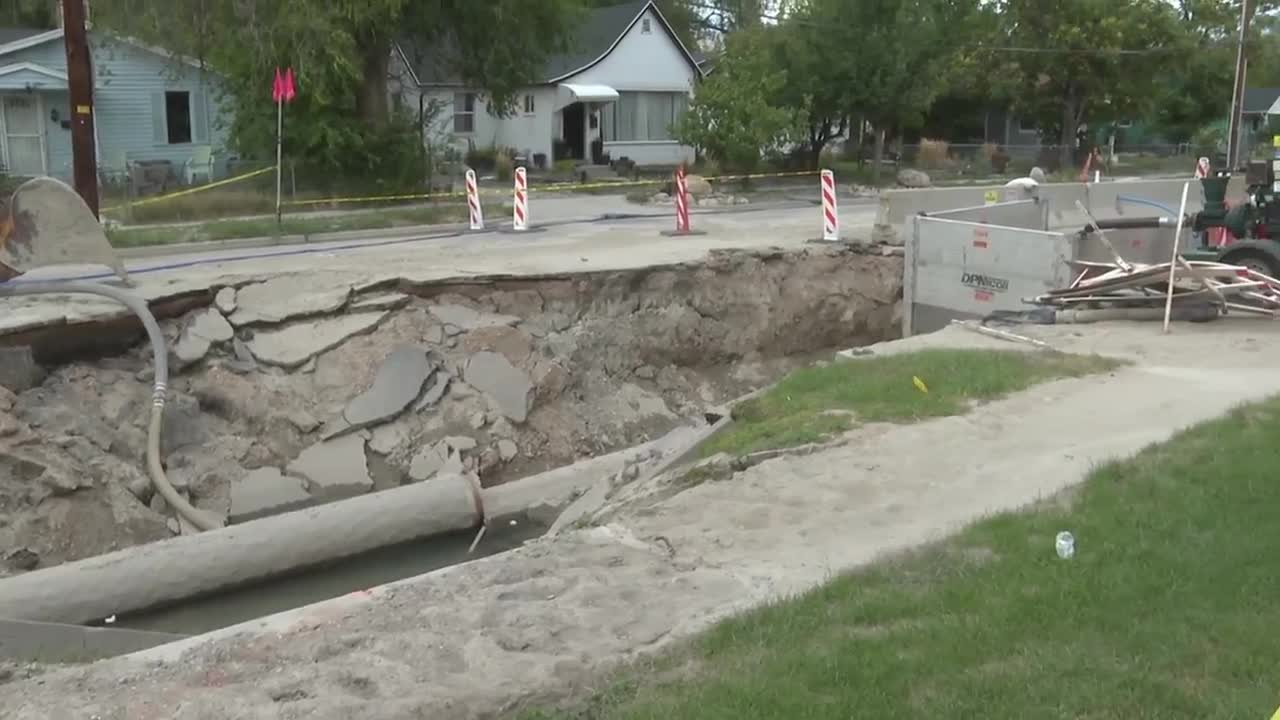


SALT LAKE CITY — Ten days after a 20-inch water main break sent water rushing into homes along Emery Street, four displaced families are still waiting to learn when they can return home and who will pay to rebuild.
The break occurred early August 16 near 500 South and 1100 West. Salt Lake City officials said the pressurized transmission line released enough water to flood 15 homes, displace four families and open a large sinkhole in the roadway.
The water is now gone, and cleanup is underway. Inside several homes, however, basements have been gutted, floors remain damaged and essential systems such as furnaces and water heaters must be replaced.
Newman has lived in the same house since he was born in 1966. His parents owned the home before him, and he took it over after they died.
“I don’t care about their project. I don’t care how long it takes,” resident Tom Newman said shortly after the flood. “I want my home back.”
Approximately 6 feet of water filled his basement and another 3 to 4 inches spread across the main floor. A water heater installed two days before the break and his furnace were submerged.
Newman and his partner, Willa Mae Graham, are living in a camper in their driveway. Graham’s son, who lived in the basement and lost nearly all his belongings, is sleeping in a tent on the property. His pet bearded dragon died in the flood.
“It looks better than it did. It’s not in the water, I guess,” Newman said while walking through the gutted basement this week.
Despite the progress, parts of the home remain damp, and the flooring on the main level feels soft underfoot.
A few doors away, Shirley Reyes is couch surfing while her mother, grandfather and pets stay with other relatives. Her finished basement, which included her bedroom, workspace and living area, has been stripped to the studs.
Reyes said residents spent much of the first week sharing information and pushing for damaged materials and debris to be removed. She said the experience — along with the continuing investigation and construction around the neighborhood — has caused her to question whether the response would be different in another part of Salt Lake City.
“Would these efforts be the same if it was on the east side, in the Avenues? Would we tolerate that?” Reyes asked. “Would that be the same timeline too?”
Reyes said residents have heard from city officials that the process could take anywhere from one month to a year. Salt Lake City has not confirmed a timeline for completing its investigation and has said recovery times will vary based on the damage and needs of each household.
Salt Lake City Public Utilities spokesperson Chloe Morroni said the city’s response began while water was still entering homes.
The city hired SERVPRO to pump out water, address potential mold and remove damaged drywall and flooring based on the needs of individual homes. City waste and recycling crews later removed piles of debris, while the Salt Lake County Health Department collected household hazardous waste.
“We’ve been out here every day,” Morroni said. “We just want to make sure that everybody has answers to the questions — as many answers as we can get right now.”
The city’s Risk Management Division also provided residents with information about filing claims. The city has instructed homeowners who have insurance to file with their insurance companies first. Residents may also submit claims to the city, which will evaluate them individually.
Newman said his homeowners insurance denied coverage for most of the damage. An adjuster from Intermountain Claims, working on behalf of the city, visited his home Monday, measured each room and documented the damage.
Newman said he is concerned that any payment based on the depreciated value of the items and materials destroyed will not cover the cost of rebuilding.
“Everything’s going to be depreciated,” he said. “How am I supposed to pay for anything with a depreciated cost?”
City and UDOT investigating cause
The cause of the break remains under investigation.
The failed city main is connected to a new waterline being installed under the Jordan River as part of a nearby Utah Department of Transportation bridge replacement project.
City officials previously said the break happened very close to an open excavation associated with that project. UDOT maintains that the break itself occurred outside the area where its crews were working.
“The investigation is happening right now,” Morroni said. “It actually started right away to figure out exactly what caused this break, and it does involve UDOT. It does involve Salt Lake City.”
UDOT public relations director John Gleason said the department is participating in that process.
“We’re working with the city to determine what happened and who would be responsible,” Gleason said.
Neither agency has accepted responsibility for the break while the investigation continues.
Additional recovery resources available
Salt Lake City Emergency Management has also activated Utah Voluntary Organizations Active in Disaster, or VOAD, to help connect affected families with nonprofit organizations and recovery programs.
Jeffrey Copeland, the Region 2 representative for Utah VOAD and director of new construction for Habitat for Humanity Greater Salt Lake, went door to door Monday to provide residents with information about available resources.
Copeland said VOAD had not yet delivered specific assistance to the affected families as of his interview, but organizations are prepared to help once residents identify needs that will not be covered by insurance.
Through Habitat for Humanity’s programs, families may be able to obtain building materials at no cost. Copeland said VOAD can also connect displaced residents with a 211 program offering temporary Airbnb stays while work is performed inside their homes.
“As soon as they come to us, we have stuff that could be helpful,” Copeland said.
For Newman, temporary housing presents its own complications. He said he needs to remain near the property to care for his dogs, meet contractors and monitor the home.
The cleanup has reached his house, an adjuster has documented the damage and additional resources are now available. What Newman still lacks is a clear answer about who will restore the only home he has ever known.
“I want my home back,” he said.