

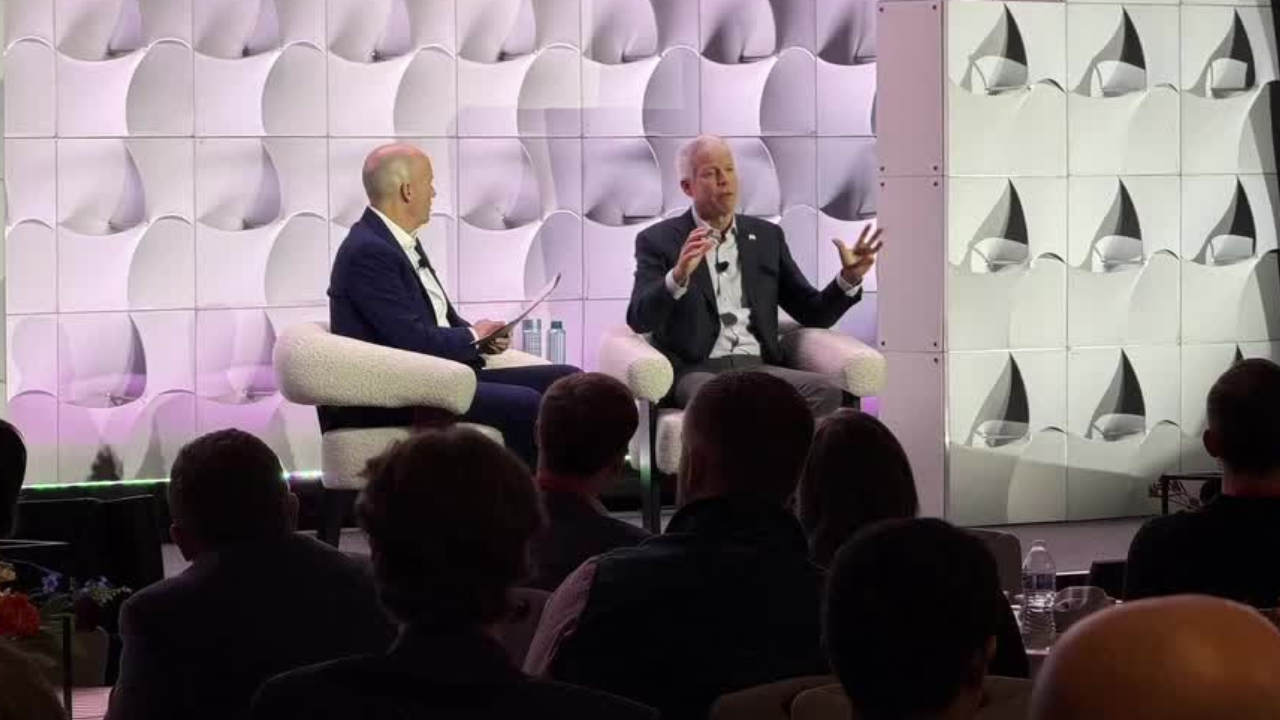


PARK CITY, Utah — Governor Spencer Cox and Trump administration officials pushed nuclear power as a solution to growing energy demands across the nation.
Appearing before a packed ballroom at Gov. Cox's Operation Gigawatt Summit on Friday, U.S. Energy Secretary Chris Wright spoke in support of the state's nuclear ambitions.
"What’s the way to drive down electricity prices and bring jobs to Utah? It’s to bring more energy to Utah," he said.
In an interview with FOX 13 News, Secretary Wright praised the governor's push to expand Utah's energy portfolio through "Operation Gigawatt," which includes an "all of the above" approach.
"It’s been a fruitful environment for business and for people to come here and prosper," he said. "I would say President Trump’s agenda to restore a golden age in America, Utah’s going to be a leader in that and has been a leader in that."
Cox promises Box Elder County data center developers 'don’t get to skip any steps':
While there were discussions about geothermal power, critical minerals and scaling the electric grid, Friday's summit focused heavily on nuclear power. There were seminars on "winning public trust" and "powering the AI boom."
Utah is actively courting small-scale modular nuclear reactor development under the Cox administration. There are experiments under way. On Friday, Secretary Wright revealed that Valar Atomics was close to achieving "criticality" with its small modular reactor experiment at Utah's San Rafael laboratory.
President Trump has set a July 4 deadline for nuclear reactors being piloted to show whether their experiments will work.
"What these reactor companies are doing with achieving criticality is showing their reactor system is performing the way they intended it to perform," said Dr. John Wagner, who heads the Idaho National Laboratory, which is heavily involved in similar experiments. "And if it doesn’t perform exactly, understanding why not and figuring that out as they develop their technology for commercialization."
In an interview with FOX 13 News at the summit on Friday, Valar Atomics CEO Isaiah Taylor said they were close to achieving their goal of being the first advanced reactor to generate power on American soil.
"As of today, the reactor is standing in Emery County," he said. "Our team is working around the clock on the final checks and procedures that need to be done, so we’re getting really excited."
Taylor said Valar Atomics' reactor is designed to scale up. One reactor could potentially power a town of about 5,000 people.
"We manufacture reactors and then just continue to turn them on as power demands scale," he said. "So if we want to power a town of 10,000 people? We put two reactors down. You can 10-times that if you want to. We can power data centers, we can power advance manufacturing. It’s really a way to bring the cost of energy down."
But the environmental group HEAL Utah said there are still significant concerns that have not been addressed.
"Summits like this and some of the state's education campaigns are focusing on just the good that they have and never addressing concerns that communities might have about long-term job creation, taxpayer increases and the real risks to radioactive exposures," Carmen ValDez, a senior policy advisor for HEAL Utah.
ValDez added that the state and federal governments are ignoring other alternative sources of energy like solar and wind.
"We are really concerned about the intense focus on the nuclear industry in the state, when it's a state claiming they're using an 'all-of-the-above' energy approach," she said.
Speaking to reporters on Friday, Gov. Cox insisted the state is exploring all forms of energy. But he said nuclear power must be part of the conversation.
"If we truly want to de-carbonize, if we truly want cleaner energy, more prosperous energy, dispatchable energy, reliable energy and cheaper energy then nuclear has to be part of that mix," he said.