

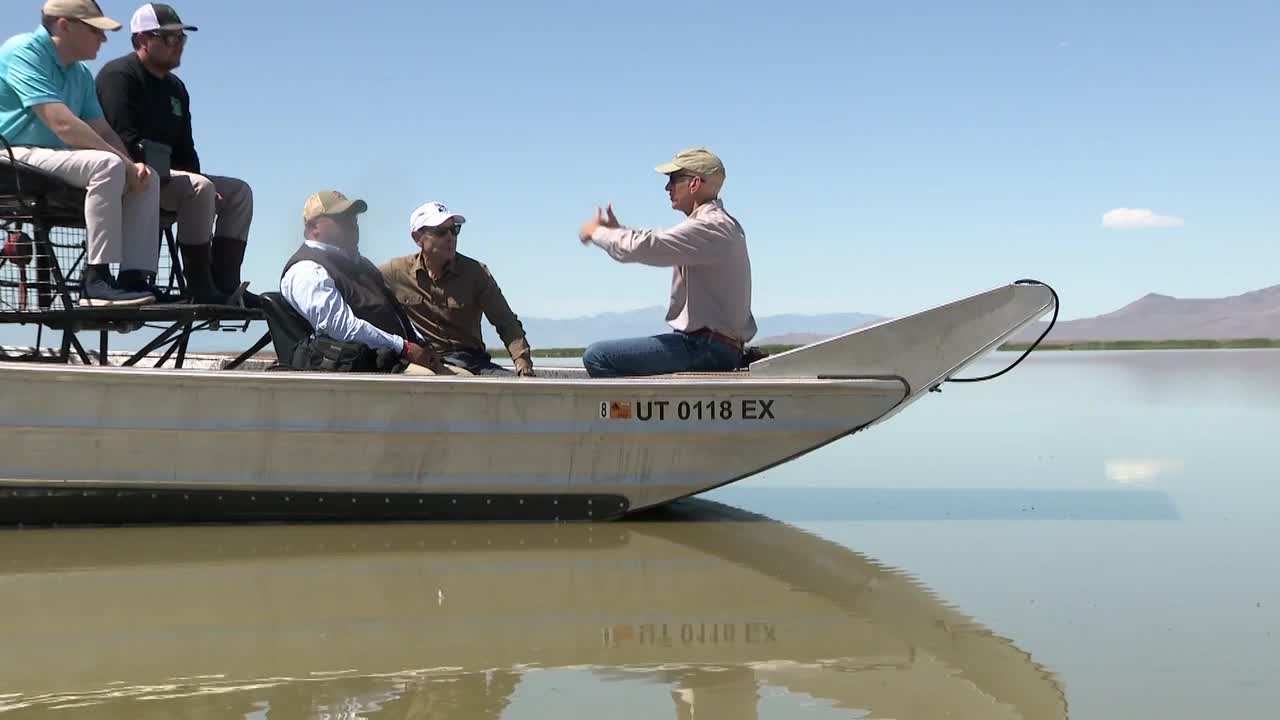


FARMINGTON, Utah — Federal and state leaders got a chance to get a close look at the Great Salt Lake during a boat tour on Saturday. The administrator of the Environmental Protection Agency, members of Utah’s congressional delegation and other state leaders were out on the lake to help understand the challenges faced by the lake.
"It’s all hands on deck. Everybody is engaged in this to reach success,” said Sen. John Curtis (R-Utah).
Curtis said it was an important step to have EPA Administrator Lee Zeldin here from Washington to truly understand this dire situation.
When President Donald Trump submitted his budget proposal, he included $1 billion to go toward helping the Great Salt Lake. '
"It’s hard to be hundreds of miles away inside an office, talking about a one billion dollar ask,” Zeldin said. "To see water that is shallow, while being informed of how the goal is for the water level at that location to be six feet higher in elevation by the time we get to the Olympics.”
Zeldin said the EPA is working on new sensors with the state and is planning to deploy them this summer.
"Developing an event-triggered passive aerosol sampler that uses real-time sensor data to trigger sampling particulate matter during storms,” he said.
Zeldin called the issues that the lake is facing a matter of national security and said he is committed to working with other federal partners to bring change.
The Center for Biological Diversity criticized the administrator's visit after the EPA proposed a rule that would allow some construction on data centers, power plants and factories to start before issuing air pollution permits.
“The proposed change would allow hundreds of millions of dollars of investment and extensive construction to proceed before permitting is complete," Deeda Seed with the Center for Biological Diversity said in a statement. "Once that much money is in the ground, approving agencies face enormous pressure to issue permits for projects that might otherwise be denied. The proposed rule is designed to put developers ahead of the public and keep them there.”
Zeldin said these processes are usually managed by the state and that he does not want to step on the toes of local officials.
"In many cases, with states and local municipalities, the state has primacy for the air permit. They are the ones doing the permitting, they have the oversight, there’s a relationship with EPA, and the Clean Air Act does end up governing many aspects of how this is done,” he added.
Curtis said he thinks Utah will get the federal dollars needed to help the Great Salt Lake.
"Very optimistic for several reasons. It’s a good ask, the president supports it, obviously EPA administrator supports it,” he said. “I think the whole country realizes this is a county-wide issue, that it's valuable for the whole country really to get this right."