



SALT LAKE CITY — A panel of judges will decide whether to block Utah's new congressional map from being implemented.
During a three-hour hearing on Wednesday, the judges heard arguments in an injunction request by lawyers representing county commissioners, mayors and Congressional Reps. Celeste Maloy and Burgess Owens. They are asking the judges to block the new map that creates a more competitive district in Salt Lake County, and order Lt. Governor Deidre Henderson to revert to the old map that the Utah State Legislature passed in 2021 that split Utah's most populous county in four pieces.
This lawsuit spiraled out of the original litigation filed by the League of Women Voters of Utah and Mormon Women for Ethical Government in state court against the Utah State Legislature. They challenged the Utah State Legislature's replacement of Prop. 4, the citizen ballot initiative for independent redistricting, and imposition of a map that they alleged was gerrymandered to favor Republicans.
Third District Court Judge Dianna Gibson ruled in their favor, threw out the 2021 map, and then rejected the legislature's redrawn map because it violated Prop. 4. Instead, she adopted a map drawn by an expert for the plaintiffs, saying it most closely aligned with Prop. 4's tenets.
In their line of questioning, U.S. District Court Judge Robert Shelby, Judge Holly Teete,r and 10th U.S. Circuit Court Judge Timothy Tymkovich appeared somewhat skeptical about arguments that Judge Gibson exceeded her powers when she implemented the map.
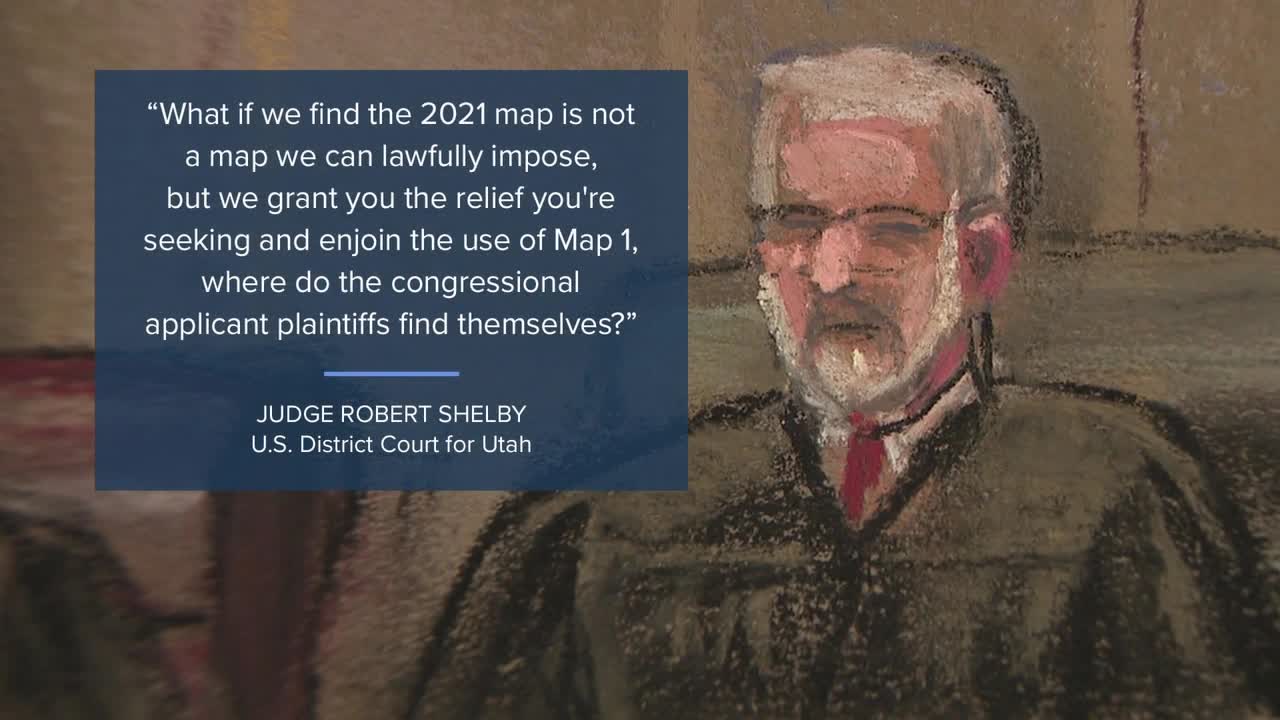
Judge Shelby called some of the plaintiffs' claims "speculative."
"What if we find the 2021 map is not a map we can lawfully impose, but we grant you the relief you're seeking and enjoin the use of Map 1, where do the congressional applicant plaintiffs find themselves?" he asked Gene Schaerr, the attorney for the plaintiffs.
Schaerr argued that it should be sent back to the Utah State Legislature to draw a new map, but added: "It's very likely if the legislature has an opportunity to pass a new map, it's going to look more like the 2021 map."
Judge Teeter cited federal code giving state and federal courts some powers over redistricting maps, asking if he agreed.
"No," Schaerr replied.
"Why?" she asked.
Schaerr reiterated his argument that the legislature should have a chance to draw a new map.
There were questions about the harms to the plaintiffs from the new map. Schaerr argued that Reps. Maloy and Owens were most likely directly impacted, and it would impact their ability to campaign. He suggested that the League and MWEG were aligned with the Democratic Party (and their actions would remove the lone racial minority in Utah's congressional delegation), a suggestion that the non-partisan groups bristled at in court and criticized on the courthouse steps.
Lt. Governor Henderson's legal team made no arguments to the panel of judges, except to tell the panel they need a ruling by Feb. 23 in order to get to work setting precinct boundaries and other important matters in time for the upcoming political party caucuses and conventions.
The judges did grant the League and MWEG the ability to intervene in the case and they defended Judge Gibson's decisions. But Judge Tymkovich pressed their attorney on the limits of overriding the legislature, which has maintained it has the sole constitutional power to redistrict.
"It seems like you're taking the injunction authority that Prop. 4 gives, but you’re not accepting the fact the entire scheme envisions it’s going to be a legislative process… with quasi-supervisory authority by the courts," he said.
Outside the court, League and MWEG attorney Mark Gaber told FOX 13 News he believed the judge was within her authority.
"When a legislature fails to enact a map on time that’s lawful, of course, a court can impose one," he said.
Asked by FOX 13 News if the 2021 map was their only recourse, Schaerr said "either the 2021 map or send the issue back to the legislature." When pressed if lawmakers on Utah's Capitol Hill were asked if they could implement a new map in time for an election, Schaerr replied: "I think they could."
The judges on the panel did raise questions about whether they should wait for the Utah Supreme Court, which is considering an appeal of Judge Gibson's rulings and could decide whether to issue a stay on the new map as soon as Friday.
Outside of court, League of Women Voters of Utah President Katharine Biele was hopeful the injunction request would not be granted.
"We are continuing to be disappointed, if not saddened by the legal gymnastics the plaintiffs are doing to undermine the will of the voters," she told reporters.
Mormon Women for Ethical Government's Laura Lewis Eyi was also hopeful.
"We’re feeling really positive and enthusiastic. We, as a group of cross-partisan Utah voters, we have been advocating for fair maps for many years and will continue to do so," she said.