

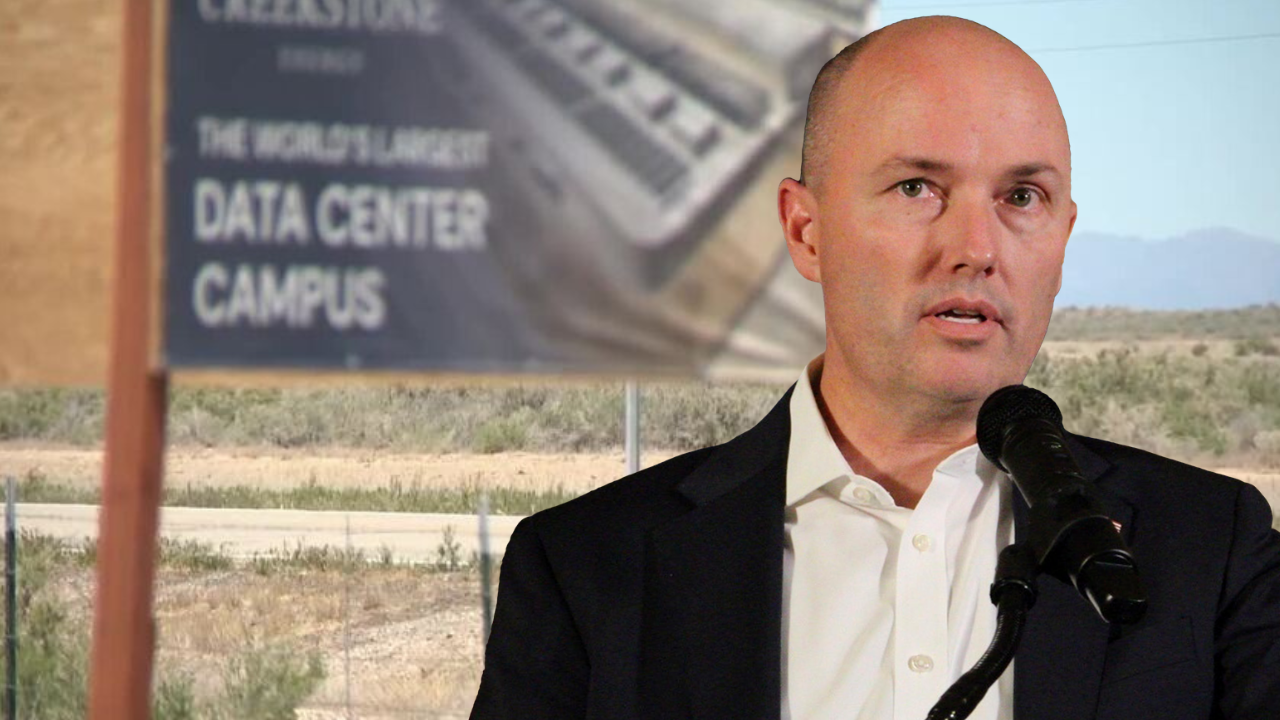


FARMINGTON BAY, Utah — Governor Spencer Cox has issued a new executive order setting new guardrails around data centers.
The order, issued Friday, aims to set a "higher bar" for data center development. It directs state agencies to prioritize the protection of water resources, the Great Salt Lake, air quality and utility ratepayers.
Speaking to reporters following a meeting of state and federal officials about the Great Salt Lake, Gov. Cox acknowledged the executive order followed public pressure. Large protests have been held at the Utah State Capitol and in Brigham City against celebrity investor Kevin O'Leary's proposed mega-data center in the Hansel Valley of Box Elder County.
It is a change of tone from the governor's previous full-throated support for the project.
"Look, we’ve had feedback I think everybody’s aware of that. The feedback has been incredibly helpful. People are concerned about data centers, they’re concerned about the lake, they’re concerned about resources," Gov. Cox said. "They should be concerned. I share those concerns. They’re right. So what we wanted to do was put out this executive order which talks about things that already law but making sure that every data center is subject to that."
The executive order includes priorities like:
- Protecting the Great Salt Lake and other water resources by ensuring water consumption is not increased and water quality is protected
- Protecting utility ratepayers from bearing the costs of infrastructure needed to serve large data center developments.
- Protecting air quality and minimizing impacts on surrounding communities
- Providing transparent, meaningful and thorough opportunities for public comment
- Supporting responsible economic development and job creation, particularly in rural Utah
Utah Department of Environmental Quality Commissioner Tim Davis told FOX 13 News the order does give some new direction for agencies like his as they consider the Stratos Project (the name for O'Leary's data center development). He pointed out that permitting for these projects for air quality and water quality are at least a year away.
"It lets people know they’ve been heard. It tells them that there’s plenty of process we will protect air quality, it will protect the Great Salt Lake, it will protect water quality," Davis said. "And it coordinates all the agencies to move forward together to make sure we’re on the same page."
But community groups mobilizing against the data center development question if Gov. Cox's executive order has any teeth. Brenna Williams with the Box Elder Accountability Referendum said she believed the Military Installation Development Authority, the entity that pushed the data center project through, is exempted.
"It’s just a PR stunt," Williams told FOX 13 News, adding: "I think he’s gotten so much backlash that he’s said this making it sound good. And it’s great he took our concerns into account, but it’s too little too late and it doesn’t affect us at all."
Asked by FOX 13 News if the executive order could shut down or delay the Stratos Project, Gov. Cox said he believed it could impact it.
"It could potentially delay the project for sure," he said. "The MIDA decision is only about land use. That’s it. We’ve already had discussions with the Stratos group about the footprint, the size, the water usage, those things. MIDA has no authority over air quality, over water. This is the beginning of a long process."
The Youth Coalition for Great Salt Lake, a group of children and teens who have pushed political leaders to do more to protect the lake, said it welcomed the executive order.
"However, this first step is not the finish line. The very existence of a 40,000 acre data center on the Great Salt Lake’s watershed still holds significant short- and long-term risks to our lake and the place we call home, and we will continue to demand urgent state and municipal action to address them," the coalition said in a statement to FOX 13 News on Friday.
"We expect Gov. Cox, legislators, and municipal leaders to work in the best interest of communities they serve, not just industry. Full transparency and genuine public input are non-negotiable. To all youth advocates across Utah: remain vigilant, stay informed, and stay loud. Our fight to protect our futures are far from over."
The Healthy Environment Alliance of Utah also expressed some optimism mixed with skepticism.
"We are encouraged that the governor has acknowledged the need for greater transparency and prioritization of community and environmental safeguards. What we need to see next is a high standard of regulation, good governance, and action put in place to back up these statements," HEAL Utah Executive Director Lexi Tuddenham said in an email to FOX 13 News. "The Stratos Project is not the only one in our state that has failed to adequately analyze and disclose potential impacts, prioritize community and environmental needs, and to address the valid concerns of Utahns-- this same 'high bar' should be put in place for other projects, including the announcement of major nuclear industry developments in our state."
One state lawmaker who is pushing legislation on data centers said he was supportive of Gov. Cox's executive order.
"I think it’s going to be great. Helpful," Rep. Doug Owens, D-Millcreek, told FOX 13 News.
Rep. Owens persuaded his colleagues on the Utah State Legislature's Natural Resources Interim Committee to study the environmental impacts of data centers. He has also opened a bill to demand environmental reviews of any new data center project that he said will be ready for the legislature's 2027 session in January.
"We don’t want to leap into the data center business without taking account of the huge impact it can have on our state," he said.
The Box Elder Accountability Referendum — or BEAR — citizen referendum to overturn resolutions approved by county commissioners that green-lit the data center project was rejected by the county attorney on Thursday. Williams said BEAR intends to appeal that decision to the courts on Monday.
Read the executive order here: