



CORRINE, Utah — The solid rocket boosters that will carry NASA's Artemis III crew toward the moon have left Utah.
Built at Northrop Grumman's facility in Utah, the eight motor segments departed by rail, bound for Florida, where they will be assembled with the two aft segments already there, inspected, and integrated into the rocket that will power NASA's next lunar mission — all while the country is still celebrating the success of Artemis II.
Julia Khodabandeh, NASA's acting SLS Booster Program Manager, said the moment carries deep personal meaning.
"America is founded on exploration, and we just have it in us to want to explore," Khodabandeh said.
She said her path to NASA began long before she ever set foot in a facility like this one.
"I got interested in working for NASA myself when I was in eighth grade…and today we are making history again," Khodabandeh said.
The same Utah facility and many of the same hands that built these boosters also supported every Space Shuttle mission. Now, the stakes are higher and the goals loftier.
Wendy Williams, Vice President and General Manager of Launch and Exploration at Northrop Grumman, said the workforce behind the boosters takes pride in knowing their work will travel far beyond Earth.
"Our employees get to go see the live event and watch it all unfold and know that their fingerprints are literally going around the moon. And it's exciting. I'm so proud of our workforce — they make it happen," Williams said.
Williams said the work her team does reflects both the engineering excellence and a deep sense of purpose in their work.
"We are so proud of what we do, and we're so fortunate that we are providing engineering capabilities and manufacturing expertise and rigor and agility into what we're doing," Williams said.
The timing of the mission carries added significance, as the country marks its 250th anniversary.
"250 years. Being able to celebrate that both with Artemis two, and then also providing these motors for Artemis three. And Artemis three is just the beginning. We are going back to the moon. We are going back to the moon. And beyond," Williams said.
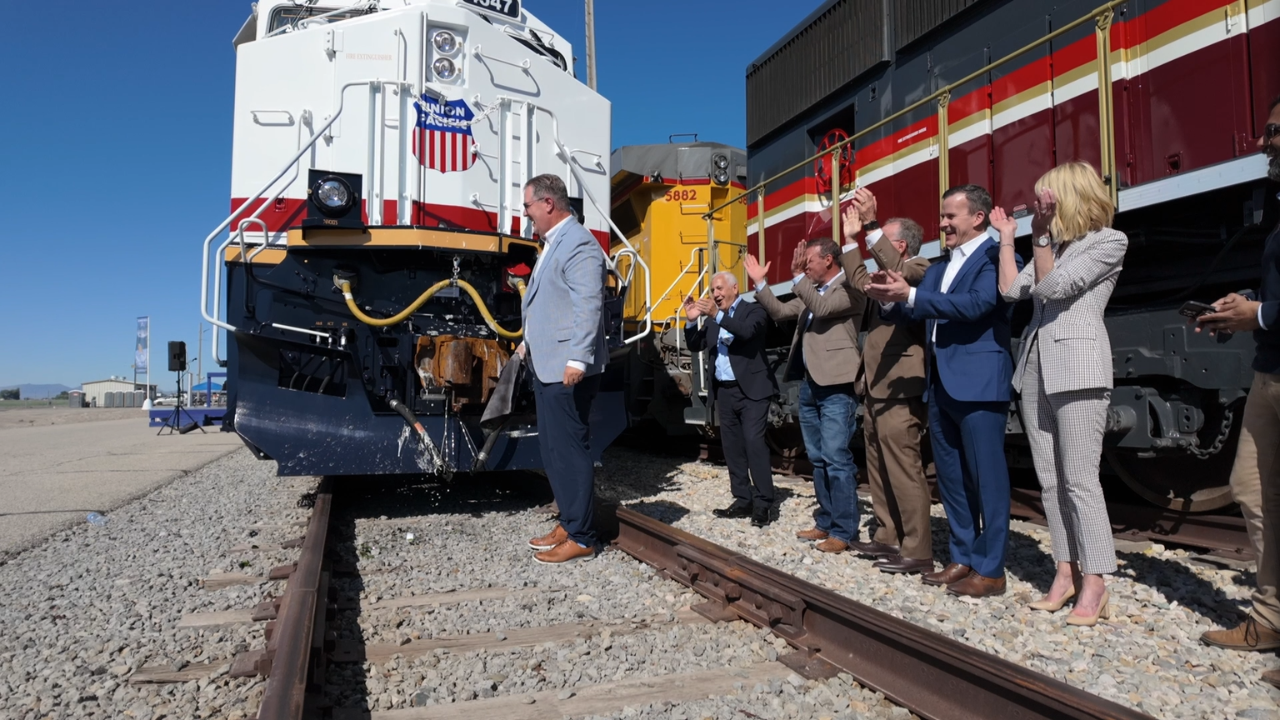
The boosters made their departure in distinctly American fashion. Two Union Pacific locomotives pulled the train — Engine 1616, painted in honor of Abraham Lincoln, the president who helped connect the country by rail, and Engine 4547, honoring President Donald Trump, as America celebrates 250 years and prepares to reconnect the Earth to the moon.
Jim Vena, CEO of Union Pacific, said the moment reflects how far the country has come.
"This is truly us celebrating with a great company, Northrop Grumman, and talking about what America is today versus America 250 years ago…what a wonderful country," Vena said.
Vena said he remembers the feeling of watching America reach the moon for the first time.
"I'm old enough to remember the Apollo and Mercury and Gemini…as a 10-year-old and an 11-year-old, I remember the excitement of looking at what man could do, and the science, and the thrill of it. And today, Artemis is another step in the process," Vena said.
As crowds gathered to take pictures, American flags flew overhead, and the journey was christened with a champagne bottle.
Williams summed up the partnership simply.
"Combining cool trains and rockets — like, that's pretty fantastic," Williams said.
Vena agreed.
"Is there anything cooler in the world?" Vena said.
Khodabandeh offered a final thought as the boosters began their journey across the Rocky Mountains toward the Atlantic.
"This is not just NASA's rocket…this is America's rocket," Khodabandeh said.
This story was reported on-air by a journalist and has been converted to this platform with the assistance of AI. Our editorial team verifies all reporting on all platforms for fairness and accuracy.
