



SALT LAKE CITY — On Thanksgiving Day in 2019, Lidia Barrus was at home with her daughter when a sudden wave of dizziness washed over her. She knew instantly that something was terribly wrong.
Her husband, Marcellus Barrus, recognized the signs immediately.
"She felt dizzy, she couldn't…she sat down," Marcellus recalled. "I knew the signs — the slurred speech, the inability to move part of her body. We immediately rushed her to the hospital."
Doctors discovered a hemorrhagic stroke, a severe brain bleed that required immediate surgery. The outcome was terrifyingly uncertain.
"That first night we didn't know if she was going to recover at all, or if she was going to even make it," Marcellus said. "From where we were six years ago to where we are now is a miracle, really."
Lidia survived, but the stroke left her with aphasia, a condition that makes finding words difficult. While she could walk with assistance, her mobility was a daily challenge. But a breakthrough came from an unexpected place: the Hans Georg Näder Lab of Bionic Engineering at the University of Utah.
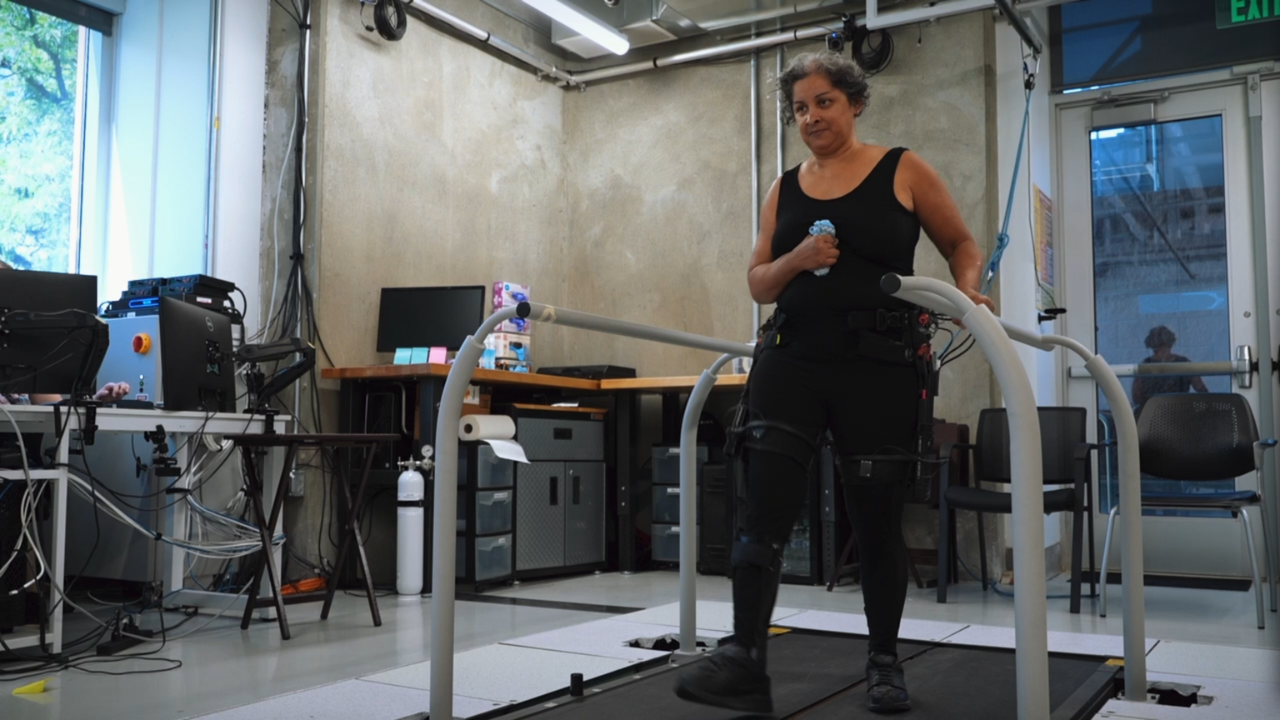
According to Associate Professor of Mechanical Engineering Tommaso Lenzi, researchers there have developed a powered exoskeleton designed to help stroke survivors walk with greater ease.
"Think of it as an e-bike for walking," said Lenzi. "The sensors understand how you're moving your legs, and then the motors react by assisting your leg. It helps you take a longer stride, walk faster, and spend less energy."
Bo Foreman, a professor in the Department of Physical Therapy and Athletic Training, emphasized that the device's impact goes beyond the physical.
"There's the physical benefit, but then there's also that personal feeling that the patient has — of accomplishment, of being able to do things that they couldn't do before," Foreman said. "And I think in reality that's sometimes even more important."
Lidia became central to the research, working closely with graduate research fellow Kai Pruyn through years of development and testing.
"Lydia is really special. Her commitment to the research and to improving her mobility…it's incredibly inspiring," Pruyn said. "She came in for a few years as we improved the controller and helped make the device work better for stroke survivors and for her."
Through the process, the two developed a deep and meaningful bond.
"She was incredibly brave…had such a positive attitude through everything," Pruyn said. "It made my day every time I had her in — to see her face again and have her try out the next iteration of the exoskeleton. We grew together."
Lidia said she can feel the profound difference the work has made.
"I think…better," she said, searching for the words. "From where I was to where…where I am now."
Her husband noted that the progress is most striking when looking back over time.
"It's hard to see the small incremental steps of improvement from yesterday to today," Marcellus said. "But when we look back from two years ago to where we are now…wow, that really does make a difference."
That progress now shows up in everyday life. Two years ago, Lidia could not tend to her beloved garden. Today, she can.
"My garden has squash…tomato," she said. "Today I'm going to plant my cucumbers and lettuce."
The research itself marks a significant milestone. According to Pruyn, the device is the first portable exoskeleton to make walking 18% easier for stroke survivors.
"The next steps are to take it into the real world," Pruyn said. "If people can take it home and walk farther, walk faster, return to activities they haven't been able to participate in because of their stroke — that's where the real impact is."
Lenzi believes the technology has the potential to reshape how we view recovery.
"Twenty years down the road, we're going to be able to rethink disability," he said. "With these technologies, after trauma, you are able to recover your full mobility and continue pursuing your life goals."
For Lidia, who has been at the heart of it all, the feeling is simple.
"It's gratitude," she said. "With everything that you have…with all of the…students."
