

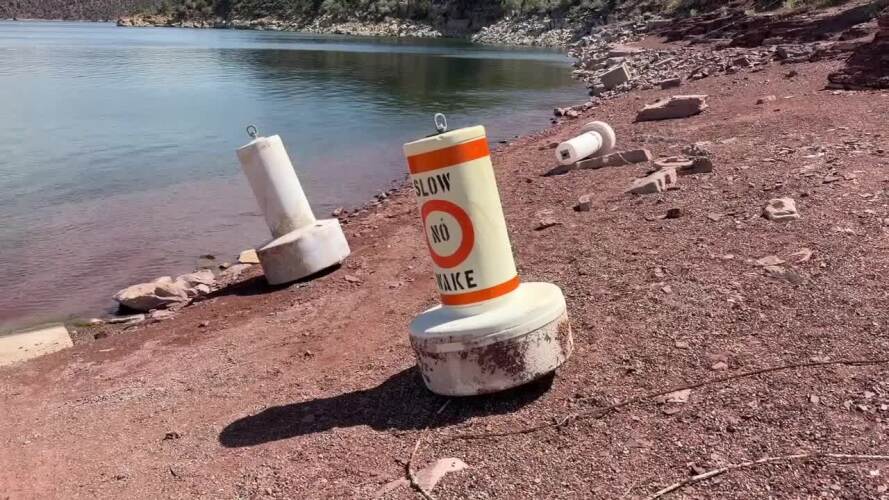


SALT LAKE CITY — A group of state and federal agencies met on Thursday to recommend Governor Spencer Cox make an emergency drought declaration for all of Utah.
The drought response committee, run under Utah's Department of Natural Resources, includes numerous government entities like the National Oceanic and Atmospheric Administration, U.S. Geological Survey, Division of Water Resources and Division of Emergency Management. No one objected to the recommendation that the governor issue an emergency declaration.
In fact, the presentation on Thursday presented a bleak picture of the state's water situation.
"Ninety-five percent of our water does come from snowpack," said Laura Haskell, the drought coordinator for Utah's Division of Water Resources. "So having that cut back, we just aren’t getting that inflow to our reservoirs."
Utah is facing record low snowpack, low stream inflows, reservoirs will be stressed, and temperatures will be above average.
"By early next week, we’re looking at temperatures forecast in the low 90s along the Wasatch Front, and 100 in southwestern Utah in the St. George area, about 25 degrees above normal," said Glen Merrill with NOAA, who added that above-average temperatures are expected to last until fall.
Water supply 'staggeringly anomalous' for Utah this year, experts say:
This also means a wildfire season that could be bad for the state.
Warmer temperatures means reservoirs will be stressed. In parts of the state, agriculture producers are seeing their water rights cut back to 1853. That means anyone with water rights after that? Will not get as much. Farmers are choosing whether to plant crops or not.
The Great Salt Lake has already peaked, but it is not forecast to hit a record low this year because more water has been dedicated to it. Lake Powell, however, is in a bad situation with a million acre-feet of water forecast to flow in.
"It’s really bad. Like, we’re seeing conditions we’ve never experienced before as a state," Joel Ferry, the commissioner of Utah's Department of Natural Resources, told FOX 13 News. "And it’s statewide. So we’ve got to raise awareness, we’ve got to use less water, we’ve got to conserve and we’ve got to be smart with how we use this limited resource."
An emergency declaration frees up numerous resources and funding for agriculture, cities and others to help mitigate the impacts of drought. The Department of Natural Resources has urged counties to make their own declarations. So far, Iron and San Juan counties have but at least a dozen others are in the works.
FOX 13 News is told Gov. Cox is likely to issue the drought declaration later this month, timed to some actions by the Utah State Legislature. That's because during the COVID-19 pandemic, the legislature rewrote emergency declaration laws to make them only good for 30 days. At the time, then-Governor Gary Herbert feuded with lawmakers who objected to his emergency health orders so they voted to limit their scope. In retaliation, Gov. Herbert issued new ones every 30 days.
The legislature isn't feuding with the Cox administration and is largely supportive of drought declarations. However, to extend them beyond 30 days lawmakers will need to meet in special session to vote to extend them.
Droughts last longer than 30 days.