

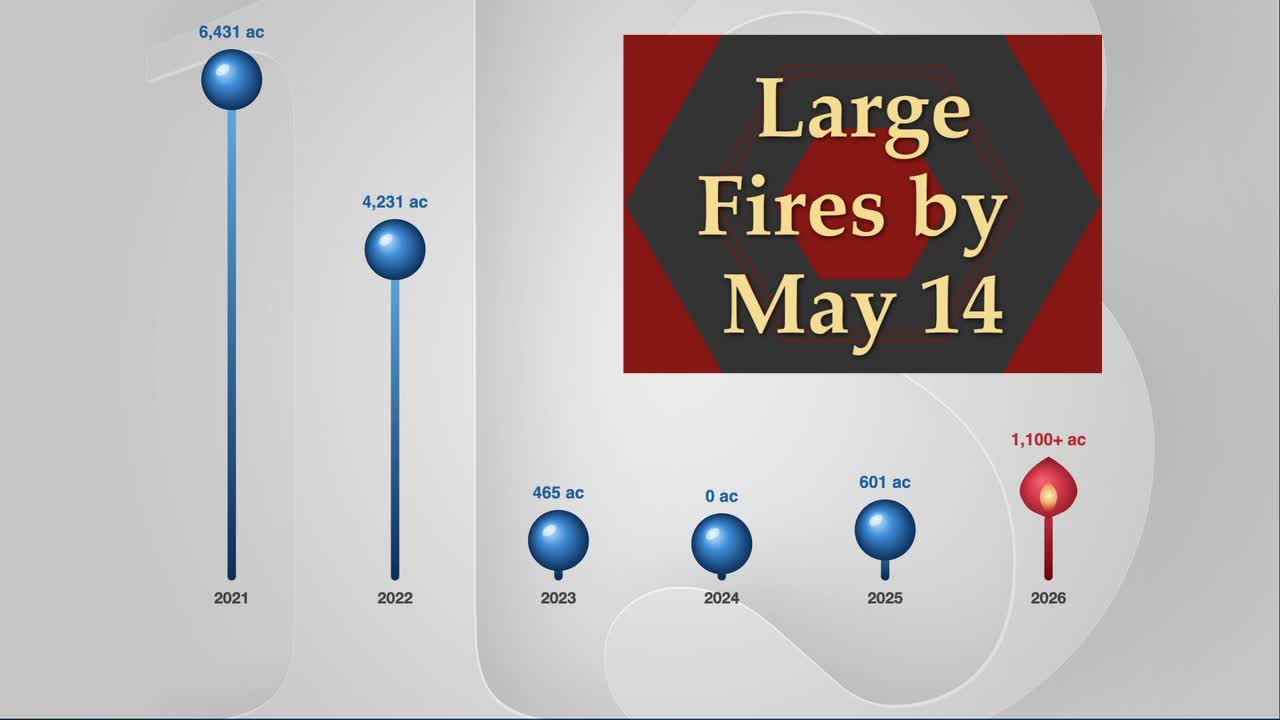


SALT LAKE CITY — The Wild Horse Fire, already consuming more than one thousand acres in Millard County, is raising concerns about what the rest of the 2026 wildfire season could bring to Utah.
At this same point last year, Utah had recorded about 600 acres of large fire activity — and 2025 went on to become one of the worst wildfire seasons in recent memory, with more than 159,000 acres burned before it was over.
The early numbers on large fires matter because they demonstrate the combustible conditions present before the summer, the height of the traditional fire season.
Looking back at the last five years, the pattern is striking. In 2023, Utah saw less than 18,000 acres burned for the entire year, thanks to a historically large snowpack. But 2024 turned active fast, and 2025 was dominated by two fires alone — Monroe Canyon and France Canyon — which together burned more than 100,000 acres on national forest land in a matter of weeks.
That history shows us something about where fires tend to be most voracious in Utah. Three primary agencies share responsibility and coordinate firefighting: the U.S. Forest Service, the Bureau of Land Management, and the State of Utah, which has jurisdiction over a large collection of state, local, and privately owned lands.
In the last full five years on record, U.S. Forest Service land has accounted for nearly two-thirds of all acres burned in Utah. The Forest Service manages only about 8.2 million acres in the state. The Bureau of Land Management controls nearly 23 million acres — almost three times as much and about 45 percent of the entire state — but BLM land tends to be more scrubby, without dense vegetation, and accounted for only 18% of fire acreage from 2021 to 2025.
That gap raises questions about fuel conditions and what tends to be threatened. A family cabin in the mountains faces greater fire danger than a desert getaway. The same is true for campgrounds. Fires get big where fuels are big, dense, and dry.