
MountainStar Healthcare hospitals and healthcare organizations across Utah are recognizing National EMS Week 2026 by honoring the paramedics, EMTs and first responders who provide lifesaving care in our communities each and every day. To get a better understanding of how EMS crews work in the field to help save lives and how they work with clinical colleagues in emergency rooms at local hospitals, FOX13’s The PLACE host, Jenny Hardman, was invited Wednesday to take a look at the history of EMS services with St. Mark’s Hospital and Gold Cross Ambulance. Jenny got a behind-the-scenes tour of the facility where Gold Cross Ambulance houses their fleet.
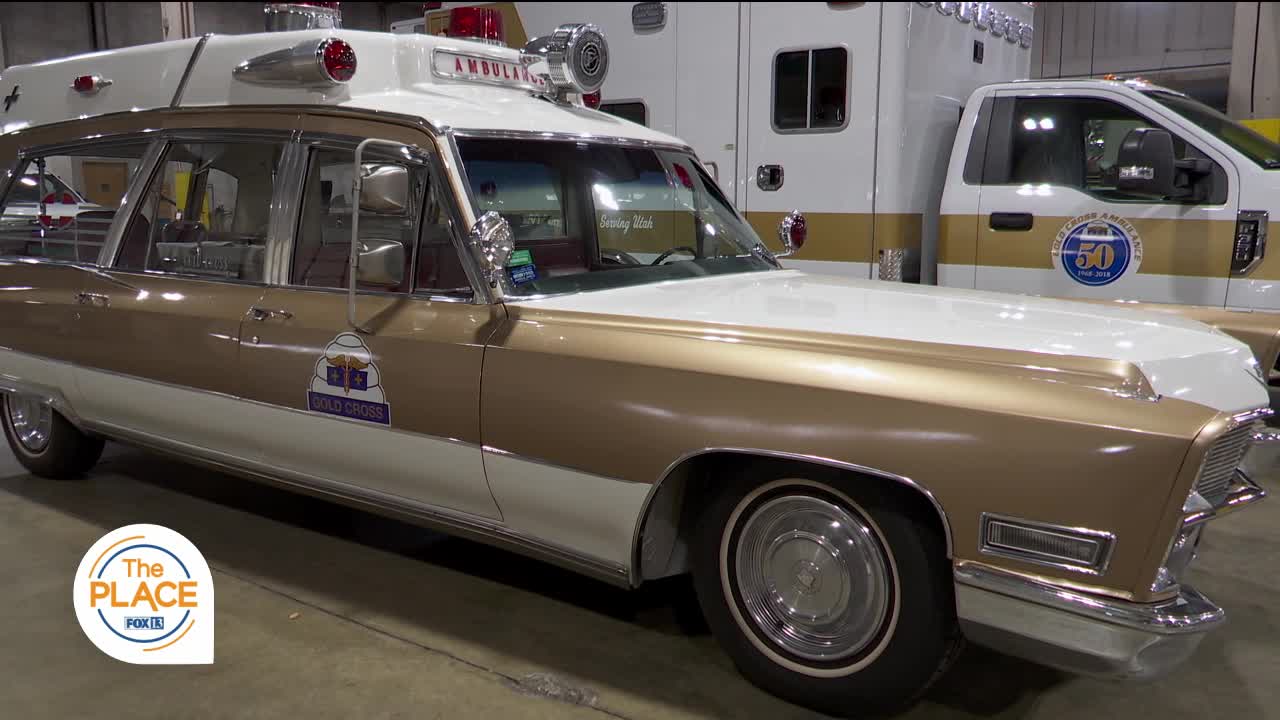
One of the standout ambulance “rigs” that’s parked inside the Gold Cross fleet garage is a 1968 Cadillac. It looks like it could have been driven out of a car museum! Utahns may have caught a glimpse of the vehicle in local parades or community events, but it is no longer an active ambulance.
Gene and Julia Moffitt founded Gold Cross Ambulance in 1968. In the beginning, Gene and three other employees responded to emergency medical calls in two of these Cadillac ambulances. They were equipped with first-aid kits, resuscitation devices and stretchers.
Mike Moffitt, President of Gold Cross Ambulance today, says the ‘68 rig was state of the art at that time.
“This is what we had back then,” Moffitt explained. “It’s good to remember our roots.”
While it was considered advanced more than 50 years ago, Moffitt says the 1968 rig meant calls were “load and go” because the vehicles were small.
“We didn’t have a lot of room in the ambulance. There’s not a lot of room to take care of patients. So, we had to stabilize and mobilize on scene and then get patients in the ambulance and rush to the hospital,” Moffitt explained. “EMS has come lightyears from then to now.”
Compared to the state-of-the-art rigs of today? Moffitt says they have plenty of room.
“It’s big enough to put a patient and two or three caregivers. It’s got, you can see, lots of room for storage, lots of electronics, and support systems; safety systems for the people riding in the back,” Moffitt said.
The collaboration between on-scene paramedics and clinicians in the emergency room is critical – it was back then and it still is today.
Kelsie Green, Chief Operating Officer (COO) at MountainStar Healthcare’s St. Mark’s Hospital, was an ER nurse for 17 years. EMS services and all MountainStar Healthcare hospitals work hand-in-hand to treat emergent patients across Utah from Logan to Payson.
“EMS professionals are often the first point of care during some of the most critical moments in a patient’s life,” Green said. “Our EMS are our partners. I’ve always thought of them as an extension of our care team. They’re my eyes and my ears as an ER nurse at the scene. They truly provide an additional layer of expertise and support.”
· RELATED: Utah honors responders during Emergency Medical Services Week
In 2018, Gold Cross Ambulance celebrated 50 years of service. Moffitt says advancements in healthcare technology have improved quality of care from the moment a paramedic arrives on the scene of an emergency. Moffitt also gave Jenny a tour of the modern, world-class, fully equipped ambulance model of today. It is equipped with oxygen, suction supplies and the capability to run vents.
Modern EMS teams provide advanced emergency care ranging from trauma response and cardiac care to stroke intervention and interfacility transport. Hospital leaders, like Green, say partnerships between EMS agencies and healthcare providers remain essential to improving patient outcomes.
“Good communication is a big part of that,” Green said. “Before a patient arrives at a hospital emergency room, EMS crews are in direct talks with the hospital to allow us to prepare for the patient’s arrival.”
Observed May 17–23, 2026 National EMS Week celebrates emergency medical services professionals and their critical role in patient care, emergency response and public safety.
The theme of the 2026 National EMS Week is “Improving Outcomes, Together.” The theme extends beyond medicine. According to EMSweek.org, the theme is “a collective responsibility that involves investing in the people behind the care with fair pay, safe staffing levels, mental health resources, leadership that listens and acts, and opportunities for professional growth.”
In 1974, President Gerald Ford authorized EMS Week™ to celebrate EMS professionals and the important work they do nationwide. National Emergency Medical Services Week brings together local communities and medical personnel to honor the dedication of those who provide the day-to-day lifesaving services of medicine's frontline. EMS Week is presented by the American College of Emergency Physicians (ACEP) in partnership with the National Associations of Emergency Medical Technicians (NAEMT).
“EMS professionals are defined by their dedication, teamwork and compassion,” Green said. “National EMS Week is an opportunity to thank these individuals for their commitment to serving and protecting our communities and we love doing just that!”
Legacy of service: 50 Years of HCA Healthcare in Utah
The year 2026 commemorates 50 years of HCA Healthcare in Utah. Known locally as MountainStar Healthcare, the half-century milestone is one marked by compassionate care, innovation, and service to our communities. MountainStar Healthcare hospitals have been a trusted healthcare partner, dedicated to providing high-quality, patient-centered care that has touched thousands of lives.
“Our first two hospitals were Brigham City Community Hospital and Lakeview Hospital in Bountiful,” Green said. “It really is incredible to think about how many patient lives have been cared for and improved the past five decades because of our hospital system and the dedication of our colleagues.”
Brigham City Community Hospital has been Box Elder County’s primary healthcare center since 1976. Two years earlier, HCA Healthcare Founder Dr. Thomas Frist met with local physicians to discuss plans for a new, modern hospital to serve the Northern Utah community. Ground broke on a 50,000-square-foot facility a year later, and the hospital opened to the public on July 31, 1976.
Lakeview Hospital has also been serving Utah families since 1976. The communities in Davis County agreed that a new hospital was needed, but efforts to build one stalled when government programs providing grants for community hospitals ended in 1972. That’s when HCA Healthcare stepped in, purchasing the land and breaking ground on a 150,000-square-foot facility in 1974. The hospital opened in September 1976.
St. Mark’s Hospital is Utah’s first hospital and has a vibrant history as one of HCA Healthcare’s earliest facilities. Opened on April 30, 1872, St. Mark’s Hospital was the first hospital established in the Utah Territory, serving the community for over 150 years. St. Mark’s was a hospital before Utah was even a state! Located in Millcreek, it started as a single doctor serving mining camps and has grown into the centerpiece of the MountainStar health system.
· RELATED: Utah’s first hospital celebrates 150 years in 2022
Ogden Regional Medical Center was originally founded in 1946 under the name of St. Benedict’s Hospital, on Ogden’s Polk Avenue. The hospital also operated its own nursing school from 1947 to 1968, which became the foundation for Weber State University’s nursing program. The hospital moved to its current location in 1977, and in 1995 it joined the HCA Healthcare network under its new name.
Mountain View Hospital has connections to Payson’s first hospital, which was opened in 1914 by Dr. A.L. Curtis and his wife, Annie. The two physicians at this 15-bed hospital delivered babies at the cost of $30. Local church groups assisted with the preparation of patient meals and sold canned goods to help the hospital break even. The hospital became part of HCA Healthcare in 1977. At that point, a new facility was built and named “Mountain View Hospital.”
Timpanogos Regional Hospital opened in 1998 after HCA Healthcare built the facility in order to meet the growing needs of communities in Utah County. Initially a 45-bed hospital with limited services, the Orem hospital has since grown into a 122-bed facility with specialty areas such as cardiovascular services, pediatric intensive care, a certified Primary Stroke Center, and a 29-bed, state-of-the-art Level III NICU.
Cache Valley Hospital first opened in October 2000 when a group of community physicians launched a small specialty hospital with 22 beds. The facility has since seen significant expansion to meet the needs of the growing Cache Valley community. Highlights include a new women’s center that opened in 2017 and multiple upgrades to the emergency room, now a Level IV Trauma Center. HCA Healthcare acquired Cache Valley Hospital in 2014.
Lone Peak Hospital in Draper is the newest MountainStar Healthcare hospital. It initially opened in 2010 as Lone Peak Emergency Center, a freestanding emergency department of St. Mark’s Hospital. As communities at the south end of the Salt Lake Valley quickly grew, Lone Peak was converted into a stand-alone hospital in 2013.
HCA Healthcare’s mission statement is: “Above all else, we are committed to care and improvement of human life.”
Gold Cross Ambulance provides basic life support, paramedic, critical care, neonatal, bariatric, and 911 services in Salt Lake County and the counties of Utah, Juab, Uintah, Iron and Washington.
If you have chest pain or suspect you or a loved one is experiencing an emergent medical condition, seek immediate medical help. Call 911. Chest pain could mean that you're having a heart attack.
For more information, visit MountainStar.com.