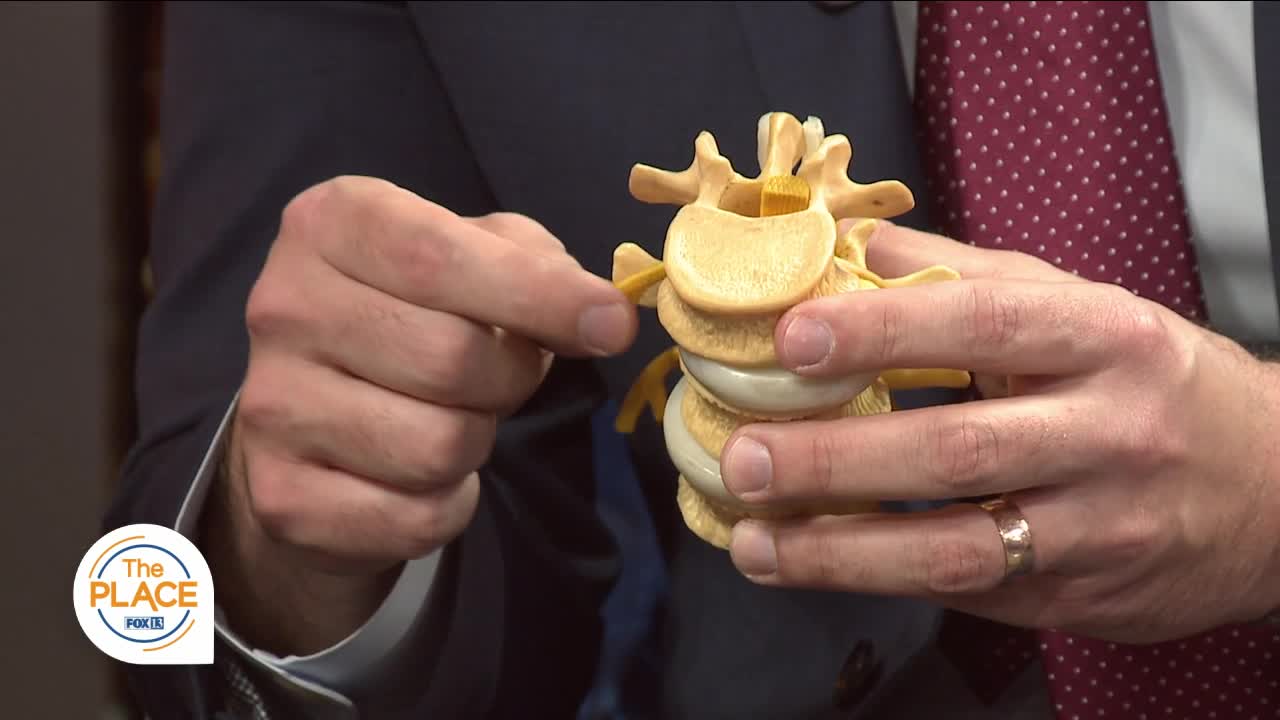

Do you experience neck pain? Numbness in your arms or legs? Do you know the cause and whether it may require treatment or even surgery?
“The neck – or cervical spine – is made up of seven bones, six disc spaces, 15 joints, multiple muscles, ligaments, and tendons; all of which can cause trouble,” Dr. Jakub Sikora explained. Dr. Sikora is a board-certified orthopedic spine surgeon and specialist practicing at the Salt Lake Orthopedic Clinic, located at MountainStar Healthcare’s St. Mark’s Hospital. “The cervical spine is mobile and has many possible pain generators. It’s no surprise that neck pain can be incredibly disabling.”
Trauma, strains, or wear and tear at any of these areas can cause pain, Dr. Sikora added. The good news? The vast majority of isolated neck pain improves on its own with time, activity modifications, and patience. But, if your neck injury isn’t going away, Dr. Sikora can help.
“With the spine, it’s all very complex, so the most important thing is getting an accurate diagnosis,” he says.
Dr. Jakub Sikora joined FOX13’s The PLACE to talk about cervical spine injuries and treatments available at the Millcreek/Salt Lake City facility.
“I often get asked by patients or by other physicians, in someone with neck pain, when do you see a spine surgeon? We're happy to see anyone with any neck pain, period. But the times where you think more of spine surgeries are if you're having some pinching on the spinal cord or the nerves, whether that's associated shoulder pain, arm pain, numbness, tingling, difficulty buttoning shirts, or even having trouble walking. That's kind of when you lean more towards, ‘Hey, maybe this is something surgical.’”
· RELATED: Getting back to life with Endoscopic Spine Surgery at St. Mark's Hospital
In order to optimize patient outcomes, Dr. Sikora is experienced in cervical spine surgery, endoscopic spine surgery, artificial disc replacement, minimally invasive techniques, and robotics.
What is Cervical Stenosis?
Cervical Stenosis is narrowing of the nerves/spinal cord in the neck. If the narrowing is pressing on a nerve or on the spinal cord, it can cause dysfunction, pain, balance issues, dexterity problems in the hands, numbness, and weakness. Stenosis is typically diagnosed using an MRI. The pinching of the spinal cord can resemble the shape of an hourglass.
“Stenosis simply means a tightness or pinching that typically happens around a nerve,” Dr. Sikora said.
Stenosis can occur because of a variety of causes.
“Think of stenosis like a boxer’s fist punching a nerve. That ‘boxer’ can either be a bone spur, a cyst, a disc herniation, a fracture or scar tissue, among other things,” Dr. Sikora explained. “And after that boxer punches, just because the fist is no longer actively punching, there still may be permanent damage.”
Two patients can be diagnosed with stenosis but may experience symptoms differently in one or more sides of their body or limbs, altogether.
“The nerve sac travels through the central canal of the spine. If you have stenosis in the central portion, you’ll typically have symptoms going down both arms or both legs (depending on whether it is in the neck or lower back),” Dr. Sikora clarified. “If you have pinching in the foramina (or ‘side part’ of the spine), then you’ll have symptoms on one side, going down either one arm or one leg.”
If the spinal cord is injured due to pinching, it is recommended to release that compression, as it only gets worse with time.
· RELATED: Take advantage of the Complex Spine Network at MountainStar Healthcare’s St. Mark’s Hospital
“The goal of a procedure to relieve spinal stenosis, whether by decompression or by implant, is to free out the whole nerve sac so the spinal canal is wide open,” Dr. Sikora said.
The success of treatment options depends on an accurate diagnosis, using a combination of but not limited to a physical exam, X-ray, CT scan, MRI, diagnostic injections, and an EMG investigation.
Treatment options include anti-inflammatories, steroids, therapy, injections, surgical decompression, surgical fusion, or surgical disc replacement. All treatment options depend on the location and type of compression. A custom treatment plan is recommended for every individual patient.
Treatments that release the pressure don’t necessarily reverse the damage, but the goal is to halt progression.
The Benefits of Cervical Spine Surgery
Cervical spine surgery can be used to relieve pressure placed on a nerve root by a damaged or abnormal component of the spine, usually a disc or vertebra. It can also be used to correct fractures or dislocations of the bones, ligaments, and tendons that protect and stabilize the spinal cord.
Cervical surgery treats neck, shoulder, and arm pain caused by compressed nerves or spinal cord damage, often due to herniated discs or stenosis. Common cervical procedures, like Anterior Cervical Discectomy and Fusion (ACDF), involve removing damaged discs, decompressing nerves, and fusing vertebrae to improve stability. The goals of cervical spine surgery include:
- Relieve pain, numbness, tingling, and weakness
- Restore nerve function
- Stop or prevent abnormal motion in the spine
In addition to Cervical Stenosis, other conditions treated with cervical spine surgery may also include cervical disc herniation, spinal cord injuries, neck fractures, degenerative neck disease, traumatic injury, tumors of the spine, as well as dislocation and instability of vertebrae.
Patients who undergo cervical spine surgery often experience relief of pain, pressure, weakness and numbness; improved mobility; restoration of nerve function; stabilization of the spine and ultimately, the prevention of abnormal motion in the spine.
Disc Herniations
Disc herniations can happen in the cervical, thoracic, or lumbar spine. Depending on the location, this can cause back pain, nerve irritation, bowel/bladder issues, balance problems, or spinal cord problems.
Endoscopic Spine Surgery (ESS) treats herniated discs by removing damaged tissue or pushing it back into place. The surgeon uses specialized tools passed through the endoscope to do so.
Dr. Sikora says additional treatment options for disc herniation include steroids, therapy, anti-inflammatories, core strengthening, weight loss, injections, surgically removing that disc, surgical decompression, surgical fusion, or surgical disc replacement. All treatment options depend on the location and type of disc herniation, as well as a custom treatment plan.
Developing highly personalized treatments – non-operative and operative – Dr. Sikora believes, are key to a healthy and happy lifestyle.
· RELATED: Free From Pain Thanks to Salt Lake Orthopedic Clinic at St. Mark’s Hospital
“I went into orthopedics because I wanted to save lifestyles – getting people to do what they want to do, what they need to do and getting them back to being active,” Dr. Sikora said. “Patients should come see me when they’re ready to see a doctor. I think there are certain aches and pains that patients often can live with, but ultimately, if it gets to a point where you’re saying, ‘I can’t do this anymore,’ I think it’s a great idea to see a doctor.”
If you live with debilitating back or neck pain, the spine specialists at MountainStar Healthcare hospitals can help. Their spine care teams include experts in both orthopedic care and neurological care to ensure they deliver the type of care that is right for their patients. These physicians work closely with physical therapists and pain management specialists so their patients can return to a more active and productive lifestyle.
The Salt Lake Orthopedic Clinic at St. Mark’s Hospital
The orthopedic surgeons and specialists at Salt Lake Orthopedic Clinic have a 30-year history of providing care in the Salt Lake City area. As one of the area's first orthopedic centers, the team offers many services for bone, joint and muscle conditions, including arthritis, back pain and whiplash. The clinic also offers advanced treatments, including knee and hip replacements and shoulder reconstruction.
1160 East 3900 South, Suite 5000
Salt Lake City, UT 84124
Phone: (801) 261-7479
The Salt Lake Orthopedic Clinic is located on the campus of St. Mark’s Hospital. Orthopedic conditions treated at St. Mark’s Hospital include, but are not limited to:
- Arthritis
- Back pain
- Fractured hips and other bones
- Nerve pain
- Neuropathy (nerve damage)
- Sciatica
- Scoliosis
- Whiplash
For more information about cervical spine surgery, Dr. Sikora, and/or this clinic, visit SaltLakeOrthopedics.com or schedule an appointment by calling (801)261-7479. If you have neck or back pain and would like to learn more information about the Complex Spine Network at St. Mark’s Hospital, click here or call (801) 263-3870.
Dr. Sikora and his physician partners at Salt Lake Orthopedic Clinic are always accepting new patients. St. Mark’s Hospital is one of eight MountainStar Healthcare hospitals in Utah.
About Jakub Sikora, MD
Dr. Jakub Sikora is a board-certified orthopedic spine surgeon and specialist practicing at the Salt Lake Orthopedic Clinic. Dr. Sikora attended Michigan State University for his undergraduate studies and graduated from Wayne State University School of Medicine in Detroit, Michigan. He completed his orthopedic surgery training at the University of California-San Diego, and spine fellowship at the prestigious Texas Back Institute.
Raised in the Midwest, while spending summers with his grandparents in Poland, Dr. Sikora understands the relationship between the spine and active lifestyle no matter the age. He has worked in Level-1 trauma centers and specialized clinics, treating grandparents, laborers, professional athletes, Olympians, and U.S. Navy SEALs. Dr. Sikora has published many research articles, book chapters, presented at national conferences, spent time on various professional committees, but is most proud of his wife and kids. They enjoy skiing, hiking, and all Utah has to offer.