

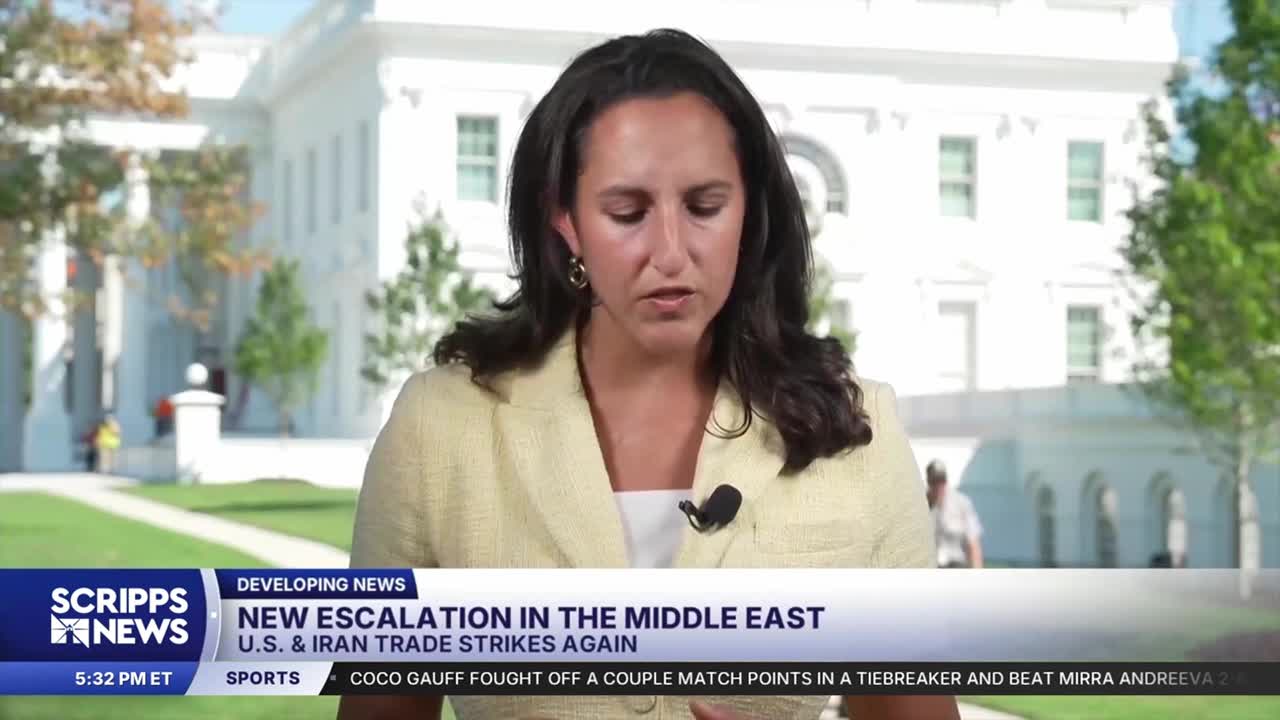


President Donald Trump said the war with Iran will end after the midterm election, but suggested oil prices may not fall significantly before then as fighting between the US and Iran flared this week.
The president issued the new timeline while en route to Dallas, Texas, where he is headlining the RNC’s midterm convention as the party looks to rally its voters ahead of November.
“I think the war will end immediately after the election, because they can't hold out any longer. They're desperate to try and affect the election so that we can get a nice weak group of people in there and leave them alone and let them have their nuclear weapon,” Trump said of Iran.
This week U.S. forces hit five additional Iranian oil carriers Tuesday in response to IRGC targeting of a U.S. Navy warship, according to U.S. Central Command, after hitting Iranian vessels over the weekend after Iran targeted US assets.
“The back-and-forth is pretty straightforward, and that is that Iran continues to try to hit U.S. naval ships, and for every time they do that or try to do that, they’re going to lose tankers,” Secretary of State Marco Rubio said.
Iran retaliated with strikes towards Jordan Tuesday, though a US official Iran’s response was “ineffective” and that American forces “have 100 percent accountability at all locations in Jordan.”
“To some extent, I'm surprised Iran hasn't responded harder than they have, right? There's been this somewhat surprising middle ground where you have you know this one-two punch of a blockade and you know pretty robust sanctions enforcement, and Iran really hasn't gone that far up the escalation ladder,” said Nate Swanson, the director of the Iran Strategy Project at the Atlantic Council.
“They're not targeting Gulf energy infrastructure, which is really their biggest card to play and something they've avoided, so to some extent, I think you know the administration's been either successful or lucky in avoiding that card. But I think you're also seeing that this is unsustainable long term, right? The more pressure Iran feels, the more they're going to lash out,” Swanson said.
RELATED STORY | US strikes five Iranian tankers in response to continued targeting of US vessels
In the aftermath of strikes, energy prices continued to climb.
Brent crude topped $100 a barrel Wednesday. The national average for a gallon of gas sat at $4.22 according to AAA, up more than a dollar from a year ago. And average diesel prices remained above $5, ticking up from an all time high last week.
"Well, I think it's very easy to explain to America. All you have to do is say, will you let Iran have a nuclear weapon? And the answer is no, and they're doing very poorly,” Trump said.
The president has maintained that oil prices will fall when the conflict ends. Wednesday he said they would tumble “right after the election” but it would take “a little bit longer than the midterms” for prices to fall below $2 a gallon.
The consumer burden is more than $101 billion since the start of the conflict, according to Brown University’s Iran War Energy Cost Tracker, which estimates the impact of gas and diesel to be more than $777 per US household.
“President Trump remains committed to unleashing American energy dominance, cutting costs, and putting more money back in the pockets of hardworking American families. Last week the President met with nearly a dozen refiners to discuss ways to expand our refining capacity, which will lower prices at the pump. As the U.S. continues to maintain full control of the Strait of Hormuz, oil and gas prices will fall back to pre-conflict levels,” said White House spokeswoman Taylor Rogers.
RELATED STORY | Record diesel prices threaten higher grocery and delivery bills
Meanwhile, the International Atomic Energy Agency, the UN’s nuclear watchdog, report Iran to the UN Security Council for the first time in 20 years over Iranian non-compliance. It cited a lack of information and access to Iran’s enrichment facilities.
“Due to the lack of information about, and access to, any of Iran’s four declared enrichment facilities to perform verification activities the Agency cannot provide any information on the current size, composition or whereabouts of the stockpile of enriched uranium in Iran or whether Iran has suspended all enrichment related activities, including R&D,” the report states.
A new analysis from the Center for Strategic and International Studies of satellite imagery, first reported by CNN, concludes “a clear surge in construction activity in 2026” at Pickaxe Mountain, a suspected Iranian nuclear site, but says imagery also suggests “… the underground facility is not yet capable of enrichment work, if that is the intended purpose.”
Trump suggested last week the U.S. could hit Pickaxe Mountain “very soon.”
“We know everybody that's moving at Pickax. We know everybody that's moving everywhere all over Iran. And if anything goes bad, we hit them,” he said.
